

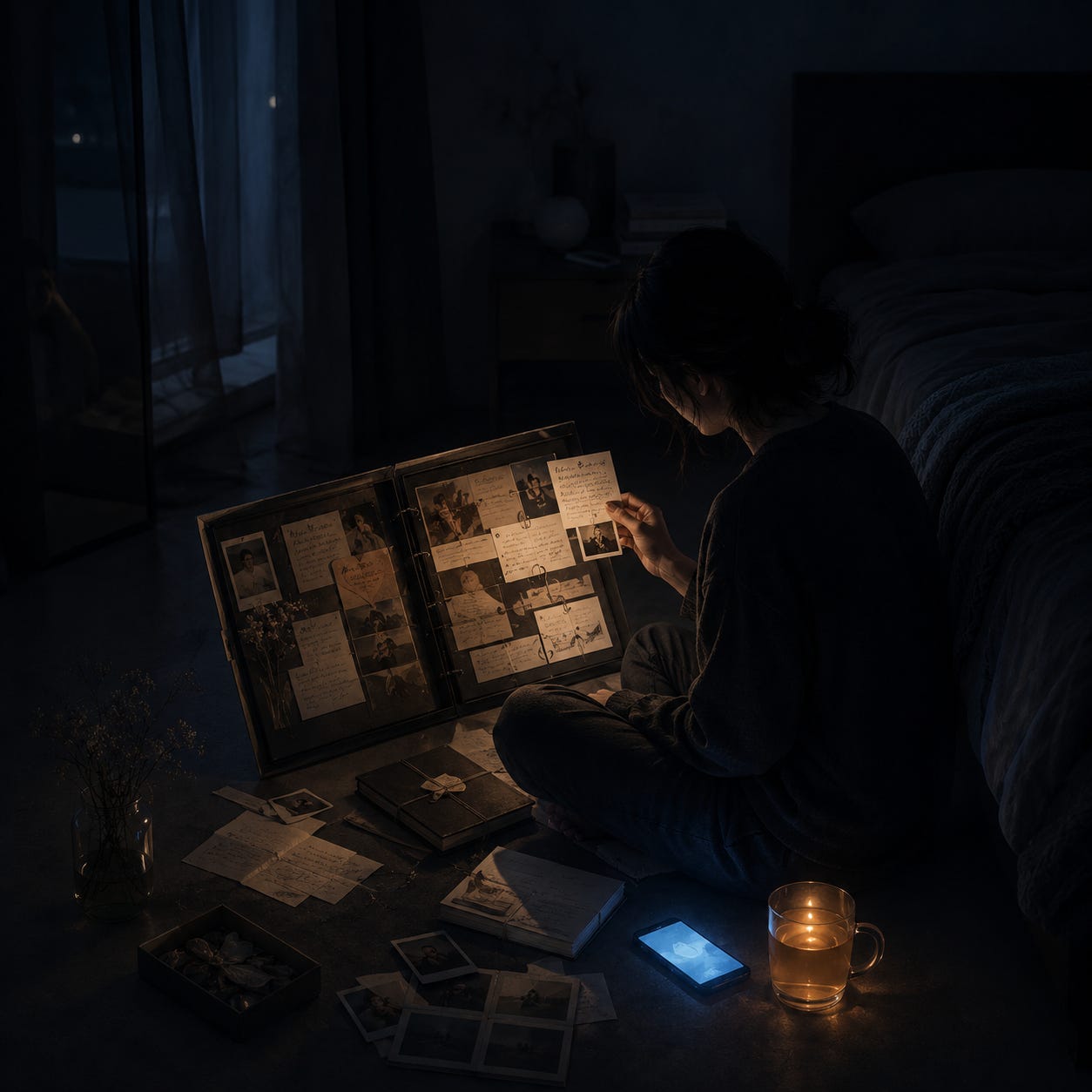
There are 78 pieces of evidence in my phone.
Each one is keeping something alive.
The folder is called: You Deserve to Be Loved.
Not a memory book.
Testimony, left for the version of me who would one day demand proof.
Evidence 001 | 2:14 a.m.
A blue message bubble in the middle of the night:
“You are really kind.”
I pinned it to the top of my notes, as if a sentence could cover the place in my chest where the wind kept getting in.
Evidence 042 | 6:47 p.m.
On a sidewalk at dusk, he handed me a bottle of water and said, almost carelessly:
“It feels easy to be with you.”
I zoomed in until the pixels broke.
I couldn’t even crop out the extra space at the end of the sentence.
It felt like one more second of tenderness I had no right to waste.
Evidence 073—
The one that looked least like a compliment.
A reader left a comment:
“You wrote another version of me.”
I saved it more carefully than the others.
They are all stacked by date, like spare oxygen left along the wall of a well.
If someone accidentally entered this archive, they might laugh.
They might think I am sentimental, someone who keeps ordinary kindness too carefully.
But they have never met bipolar at 3 a.m.
The first time I built this folder, I was curled under a cold blanket, pushing those sentences into the dark one by one.
I’ve never told anyone why I save every “you are good” so greedily.
Because the person who truly needs this evidence is not the one being praised.
It is the one in the dark, reading it back to herself, one word at a time.
Tenderness Was Never the Point
If you ever see the evidence archive in my phone, do not mistake it for a collection of tenderness.
I never saved them for comfort.
I was saving ammunition.
For the hour when the illness takes over.
When self-denial becomes the only voice left in the room.
When I sit on the edge of my bed and scroll through old messages like someone searching a crime scene.
Bipolar can turn every act of love into false testimony.
The words that once glowed were erased by another, sharper voice:
“They don’t know the real you.”
“They will find out how difficult you are.”
The lines I once saved began to look like paper crowns — bright enough to hurt, light enough to crown a ghost.
The first time I understood this, it was not graceful.
I was staring at one sentence:
“You deserve to be treated seriously.”
My chest should have warmed.
Instead, I heard a cold laugh inside me:
“Just politeness.”
That was when I understood:
it was not that the praise was false.
It was that I had already begun to testify against myself.
So while reason was still online, I started doing something almost tragic.
I hid every “you are good” inside an encrypted layer.
Not to return to the sweetness, but because I knew that the next time I fell, the version of me covered in thorns would look up and ask:
“Where is the proof?
None of this counts.”
At least then, a folder could appear in court for me.
Even when I had already defected, becoming my own cruelest prosecutor.
I Was the First One to Turn Against Her
At 3 a.m., I met the person who hated me most.
She stood in the mirror, borrowing my eyes to inspect the wreckage I was living in.
Her mouth did not move.
The voice went straight into my skull:
“You were never worthy of love.”
I wanted to wipe that pale outline away.
“Why are you here again?
Do you know how shameful you are?”
My voice was so low even the tiles seemed to turn away.
I was not speaking to myself like a person.
I was speaking to something that had failed to learn shame.
Then she laughed.
The smile did not appear on her face. It opened directly inside my chest, like a Venus flytrap.
All the evidence I had saved became, in her eyes, nothing but forged testimony.
I ran back to the bedroom.
My phone lit up with a message from a friend:
“Text me when you wake up.”
Then my fingers betrayed me.
Delete.
Block.
Confirm.
The moment the screen went dark, it felt as if someone had reached into my chest and removed a piece by hand.
She turned toward me then, her eyes dark and familiar, as if delivering a verdict:
See?
No archive of tenderness can stop me.
Once she appears, every piece of evidence is declared forged in court.
She always arrives when bipolar is at its heaviest, announcing on my behalf that I am not worthy of love.
I slid down against the wall, my knuckles turning pale from holding too hard.
Only one sentence remained in my head, dull and heavy:
The first one to turn against her
was me.
I Turned Against Her, and Still Left Her a Light
I sat in the corner for a long time.
The Venus flytrap inside me was still chewing.
Then a message broke through the dark:
“Tonight’s piece was powerful. Please keep writing.”
I froze for half a second, as if someone had dropped a stone into the deep well where I was about to drown.
The name of the folder lit up again.
For one brief moment, I smiled at the black screen.
There was a small burn inside my chest, like secretly slipping a match into my pocket on the most absurd night.
I left a code for the thorn-covered version of me in the future:
“Look. This time, someone saw you too.”
The match was small.
But it scorched a mark into the petals — proof that even this flower could hurt.
I knew that when she stood again inside the pale mirror, this screenshot might still be declared forged.
I would still be the first hand reaching to put that light out.
Ridiculous, maybe.
But true enough to burn:
I despise her fragility.
And I keep building her escape routes anyway.
Maybe one day she will tear every tenderness into pieces again.
But if she is willing to look down inside the wreckage, she will find at least this one slip of paper near her feet —
proof that she had once been held with care,
once called by name,
and seen without being erased.
Maybe testimony will fail one day.
But if I keep secretly adding pages, she can never be sure whether the next one might light up.
As Long as I Keep Adding Pages
The new slip of paper did not stop her right away.
At 3 a.m., she still came quietly to sit beside my bed, like a twin flower grown out of shadow.
This time, I did not argue with her.
I only got up, went to the kitchen, and poured myself half a cup of warm water.
The porcelain cup pressed against my palm.
A faint heat passed through my finger bones.
She frowned.
But in the end, she did not spit out those poisoned sentences.
My breathing slowed in the dark, like gray-blue light squeezing through the window crack, carefully smoothing the wrinkles of the room.
“Just sit here for now.”
I said it to her.
I said it to myself.
The cup was still warm.
There was still no daylight at the window.
But I knew this:
as long as I am still willing to add the next page for her,
she cannot declare all the evidence invalid.
And as long as testimony remains,
she can never announce
that the me who deserved to be loved
had never existed.
🌙 Why do some of us need proof — again and again — that we are still worth loving?
Because when love once had to be earned, some nights can turn tenderness into false testimony. A kind word, a saved message, a reader’s comment — they become evidence for the version of us who may forget.
Have you ever kept a private record of kindness because you were afraid you might forget it was real?
You can leave it here.
I read every comment.
If this piece felt close to the part of you that keeps asking for proof, these essays may belong nearby:
[The Bipolar Girl Who Got Too Good at Performing Recovery]
[Depression Made Me Disappear for Three Months. Coming Back Was Harder]
[I Have Bipolar Disorder. Sometimes Happiness Feels Like a Warning]