

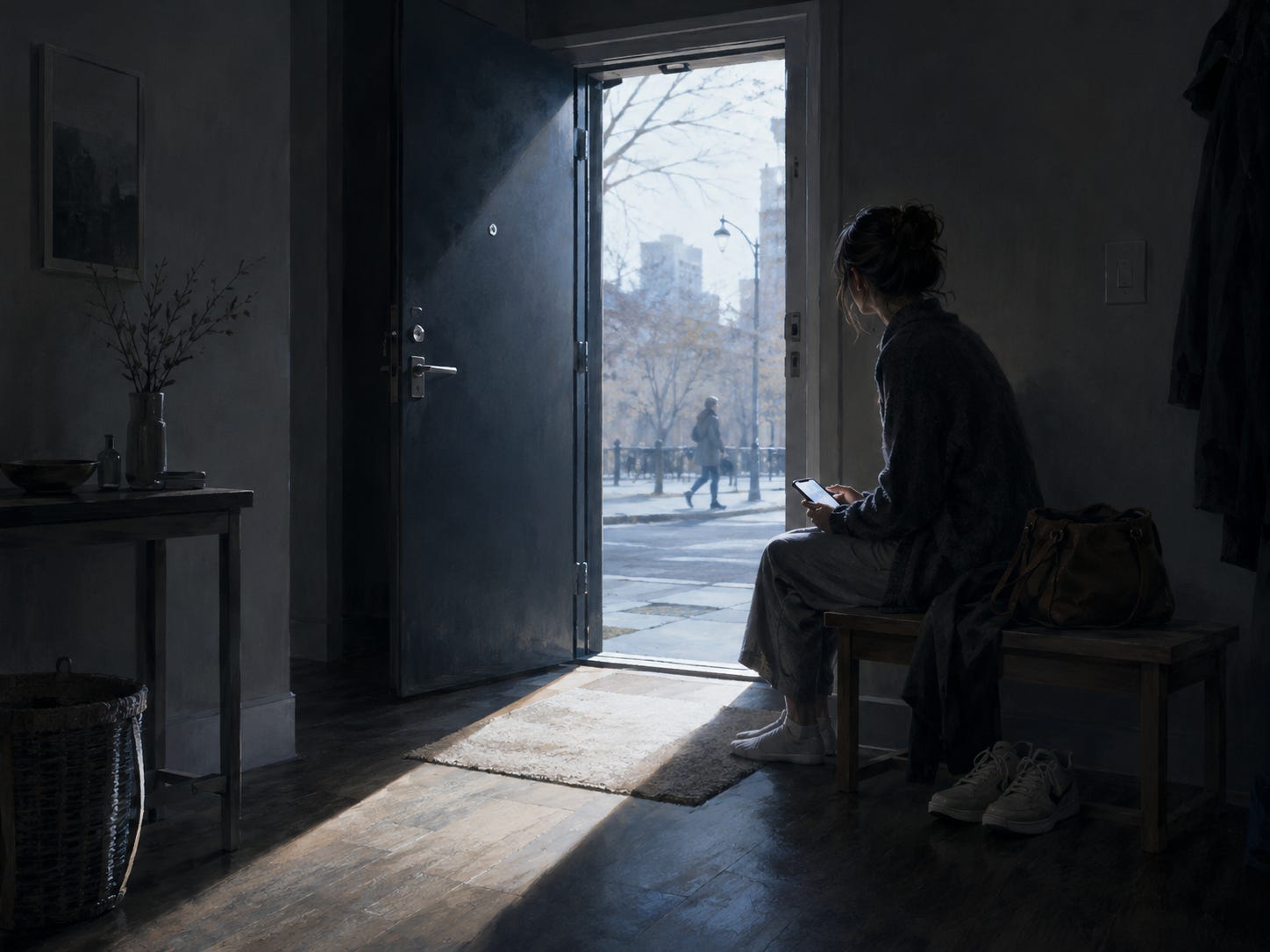
After three months of silence, I did not even have the courage to press publish on a simple post.
On the first night after the holiday, I typed:
“I’m sorry. I disappeared for the past three months. I’ve made it through now.”
Then I deleted it, word by word, until the box was empty again. The cursor twitched as if mocking my guilty conscience.
It turns out disappearing was easy.
Coming back is harder.
My last update had been a suppressed goodbye. After that, every relationship stayed frozen at that exact moment.
I wanted to write something light, like:
“I’ve just been a little busy lately.”
But it felt like stamping a false seal of self-deception over all the time I had been gone.
I wanted to admit that I had been hiding inside depression. But I was afraid that weight would land too suddenly in front of other people.
The two impulses pulled me back and forth. My fingertip hovered over the send button, unable to move forward or retreat.
Forward meant exposing the scar.
Backward meant continuing to evaporate without a sound.
I refreshed a screen full of updates: evening runs in the wind, post-holiday milk tea, the warm smoke of someone cooking late at night. So many familiar avatars were still bright. But not a single message had left any waiting space for my absence.
What I feared most was this:
that I would use up all my courage to post something,
only for no one to care.
I had clearly climbed up from the bottom of depression. But standing at the entrance of returning to the human world, I could not even say one opening line.
I Was Waiting for a Ticket Back In
I had hidden myself away, but I still could not stop staring at the red notification dot on the group chat flickering on and off, like an indifferent ECG, silently mocking my absence.
Every day, for exactly half an hour, I opened the chat and closed it again. I waited almost obsessively for someone to tag me and say:
“Long time no see. How have you been?”
That was the ticket back in I had left for myself. As long as someone was willing to remember me, I could take the cue and say with some dignity:
“I’m back.”
But the liveliness of the group kept rotating as usual. Takeout coupons scrolled by. Cat selfies. Old friends bringing up small jokes from past gatherings.
The noise brushed past me, and no one remembered the version of me who had disappeared.
Day after day was cut off by the refresh button. Every day, I lied to myself:
Wait a little longer.
Maybe the next message will remember me.
Until the eighth day, near dawn, I saw a photo of them on a trip together. The season had changed its scenery. I was not in the frame. And there was no longer a place for me in the chat box either.
“They’ve probably gotten used to me being gone.”
The sentence turned over and over inside me, until it finally sank into a quiet fact.
I put away the light of the screen and left both the unread and the unsent where they were.
If permission never came, then I would remain outside the door, listening to silence grow into a wall.
My Old Seat Had Already Been Taken
Laughter suddenly broke out across the group chat.
I stared at the screen. The whole page surged with noise and life, but none of it landed on me.
They kept talking about names I no longer recognized. The place that had once been mine—the place where I used to catch the rhythm of the jokes and answer them without thinking—had already been taken over seamlessly by someone else.
The chat filled with late-night gossip. People kept talking about how good the newcomer was at keeping the atmosphere alive.
I typed, “Who is he?”
Then deleted it in a panic.
I was afraid that one awkward question would expose the truth: during the three months I had been gone, I had already been pushed to the edge.
It turned out that relationships know how to replace what is missing. If one person stays offline for too long, life quietly finds her a substitute.
Often, the hardest aftereffect of disappearing during depression is not the three months themselves.
It is coming back and realizing that the crowd has already learned how to live without you.
The laughter rolled on for screen after screen. No one was deliberately leaving me out. They were simply chatting as usual, catching each other’s jokes, moving their lives forward as if nothing had happened.
And I stood outside those new punchlines as if there were a pane of glass between us, one I could never quite wipe clean.
I sent an emoji. It was swallowed almost immediately by the flood of the conversation.
I could not even tell whether I was supposed to laugh along or step in casually. Either way, I felt awkward.
The window reflected my dim outline, like an old ticket with no way back left on it. The familiar names I used to call them by caught in my throat. There was no natural way to say them anymore.
Shared memories had been covered, layer by layer, by new ones.
We all knew where the distance was.
No one said it aloud.
My palm rested against the cold screen, and all that came back was cold.
What I was doing did not feel like rejoining.
It felt more like walking, unannounced, into an old room where the lights were still on, but the seats had already been rearranged.
Do Our Old Promises Still Count?
One late night, while scrolling through my feed, I saw her reply to someone else with the emoji that had once belonged only to us.
Only then did I realize
I was no longer the exception.
Before, whenever my emotions spun out of control, she was always the first one to catch me. We had promised that during the holiday, we would go see the sea together.
But depression had trapped me in the abyss for three months. By the time I walked out covered in wounds, the world had already changed its scenery.
Her world was still loud and alive.
And I could no longer find the place that had once been kept empty only for me.
I had no one to blame. No one is obligated to keep catching the darkest version of me through every low point.
It was not that anyone had changed their heart. I had simply been gone too long.
The place that belonged to me
had already been rearranged by life.
But this thought hurt more than being forgotten.
If a friendship can survive distance,
why did my “I’m back”
receive no answer?
If it had always been shallow and fragile,
then what were all those midnight arrivals,
all those careful reminders,
supposed to mean?
“Was I the only one
who had treated this friendship
as a home?”
The question was like salt, grinding again and again over the wound that had not yet healed.
I knew those unspoken subtexts too well:
“We cannot catch her when she is sick.”
“You cannot ask everyone to keep standing in the past.”
Absence was the consequence depression left behind. But whether a real bond could survive my disappearance was another question.
I began to understand that after losing contact during depression, finding your way back into old relationships is often harder than disappearing itself.
I stood at the doorway of the past, wavering.
Should I gather my courage and knock once more?
Or should I turn away with dignity and leave the stage for good?
It was like coming back with an old key in my hand, only to find that behind the door, there was nothing left.
The cruelest part was never simply that I could not go back.
It was that after surviving the dark,
I had to start wondering:
Would the place
that once belonged to me
still be kept for me now?
The Old Wall Let in a Little Sea Wind
At one in the morning, I was still stuck inside that old question.
The group chat had gone quiet. There were no new updates on my feed. The bitterness of the pills stayed at the root of my tongue, as if pressing someone who could not get an answer temporarily back into the dark.
My thoughts would not settle. My knuckles tapped lightly against the desk, each sound asking the same question:
“Has my place
really been taken away?”
Just as I was about to turn off my phone, a message from an old friend suddenly appeared:
“The sea is so beautiful.
I wanted to share it with you.”
She did not ask about my absence. She did not force any careful small talk. Her tone was cautious, like a gentle knock on the door.
I closed the chat instinctively, then opened it again. My fingertip stopped half an inch above the screen, and my eyes reddened at once.
Slowly, I typed:
“It’s really beautiful.
It looks like the sea from my dreams.”
I deleted the extra emotion and let the words land calmly.
First, I would drop one small bead of water into this silent relationship and see whether it could ripple outward again.
Send.
The gray check mark turned blue.
Inside me, the wall sealed in ice cracked open a thin seam.
Too narrow for a footstep to pass through,
but wide enough for a thread of damp, salty sea wind
to slip in.
The pain was still there, like a reef being struck again and again by the tide.
But this sudden trace of warmth told me:
I did not have to force myself
to leap across the whole deep sea
all at once.
I could follow this bit of tenderness
and slowly hand myself
back to the human world.
Reappearing, maybe,
does not mean explaining
every absence
in one breath.
Maybe it only begins
by letting one small response
return to the relationship first.
🌙 Why do we wait for someone to invite us back after depression?
It is not always because we expect the world to stop for us. Sometimes it is because disappearing freezes the relationship only on our side. The group chat keeps learning new jokes. Your old seat gets quietly taken. The red notification dot keeps blinking like a life you no longer know how to enter.
So you wait for a tag, a “long time no see,” a small ticket back in — proof that your absence left a space somewhere.
Without it, “I’m back” can feel less like returning than walking into an old room where the lights are still on, but the seats have already been rearranged.
Coming back rarely starts with explaining everything. Sometimes it starts with one small response, handed quietly back to the relationship.
Have you ever typed “I’m back” and deleted it over and over again?
If this felt familiar, you can leave it here quietly.
I read every comment.