

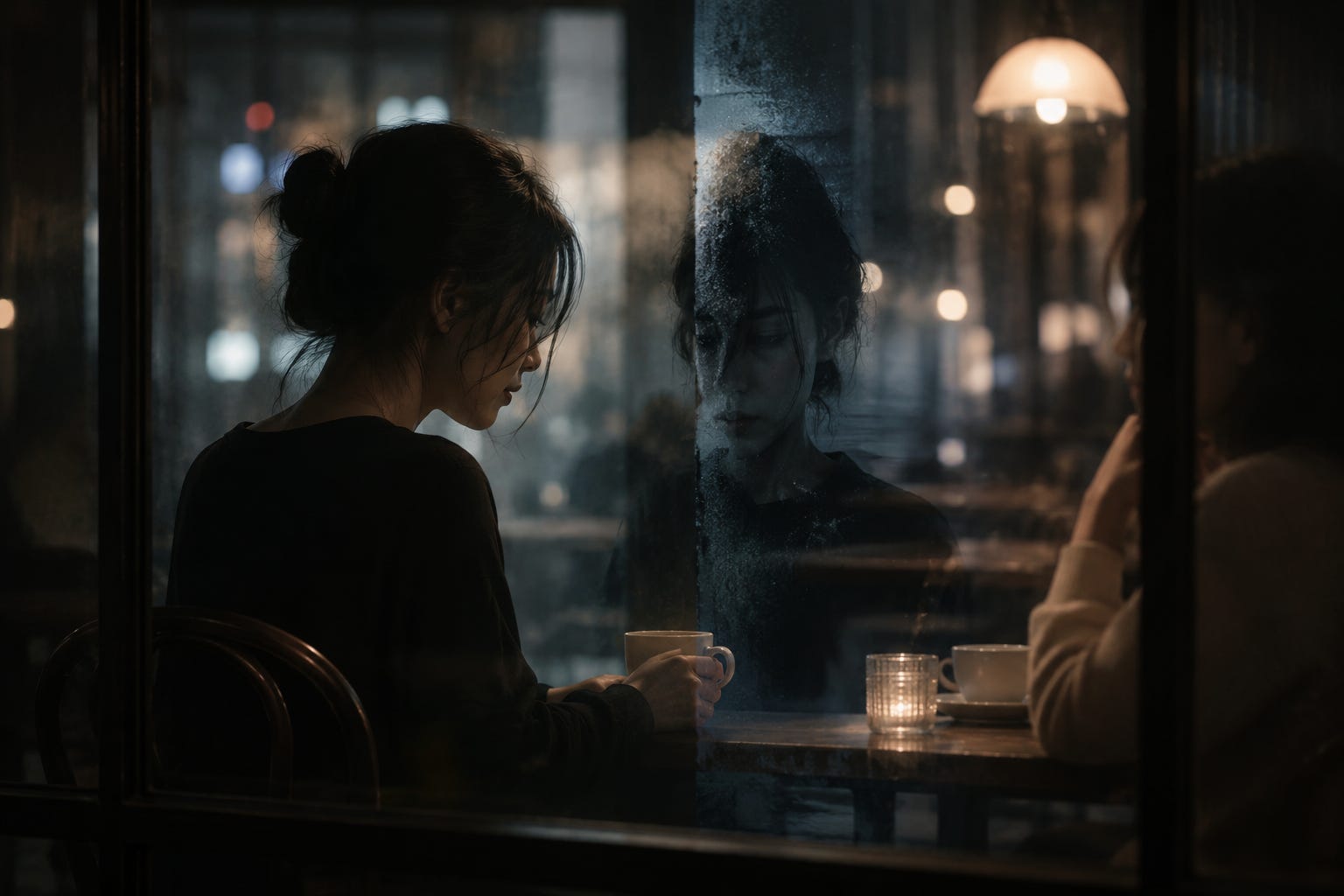
The first sip of coffee had not even reached my stomach when her casual compliment found its mark.
“You look really well.”
“Yeah. I’ve been doing pretty well lately.”
I smiled with exactly the right number of teeth. In truth, my foundation was thick enough to hide the gray collapse of an entire night.
She asked how I’d been. I handed the question back to her smoothly:
“How’s your project going? Is work still okay?”
So she began telling me about a raise, a pet, a weekend hike.
I adjusted the rhythm of my breathing to something closer to a normal human setting. I offered sympathetic sounds at the right moments, smooth as a performance rehearsed twenty-seven times.
She took a sip of her latte and looked at me softly.
“It’s really good to see you like this.”
I nodded, like an actor receiving imaginary flowers in the dark.
But inside my chest, I heard the set collapse.
Steam rose from the cup and split my reflection in the glass across from me.
One half was the recovered version she could recognize.
The other half was me, using everything I had to perform a version of myself that would not be a burden.
She did not notice.
For a moment, I thought that meant I had succeeded.
Then my heart sank.
The better I performed, the farther away I became.
I was not getting closer to her.
I was handing her the version of me that would not cost her anything.
Even My Pain Had a Queue
Only later did I realize the performance in that café had only been rehearsal.
The real show happened inside every message box that asked:
“How have you been?”
Draft: “I think I’m falling into a low again.”
Published: “Hahaha. I’ll just sleep it off.”
Draft: “Am I really unworthy of being loved?”
Published: “Don’t worry. I’m fine.”
The sound of my fingers deleting words was so light even I could barely hear it.
Before seeing her, my body had already begun its safety check.
Step one: conceal the darkness under my eyes.
Step two: three deep breaths downstairs, trembling switched to silent mode.
Like an actor checking her marks in the dark, making sure the ease looked flawless.
But some lines always defected at the last second.
“I really don’t think I can hold on much longer.”
“Can you please stop saying I look well?”
They rose against my teeth.
And I swallowed them back by force.
When did this performance become instinct?
Maybe after every “I’m fine” was answered with “That’s good” — and every “I can’t do this anymore” made the chat window freeze five centimeters over.
So I learned to cut my pain into milligrams small enough for someone else to swallow.
Like putting a filter over a wound, I completed a breakdown alone, with no audience.
Late at night, I closed my phone.
The screen was full of little “hahaha”s.
Neat. False. Without the temperature of ink.
I looked at the perfect porcelain doll in the mirror. She nodded back at me.
And I suddenly couldn’t tell — was she confirming the performance had succeeded, or signing, on behalf of the real me, a permanent notice of disappearance?
I Played the Ending Before She Left
At 4:07 a.m., my body was rehearsing a collapse.
Not because of anything she did.
Because I had written an ending for myself, and the ending was called being left.
In it, she would one day grow tired of me and mute me completely out of her world.
To avoid that ending, I set three red lights.
The first: when an instant reply became ten minutes unread.
The second: when a whole paragraph was sealed shut by one laughing-crying emoji.
The third: when “good night, baby” became “sleep early.”
Whenever one of them lit up, I removed another layer of my own weight.
That night I had wanted to message her. To say the memories had pulled open an old wound again.
My fingers hovered over the input box.
Then stopped.
I told myself: she has a 7 a.m. meeting tomorrow. She has so many important worlds waiting for her.
So I deleted it. Closed the app.
Locked the night back inside my body.
This whole system of self-muting — she never asked for it.
It was a eulogy I submitted in advance.
I was afraid she would one day clear the room, so I nailed myself to the wall first, like a decoration that knew not to take up space.
That way, when she turned away, I could still smile and say:
Look.
I was never in the way.
The screen reflected my face back at me — pixelated, blurred at the edges.
I smiled bitterly.
And finally recognized it:
the one who let go first had always been me.
What I had planned for her was never an exit.
It was a soft dead end I dug with my own hands.
The most hidden performance in bipolar is not pretending to be happy.
It is pretending, in advance, that you do not need to be held.
I Called My Escape Consideration
I deleted the sentence: “I think I’m falling apart.”
The screen went white.
From somewhere in my chest, a sigh escaped — so light it almost felt indecent.
So this was what I had always been afraid of.
Not the collapse itself, but the alarm it would set off once she heard it:
being left.
So I gave myself a better label.
Considerate.
When she was busy, I switched myself to silent mode.
When she deserved to be drinking coffee in the sun, I pickled the storm clouds back into my throat.
Over time, even my pain learned to take a number and wait.
I told myself this was an advance payment for goodbye.
Step back first, and you can never lose.
Until one sleepless night, I scrolled back through old messages.
The chat log looked like a film that had been cut too many times — first just a few silenced punctuation marks, then whole fields of blankness — so empty I could see the exit route I had laid there with my own hands.
What I had been protecting was never the friendship.
It was the version of me that could not be abandoned because I had already sent her away first.
If I exited the stage before anyone asked, then she would have no right to announce the show was over.
So I removed the real me from the relationship in advance.
I saw that perfect route of retreat.
In truth, I had folded my soul into a paper plane, sent it out of her sight ahead of time, and applauded myself in midair:
Look.
How considerate I am.
The first person who abandoned me was never her.
It was me — the one who had already buried herself the moment she pressed delete.
She Didn’t Know the Blank Spaces Were Me
She still doesn’t know that the sentences buried at the bottom of our chat had once lit up on my screen like small emergency lights.
She only saw my “later,” my “another day,” my “I’m busy.”
She assumed it was just the time difference of living.
She didn’t know that every blank beat was a trace of me folding myself once more.
Even I had almost begun to believe it: that silence was a dignified kind of maturity, that retreat was a gentle kind of consideration.
Until tonight, when the gaps in our chat history looked like a corridor with all the lights off.
And I was suddenly afraid:
if I kept folding, I would become dust between my own fingers.
My fingertips trembled — the way a heartbeat feels at the edge of a cliff — but for the first time, I didn’t press delete.
I typed: “Are you there?”
Like taking a piece of paper folded too many times and pressing it gently back along the crease, letting it open again.
Five seconds passed.
The bubble stayed silent.
But inside my chest, the first real, heavy echo arrived.
The “Sent” on the screen was like a small ember fallen into the crease.
Not bright.
But warm.
Not to light anyone else.
Only to prove this:
I had finally stopped hiding myself completely.
🌙 Why do we hide our worst episodes from the people we trust most?
Because hiding can look like being considerate. You smile with the right amount of ease, cut your pain into milligrams small enough for others to carry, and call it kindness when you disappear before anyone can leave.
But performing being fine is not the same as getting better. Sometimes it is the most exhausting way of saying: please don’t let me cost you too much.
Have you ever made your pain smaller because you were afraid of what it would cost the people you love?
You don’t have to be okay to leave a comment here.
I read every comment.