

At three on a Saturday afternoon, the mall’s glittering ceiling lights hung overhead like interrogation lamps, pressing down until there was nowhere to hide.
My friend turned toward me with a casual invitation.
“Want to see a movie later? What kind do you usually like?”
I answered almost without hesitation.
“Thrillers, I guess.”
The answer came with the practiced ease of an old coin rubbed smooth by years of handling—already minted, already waiting to be handed over the moment someone asked.
Something in my chest caved in, leaving a patch of wasteland.
That was his preference—the kind of film he would stay up past midnight for, just to catch the post-credit scene. It wasn’t mine—the softness I loved, the kind that could still leave me laughing when the theater lights came back on.
My step fell half a beat heavier. My knuckles tightened quietly around the handle of my shopping bag, as though I could catch the frequency that had just fled.
Surprise flickered through my friend’s eyes. She remembered how I used to avoid stories that were too cryptic, too determined to make the brain burn. I shook the soda in my hand, letting the static of bursting bubbles cover my panic, and brushed it off by saying I couldn’t remember. She could choose.
I folded those 0.3 seconds of silence into the seam between heartbeats.
They kept ticking inside me:
Is this what I like?
Why was he the first thing I thought of?
If he weren’t here, would I still choose this?
The crowd kept moving forward. And suddenly I realized the answer had come too smoothly to feel borrowed.
My friend didn’t press. But at the edge of my vision, I kept searching for the missing echo:
If that wasn’t my channel, where had the original frequency of my own heartbeat gone to hide?
My Preferences Stepped Aside First
Only later did I realize that the first thing to disappear was not the answer, but the instinct in the instant before an answer formed.
At seven in the morning, before the alarm had even startled sleep awake, I was already listening beside the pillow for the weight of his tired breathing.
I wanted the warmth of the bed. I wanted to spend the morning alone, finally finishing the book I had left untouched for too long. But I pulled open the curtains first, offering an invitation phrased like a question while quietly laying out the choice that would spare him from having to struggle at all.
That afternoon, we sat down at a Sichuan restaurant. My eyes lingered hungrily over the menu’s blazing pools of red chili oil. Then I saw him rub his stomach without thinking, and my fingers silently turned the page toward a mild clay-pot congee.
He smiled and said I understood him better than anyone.
Steam curled upward between us. Beneath it, only the familiar whisper of compromise remained:
Just go along with him. It’s not as if I have anything I care enough about to insist on.
For that entire day, every preference of mine stayed curled inside the borders of his comfort. Every stroke of the itinerary traced itself around him. Not one belonged to my own hand.
I used to think this was thoughtfulness—the kind of mutual accommodation mature love was supposed to contain.
It took me much longer to see that this did not even qualify as sacrifice.
Sacrifice requires knowing what you want first, and then willingly placing it in someone else’s hands.
But most of the time, a thought of pleasure had barely begun to take shape inside me before it was already passing, instinctively, through the filter of his preferences. My liking had not yet opened its mouth before it stepped aside for his comfort.
I had never deliberately pushed the things I loved to the back. It was simply that the instinct for recognizing joy had already learned to route itself through the frequency of his life first.
By the time I finally tried to ask myself, seriously, what I actually preferred, I was startled to find:
the self I had misplaced for too long could no longer return a clear answer.
Even the Princess Dress Couldn't Testify
Deliberately leaving behind every shade he preferred, I went to an interrogation of the soul that was years overdue.
I walked into the mall alone and made a pact with myself: today, I would choose only the clothes I would have loved before I learned to live tethered to his frequency.
I avoided the familiar black, white, and gray, returning the plain long dresses he had praised again and again to their racks.
But when all that color rushed toward me, my chest felt hollow, as though the negative of my soul had been pulled out. My fingertips wandered between lemon yellow, berry pink, and peacock blue.
Every pause became another difficult interrogation:
Is this really my color?
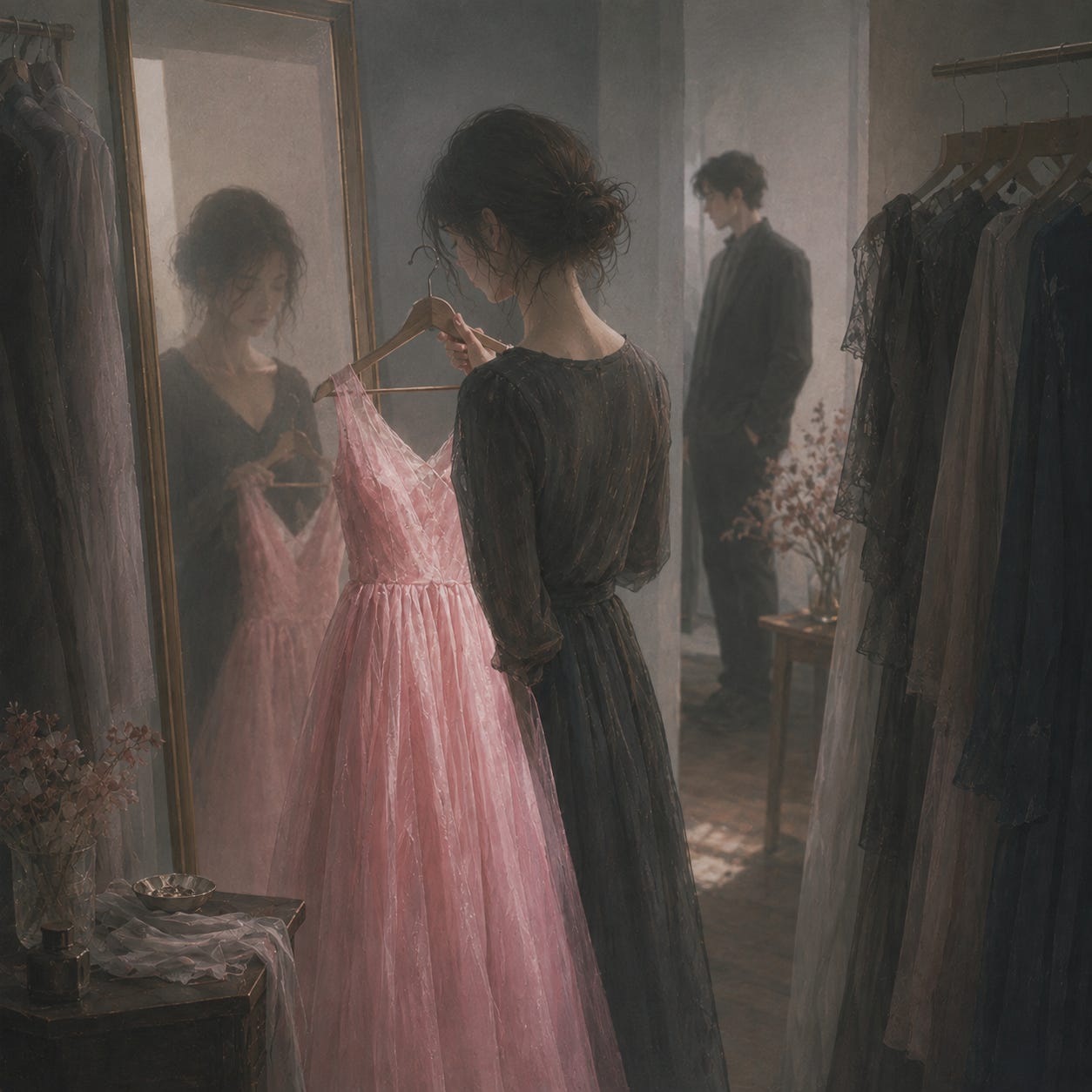
I lifted the pink princess dress from the rack. Its soft fabric held the girlish longing I had kept pressed down for years. But the next second, panic arrived.
I couldn’t tell whether I had always loved it, or whether this liking was only a deliberate rebellion staged in the opposite direction of his preferences.
The woman in the mirror stood rigid.
A question dropped into the hollow:
What had I ever truly loved before him?
I hung the dress back in its place, and suddenly understood: what frightened me was never simply that I had grown used to living by someone else’s preferences.
It was that even the things I thought I had recovered had origins too blurred to trace. I could no longer tell instinct from intention.
I tried desperately to find my way back to the self who had existed before all that tuning and compromise, only to realize, with a quiet grief, that she seemed never to have left a backup.
And then I began to doubt all the evidence I had once collected for our supposed natural compatibility:
How much of it had been an echo I had tuned into existence, little by little?
Compatibility Can Be Forged
He used to boast to our friends, smiling, that we had barely needed an adjustment period.
Back then, I held my whole heart burning in my hands and took that sentence as a love certificate stamped by fate, proof that I had finally found the kind of compatibility people were destined for.
It wasn’t until the pink princess dress crashed back into view that I suddenly learned to read the other side of the stamp.
He liked to keep moving, checking landmarks off one after another, so I said I preferred tightly packed trips too. He ordered an iced Americano, and I smiled as I agreed that lately I had grown fond of that clean bitterness. He offered an opinion almost in passing, and I could always nod immediately, as though the thought had already been sitting, certain and complete, inside me.
I used to hunger for that compatibility, treating every moment of perfect sync between us like two souls clinking glasses.
Every “We’re so alike” was warm red wine, fermenting all the sweetness in our relationship.
It wasn’t until the pink princess dress crashed back into view that I finally understood:
it had never been two souls born in harmony.
I had been sanding down my edges, inch by inch, slowly retuning myself toward the wavelength of his life.
The compatibility he was so proud of was only a shadow I had carved for love.
The bright dresses could not reflect the real exhaustion in my eyes. My breath moved like wind finding its way around broken glass.
Compatibility does not always mean deep love.
Sometimes it is what remains after one person has gone wordless for so long that she loses the courage to voice herself.
I once believed with absolute certainty that we were naturally made to fit. Only later did I realize how much of that fit had come from all the ways I had been trying to become like him.
And what hurt most was this:
the soul-deep resonance I had treasured so fiercely had been a tender, bone-chilling illusion I had tuned into existence with my own hands.
Even the Cake Had No Answer
At nine-thirty, the white light of the supermarket dessert case was sharp enough to burn my eyes.
I pushed an empty cart into the most crowded aisle and was suddenly stopped by a cheesecake tied with a pink satin ribbon. Its snow-white surface was cruelly clean. The cloying sweetness in the air was a flicker of desire I did not dare claim as mine.
My hand reached toward the refrigerated case, then jerked back.
Usually, by now, his refusals would already have occupied my thoughts:
Too rich. Too childish. Too many calories.
But this time, the familiar shackles did not descend on schedule.
I pressed my fingers against the icy glass. Cold and bitterness rose together into my throat—
If I can’t even be sure I prefer sweet-and-tart flavors, how much of the real me is left?
I picked up the cake, put it back, then did it all over again, like testing an access door again and again with a missing key.
Voices crowded around me, urging the world forward. I remained frozen where I was, pain climbing my spine, but there was no one left to answer for me.
I finally placed the cake gently in the front basket of the cart. I didn’t dare return it. I didn’t dare confess that I might want it.
The pink ribbon trembled slightly in the refrigerated air, like a signal that still hadn’t found its channel.
Noise wrapped itself around the empty cart. I drew in a cold breath laced with the scent of milk and let the “I don’t know” spread inside me.
The hurt still occupied my chest.
But for the first time, I was unwilling to borrow someone else’s ruler or frequency to fill the wasteland where my own self was missing.
🌙 What does losing yourself in a relationship mean?
It can begin before you consciously give anything up.
Your preferences start passing through him first—filtered for his comfort before they are allowed to form—until one day, you are asked what you want, and the answer no longer arrives.
Nothing disappears all at once. A liking simply steps aside before it ever opens its mouth.
It is not sacrifice. Sacrifice requires knowing what you want first.
Have you ever been asked what you wanted—only to hear his answer arrive before yours?
You can leave it here quietly.
I read every comment.
You described this subtle process so eloquently 😊 I completely recognize that desire to feel the closeness to someone, up to the point you decide to let go of your own preferences. Only to learn later on that in losing the small things of yourself, you were also losing the big things.
I am slowly learning that this process doesn’t only require one person though, it involves both of them. Most of the times both partners participate without understanding completely what’s happening, but it is still very important to acknowledge it is not just your ‘flaw’. It is a dynamic that you’ve created together.