

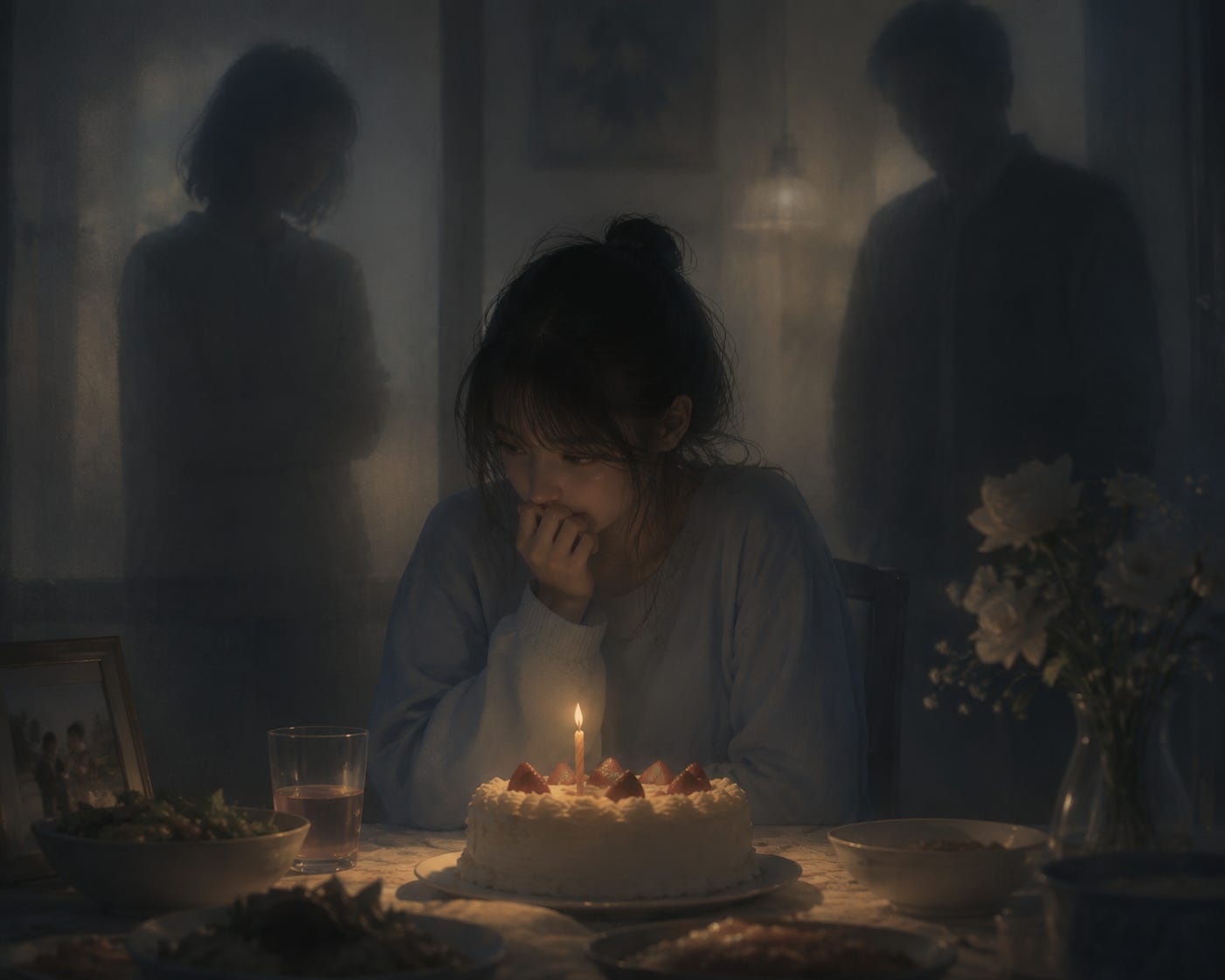
They said my temper was made of sparks from the hearth of my childhood, leaving burns across the hand I raised to shield my parents from blame.
My grandparents’ criticism hung beneath the eaves like strings of dried firecrackers, waiting in the shadows after every dusk.
Still, whenever they exploded, I threw myself forward and caught the sparks against my chest. The words meant to wound my parents frightened me more than the burns ever did.
No one had taught me how to say “I love you” gently, so I learned the clumsiest form of protection:
eyes burning red,
a voice trembling at full volume,
a stubbornness that refused to move an inch.
“Why do you have such a temper?”
I was ten years old, standing in the middle of the living room, surrounded by my family. They watched me as though an unnatural storm had broken indoors, pouring buckets of blame over the tender place already burning inside me.
I tried to sand my sharp edges into obedient curves. I thought that if I made myself easier to hold, understanding might finally let in a little light.
Then I was diagnosed, and my family was handed a new script:
“Are you having an episode again?”
That word — again — was a nail driven into bone. It pinned every feeling I had to a blueprint of illness.
They began searching for an approaching storm in the set of my mouth, the way my eyes slipped away, the pauses between my words.
Eventually, I became a fireworks factory they believed could ignite at any moment. They appointed themselves the safety inspectors.
You called it concern.
But even my tears had to take a number.
Once bad temper became patient, explanation itself became contraband.
I Let a Smiling Doll Take My Place
I began to melt away like snow, afraid that crying might shatter the moonlight in your eyes. Your lowered voices were silver needles, sewing their assumptions into the folds of my heart.
I hid behind doors and collected the looks you traded. The sentence you never quite finished — “Lately, she seems off again…” — hung above me like an icicle, refracting a hard, cold light.
I became a ghost in my own home, afraid even to let my shadow overlap anyone else’s. Only after the laughter had faded did I dare cross the kitchen like a wounded fawn.
Whenever I left a gathering early, “tiredness” was only a candy wrapper around tears — sweet on the surface, full of cracks underneath.
Later, I folded myself into a shadow and let a smiling doll take my place at every gathering where I might have broken.
But avoidance is an addictive poison.
I curled up in the bay window, living like a stray inside my own home. At night, I ground my sobs into fine stardust, afraid that one escaped sigh might rise like a tide and flood your dreams.
Hot tears fell into my palms. Each one hardened into a lead weight sinking toward the deep sea, weighing down every trembling breath.
I unfolded my crumpled thoughts to Bianbian, the chinchilla I had grown up with. His black-bean eyes held a galaxy; with every blink, he seemed to lift another broken piece of me from the dark.
I thought removing myself would buy peace.
Instead, I surrendered even the right to want to be loved.
You adopted a brighter script and stopped asking, “What is it this time?”
Every smile walked a tightrope, each curve grinding across my exiled heart.
And I held Bianbian in silence, inside this carefully staged performance of tenderness.
Had my pain lost the right to be seen the moment I volunteered to disappear?
I Became My Own Final Executioner
At one in the morning, the glittering lives in my classmates’ posts cut me into ragged scraps of paper. Those polished fragments looked like specimens preserved in amber, reflecting a sharp white moonlight that made every festering crack in me impossible to miss.
I realized then that I had long since become a drifting island, left off the map of the world.
My fingertips moved over the scar on the wall that read, “You do not deserve to be loved.”
Each touch felt like gilding despair.
Bianbian circled my ankles, winding anxiety around them like vines. His damp nose was the only candle left in the dark.
The moment the door opened, my parents’ “Go take a pill” came at me like a poisoned arrow through the heart.
In that instant, my soul split in two beneath the force of the pain:
one half sobbing in a blood-dark swamp,
the other suspended high above it, coldly watching the whole absurd performance unfold.
When the pain of “Why am I like this again?” rose from the deepest part of my chest, I heard the walls inside me collapse.
Those familiar words of judgment climbed onto my vocal cords and used my own tongue to embroider a sentence lined with thorns.
The girl in the mirror was tied to the scaffold by my own hands.
When the blade came down, the wind it raised blew away the last grain of starlight in her eyes.
I looked at the shattered reflection in the glass and whispered:
“You are so pitiful. Not even you love yourself anymore.”
In Bianbian’s eyes, I could see the shape of my collapse reflected back at me. Between the real and the unreal, I could no longer tell which version of me was true.
So this was where the deepest inferno began:
when I took on the voice of the enemy,
turned the blade toward a beating heart,
and became the last person left to betray me.
The Only Eyes That Never Said “Again”
After I became my own executioner, the world stiffened into an amber silence.
Bianbian paced the edges of my island with the slow sweep of his tail. Then he stopped and looked up, his eyes holding two small pools of moonlight untouched by suspicion.
From outside the door came the low murmur of my parents’ latest case conference.
“Lately she’s been having…”
The rest snagged in the crack of the door.
By then, I had already brewed my collapse into a mute liquor, ground every sob into moonlit ash, and let no sound spill beyond the shore of my island.
Bianbian touched his damp nose to my cold fingertips, and something like silver frost flickered across the wasteland inside me.
At last, I saw it clearly: among all the monuments others had carved with that word again, he alone still carried the version of me that had not been damaged.
He knew nothing of old family wounds. He did not know how emotions could oxidize.
In his soft-furred universe, I was still the small glowing star who brought him dried apple and scratched the places he could not reach.
🌙 Can someone with bipolar disorder be angry without it being an episode?
Yes.
Bipolar disorder can intensify or alter a mood. It does not own every spark of anger, every silence, or every tear.
But inside a family, concern can appoint itself the safety inspector of every expression. A raised voice is searched for relapse. A pause becomes evidence. Tears are asked to take a number before anyone asks what hurt.
So feelings begin hiding before they can be named.
That is how stigma moves inward. It does not only misread an emotion. It teaches you to distrust your right to call it yours.
Maybe the cruelest part is not hearing your family say “again.”
It is learning to say it before they do.
Have you ever had a real feeling treated like a symptom — until you began cross-examining it too?
You can leave it here quietly.
I read every comment.
They labeled every feeling.
Until they no longer had to.
They had already learned
to do it
to themselves.
— AËLA
Listening to this while reading it. This is one of the most brutally intense, raw and vulnerable pieces I've read in quite a while. Absolutely gut wrenching how a diagnosis completely dismissed your feelings and was blamed for every mood. I hope you've found common ground with your family now. I hope they are more understanding and I truly hope that they've reflected on how disastrous their attitude was towards you while you were trying to weather the storm at such a young age.