

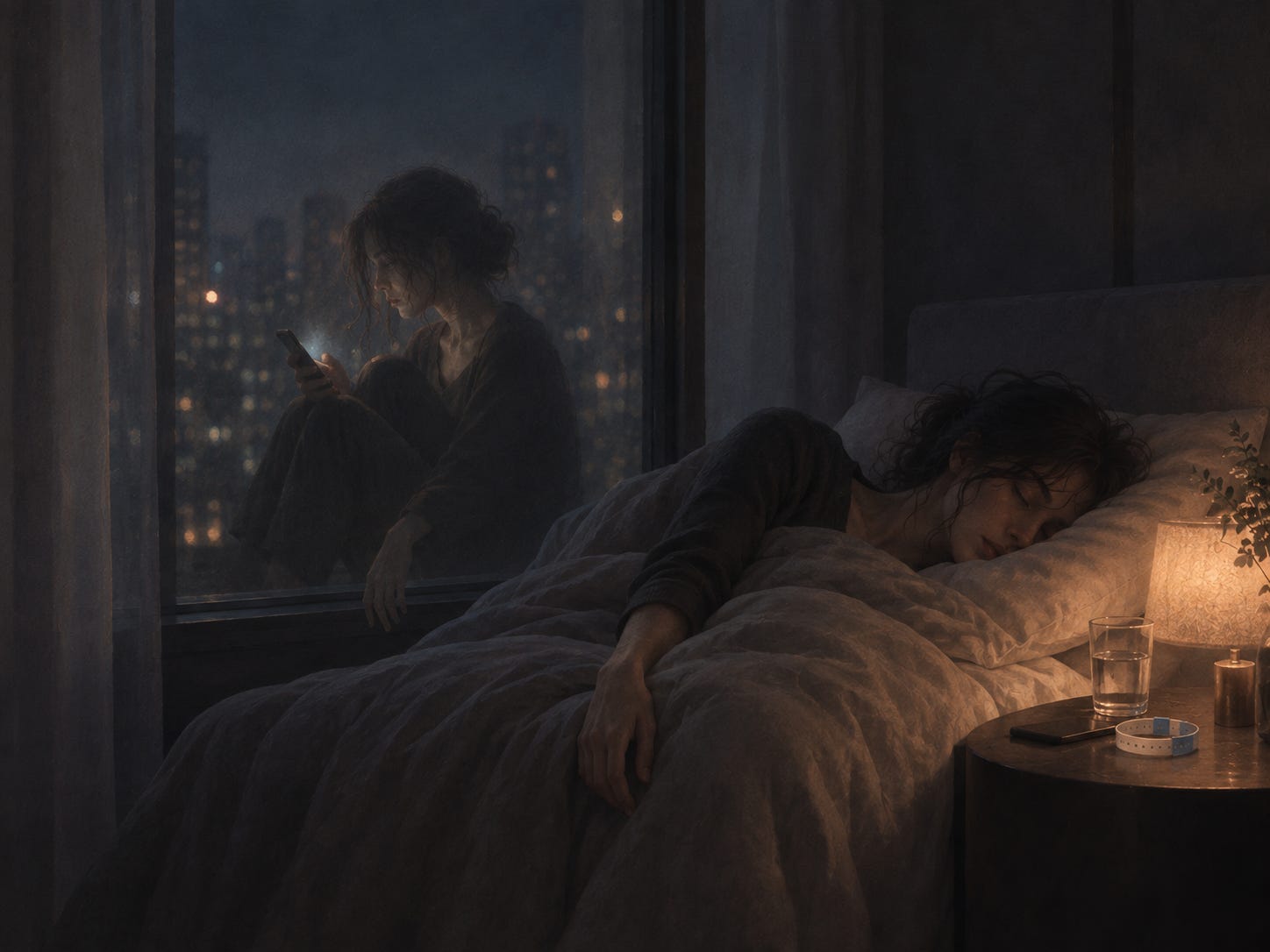
One offhand compliment seemed to presume it could destroy every scar my illness had left behind.
A friend I hadn’t seen in six months had barely stepped through the door before she clasped my hand, her voice so breezy it felt cruel:
“You’re doing so well now—I’d almost forgotten you were ever sick.”
For a moment, my hearing cut out, as though a verdict had just declared that whole dark stretch of struggle invalid. I pulled a matching smile into place.
“It’s only stable for now. I could collapse again someday.”
She set down her wet umbrella and patted the back of my hand, relieved, telling me not to think too much and just enjoy the present.
The damp air filled the living room. From a narrow gap in the coffee table, a strip of my hospital wristband had quietly slipped into view. The most straightforward proof of my suffering now emerged like a written statement, awkwardly sliding out of its hiding place.
She went on complimenting how put-together I looked, how relaxed I seemed. I murmured agreement, but my fingertips had gone ice-cold. My body noticed before language did: the steadiness I spoke aloud and the dread underneath it were already moving in opposite directions.
I opened the front-facing camera for a photo with her. My smile looked whole and flawless, as though I had never broken, never gone under. I stared at the image and suddenly wasn’t sure who I was looking at.
“If I can recover enough to look normal again, does the pain that tore me apart back then stop being worth mentioning?”
I put my phone away and tucked the wristband back into the drawer, carefully hiding it from sight. My lipstick was still bright, but something inside me shook violently for the first time:
“Could this so-called getting better be a way of retracting my own statement?”
At 2 A.M., Even Pain Needs Proof
Having to produce evidence even for breaking down and crying was the coldest injustice of that winter. That sudden bipolar episode locked me out of ordinary life for three months.
Pain dragged me toward the abyss, and still I had to prove that the barren darkness around me was not something I had imagined.
At two in the morning, I curled up on the cold bay-window seat, staring at the glaring red marks in my sleep log: three nights in a row, fewer than two hours of sleep.
My body was so exhausted it had gone cold. A shattered fear roared through it:
“What if I can never sleep again?”
At four, my eyes landed on the words in the corner of the wall—the ones I had branded into myself:
“You do not deserve to be loved.”
The tears finally gave way. The pain felt like being sentenced all over again. I typed fragments into my notes app, filing away every second of sleeplessness.
Only by dissecting my ruin until it was plain and legible could I keep daylight from reducing the pain to something easy to dismiss.
Later, I stood outside my parents’ bedroom for a long time before finally knocking and asking for help in barely more than a breath:
“I can’t sleep no matter what I do. Can you help me?”
My mother stayed awake with me until daybreak, but even then she hesitated.
“Is it really that bad?”
A marrow-deep regret swept through me. Pain is already hard enough to explain; the less it is understood, the more brutally I felt I had to tear the wound open.
After I left the hospital, I hid the blue-and-white wristband deep inside a drawer. My name and the date slowly faded, yet they carried more weight than a thousand pale defenses ever could.
When my vulnerability was met with doubt everywhere else, it was the only witness that never doubted me.
Later, other people forgot those long nights. But my body never made the pain more presentable for me. Through an erratic pulse and eyes worn gray by sleeplessness, it kept a long, stubborn oath in silence:
those nights of suffocation and struggle had truly happened.
The One Who Wakes Up Is the Cruelest
When I finally made it through the night, the first person to doubt that drowning was the clear-headed self who came afterward.
My sleep app flashed a notification praising my healthy schedule. One neat conclusion rushed to pass judgment on the abyss behind me. For six nights in a row, I had slept soundly for a full seven hours.
In the closed darkness, I kept going back through old records, obsessively searching for one night of insomnia that had left me in total rout, afraid that the agony that once tore me apart would be denied out of existence.
My fingertip opened a conversation that had gathered dust:
03:47 — I really can’t do this anymore.
03:52 — Don’t take that last message seriously.
The typos, the broken sentences, the sobs I could not suppress—even through the screen, they trembled with hurt.
And yet here I was now, breathing evenly, thinking clearly, somehow finding those old pleas—once bleeding word by word—exaggerated and unreal.
“Was that collapse really enough to crush someone?”
“Or had I turned one brief emotional cave-in into a catastrophe I claimed could drown me?”
I weighed those old outpourings word by word, deliberately pulling out every phrase that sounded too intense, too grief-stricken. Six green curves, level and smooth, lay across the screen, as though declaring that nothing in me was broken anymore.
Maybe all that ruin back then had not meant the pain ran marrow-deep after all.
I lowered my phone. The room remained steeped in darkness. Traffic noise seeped through the gap in the window. Two severed selves faced each other across the shadows.
Clarity shows the scars no mercy. It only becomes their harshest interrogator.
Only later did I realize: being able to sleep peacefully now did not prove that the night had not crushed me then.
She had left so much evidence behind. If even I refused to believe her, the old me—alone, with no one to turn to—would be left without a single witness.
I Add a “But” to Every Moment of Calm
I could not let anyone become certain that I was finding my way out of the dark. If everyone felt completely reassured, the one who had cried until she lost her voice in the small hours would have no witness left.
I had just washed my hair when a friend texted to invite me on a picnic. In the mirror, almost all the grayness beneath my eyes had faded. My fingertips instinctively typed an eager yes, then cleared the whole reply.
Carefully, I left myself a margin of uncertainty:
“I’m doing pretty well right now, but I’m afraid my mood might become unstable again.”
She sent back a comforting hug and told me to say something anytime I didn’t feel right. Guilt and relief collided in my chest. That worry was the only thing that left behind proof of the pain I had already lived through.
The next morning, I woke on my own. The deep-sleep trace on my sleep app had stretched farther again. I took a screenshot and almost sent it to the close friend who had stayed with me through the abyss:
“I think I’m not afraid of nightfall anymore.”
But above it were voice messages from those late nights, stacked one after another, my words choked with tears—as though I were still stranded in that barren land, waiting for someone to pull me out.
If I sent this good news now, would all those hoarse cries for help from before suddenly look like a lie I had deliberately invented?
I withdrew the words and dragged the screenshot into my hidden album, locking it away beside my red, tear-swollen face from the year before.
I dreaded time burying the pain completely, yet was just as wary of recovery itself coming to look false. I imprisoned those two contradictory truths inside the same dark compartment.
After that, every time I spoke about getting better, I appended a careful, roundabout “but.”
If I didn’t diminish this steadiness, those old sleepless nights would be voided altogether, reduced to a mirage.
It wasn’t that I refused to admit I was recovering. I was afraid getting better would be misread to mean the past had never really hurt that much.
Lost inside that contradiction, I could no longer tell:
was I standing guard, for the girl who had struggled through entire nights, over the last epitaph for those scars,
or was I punishing the heart that had finally dared to close its eyes in peace?
The “But” Has No Next Line
The “but” I had always used to tether calm to pain caught in my throat tonight.
At eleven that night, my best friend’s worried voice lit the deepest part of me like a cold lamp. I instinctively reached for my usual line, but the word itself went stiff between my teeth.
She waited for me to tell her how I was crumbling. I searched every corner of that deepest part and found no agony I could offer as proof that I was still suffering.
I could only scramble for another subject and listen as she told me her cat had torn the new drapes. In the end, she gently told me I didn’t have to force myself to be strong. I could only murmur my agreement, not daring to let one more word of calm leave my mouth.
After the call, the white noise I slept to soaked the room, and my sleep app glowed blue. I used to open it again and again, dredging up fragments of sleeplessness to use as proof of suffering.
Tonight, I pressed the screen dark and turned my phone face down.
A handful of warm light rested by the bed, as though offering the night somewhere to recede.
The marks on the wall, the hospital wristband—all the evidence of pain was still there. But tonight, I no longer forced every one of them to take the stand and prove how broken I had been.
At some point, awareness gave way, and I fell into a deep sleep.
The soft swish of the street sweeper pulled back the dark before my alarm could. I used to lie awake with dry eyes, listening as it dragged a whole night’s rout toward morning.
Now, my chest held only a wide, loosened openness.
🌙 Why does getting better make me doubt how sick I was?
Sometimes getting better creates enough distance from a crisis that the past starts to look exaggerated. When today’s stability becomes the evidence, you may begin using it against the person you were then.
Recovery can change how pain feels in memory without making that pain unreal.
Sometimes the hardest thing to believe is that both can be true: you really were suffering then, and you really can be doing better now.
Have you ever added a “but” to good news because getting better felt like betraying the version of you who had suffered?
You don’t have to make either truth prove itself here.
You can leave it here quietly.
I read every comment.
Balancing the fear of recovery erasing your past pain with the gentle allowance to finally rest in the present shows such a beautiful, heartbreaking depth of human emotion, Xiaobian..🫶🏻🥹