

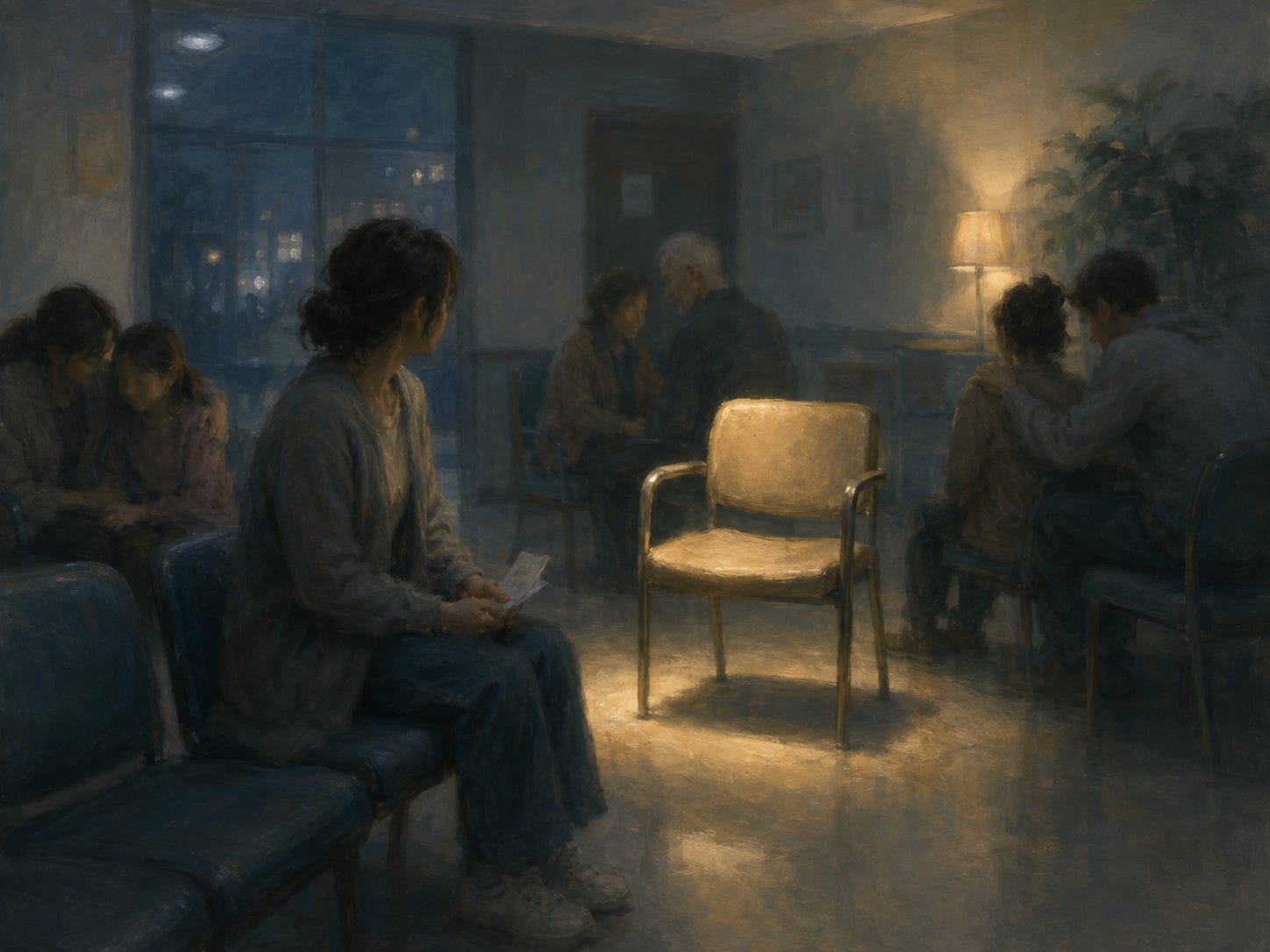
Sometimes, looking too closely at my own soul was almost unbearable. No matter how gently the clinic had been furnished, it could not muffle the sound of hearts breaking.
I had lost track of what year of these monthly appointments I was in. Every part of the routine felt like a wordless play rehearsed a thousand times, except both the actor and the audience had long since gone numb.
The nurse always smiled when she saw me. She had become a familiar stranger—the kind you somehow end up on good terms with.
The clinic carried none of the harsh disinfectant smell that usually spread through hospitals. Reassuring quotations covered the walls, but they could not seep into the furrowed brows of the patients and their families. Apparently, gloom knew how to travel through every wounded soul.
I found a seat without much thought and waited for the nurse to check my vital signs.
Still, I could feel the eyes around me. They were searching for scraps of evidence in someone else’s posture, expression, or hands, hoping another person’s condition might offer an answer to whatever remained missing inside themselves.
Glances were exchanged in secret and withdrawn at once. Fingers tapped without their owners noticing. Inside the sealed waiting room, every small motion seemed infinitely magnified.
But what about me?
Was I any freer from this bone-deep habit of watching? My gaze began to drift, unbidden, across the patients in the waiting area, trying to catch each soul at its most fragile.
The Fallen Teardrop Earring
Under the fluorescent lights, a girl curled into herself in the far-left corner like a startled migratory bird. Her hair cast shadows across her cheeks. Her fingernails had been bitten into uneven ridges, their color drained to a bluish white.
A support worker sat half a step away, her watchful but gentle gaze fixed on the girl’s trembling shoulders.
“Breathe out slowly. Count to five…”
The instruction was barely louder than a whisper, yet the girl seized the back of her chair. Her knees began shaking at a frantic rhythm. Her interlaced fingers kept weaving themselves together and pulling apart, clawing disorderly creases into her jeans.
The click of the consultation-room latch springing open pierced the silence. Every gaze in the room flickered.
The young man stepping through the door had barely lifted his head when the girl gripped the edge of the table. Her fingertips turned white, and then her right hand came down hard against the surface.
“You promised you wouldn’t force me!”
Her scream shattered against the tiled wall.
The support worker quickly covered the girl’s spasming hand with her own, only to be thrown off. An overturned chair carved a sharp arc across the floor. Loose magazine pages fluttered down like butterflies with broken wings.
The nurses closed in from every side. In the small wind lifted by the hems of their white coats, the girl was guided—gently, but irresistibly—toward the quiet room.
I stared at the crescent marks my nails had pressed into my palm.
Three winters earlier, I had torn open silence in the same way. I had smashed a mirror then, and the reflection fractured across the glass seemed to overlap perfectly with the girl before me.
“She’s taken her medication. She’ll calm down soon.”
Her boyfriend offered the explanation helplessly to the air, while another sedative was dropped into the heaving sea inside her chest.
I could not stop wondering what kind of storm had pushed her to the edge of a cliff, or what shape the wound buried deep inside her had taken.
But that was not the point.
I only knew that her tears felt both familiar and strange, and that another diagnosis was about to be born on paper.
The storms I had already lived through led my gaze toward another unfamiliar face in the waiting room.
Love, One Chair Apart
A middle-aged man sat on one of the square-backed chairs, rubbing his phone over and over. His shirt collar was folded into the hurried creases of someone who had dressed too quickly.
The consultation-room door opened with a soft click. A curly-haired girl stepped out, her earrings swaying, a faint flush still resting on her cheeks after the armor had come off.
“What did the doctor say?”
The man sprang upright, the toe of his leather shoe catching the narrowing gap before the door could close.
The girl’s shoulders and neck tightened at once. She backed slowly toward the potted plant.
“Just the usual advice.”
“I’ll go ask—”
“Dad! I’m already eighteen!”
Her voice rose suddenly. Her nails had already dug deep into the frayed threads around the rip in her jeans.
The moment the consultation-room door swallowed her father, the girl collapsed into the chair.
When a nurse brought her water, she pointed toward the door and sobbed, “He always wants to pry open my brain and inspect every corner.”
I unlocked my phone. Twenty-three unread messages from the family group chat were piled inside the notification bar.
A muffled argument drifted through the consultation-room door:
“Emotional ups and downs can be normal at her age… She needs space…”
“But I’m her father!”
The girl grabbed her canvas bag and rushed toward the bathroom. A hair tie flew loose from her ponytail and rolled to my feet.
When I picked it up, I saw that the little plastic bear attached to it was missing one eye, like the lining worn white at the elbow of her father’s suit.
Across the room, an elderly couple shared tea from a thermos. The woman split a pill in half and placed it in her husband’s palm.
When the consultation-room door opened again, the man emerged clutching a form covered in writing.
He stood in front of the empty chair and hesitated for three seconds. Then he tightened the cap on the half-finished bottle of water his daughter had left behind and slipped it into the side pocket of his briefcase.
The digital clock clicked over to the hour. The air conditioner exhaled a cold draft tinged with medicine.
I darkened my screen and sent the words “I’m fine” into the ocean of the family group chat.
Love Between a Cane and a Chair
In the middle of the clinic, an elderly couple sat pressed close together on two plastic chairs, borrowing warmth from each other.
The old man’s wooden cane leaned against his seat, its handle polished dark with years of use. The woman kept her right hand pressed over his trembling left, as though holding shut an old cotton coat with wind leaking through its seams.
When she pulled a thermos from a navy cloth bag, the scent of dried tangerine peel spread through the steam.
She blew across the rim three times. “It’s cool enough to drink now.”
“Isn’t it time to pick up our grandson from piano practice?” the old man suddenly asked, a stain from that morning’s porridge still caught on his collar.
“His lesson was moved to tomorrow.” She dampened the corner of a handkerchief and wiped his collar. “First, we’ll go buy the sesame candy you keep talking about.”
The electronic queue announcement exploded through the room.
As she crouched to tie his shoelaces, a faded hospital wristband slipped from beneath her sleeve. The plastic had yellowed, its edges curling inward.
She tied the laces into a loose bow—the kind of knot learned over thirty years of caring for his diabetes.
The cane and the heel of his leather shoe tapped out a broken rhythm across the floor.
At the step, the muscles in her arm tightened suddenly, the way they might once have when she was young and hoisting sacks of grain.
“Lift your foot.”
The old man raised his right leg with a tremor, preserving with strange precision the stride they had kept through thirty years of walks.
The seats they left behind held two shallow hollows. Between them, half a piece of sesame candy clung to the plastic, its glossy sugar shell holding a faint medicinal trace from the clinic.
It looked like a secret promise time had forgotten in the corner.
I closed my medical record. The nurse’s voice pulled me back into the room.
“Xiaobian, it’s your turn.”
Myself in Other People’s Stories
When I stood up, the eyes around me skimmed my skin like fine needles, then quickly retreated behind their own medical charts.
Under the harsh white light of the consultation room, the doctor’s blue-black fountain pen moved across the page.
“How have you been sleeping lately?”
The question returned every month. My answer came almost by reflex: “A little better than last time.”
By the time I folded the new prescription, the waiting area had already changed faces. The words “The follow-up went well” blinked inside the message box on my phone.
When my key turned in the lock, sunset was passing through the dust-coated cat toy on the windowsill, turning its fur transparent. A few years ago, at this same hour, Bianbian, the chinchilla I had grown up with, would have been curled up there asleep.
The torn-off prescription sheet lay on the dining table beside a bottle of vitamins. The bold print on the medication leaflet was dissolving into dusk.
In some clinic, a cleaner had begun wiping the hollows from the waiting-room chairs.
A new patient was folding their registration slip for the seventh time, while a thousand unasked words hid inside the creases.
🌙 Why do psychiatric waiting rooms feel so exposing?
Because everyone is trying to protect what cannot be hidden completely.
A tapping finger, a tightened hand, a question asked too quickly—small gestures begin to feel like clues. We watch strangers for answers, then look away before they can read us back.
But the room does not divide neatly into the observed and the observer. Fear, care, and control can occupy any chair. Sometimes we recognize ourselves not in someone else’s diagnosis, but in the way they brace, reach, retreat, or stay.
Maybe that is what makes the room so difficult: no one is fully outside the story.
Have you ever recognized part of yourself in a stranger whose life you knew nothing about?
You can leave it here quietly.
I read every comment.
Some stories don't ask for sympathy...they simply ask to be seen, this felt incredibly human. Thankyou for sharing something so vulnerable. <33
Learned a lot from that story!