

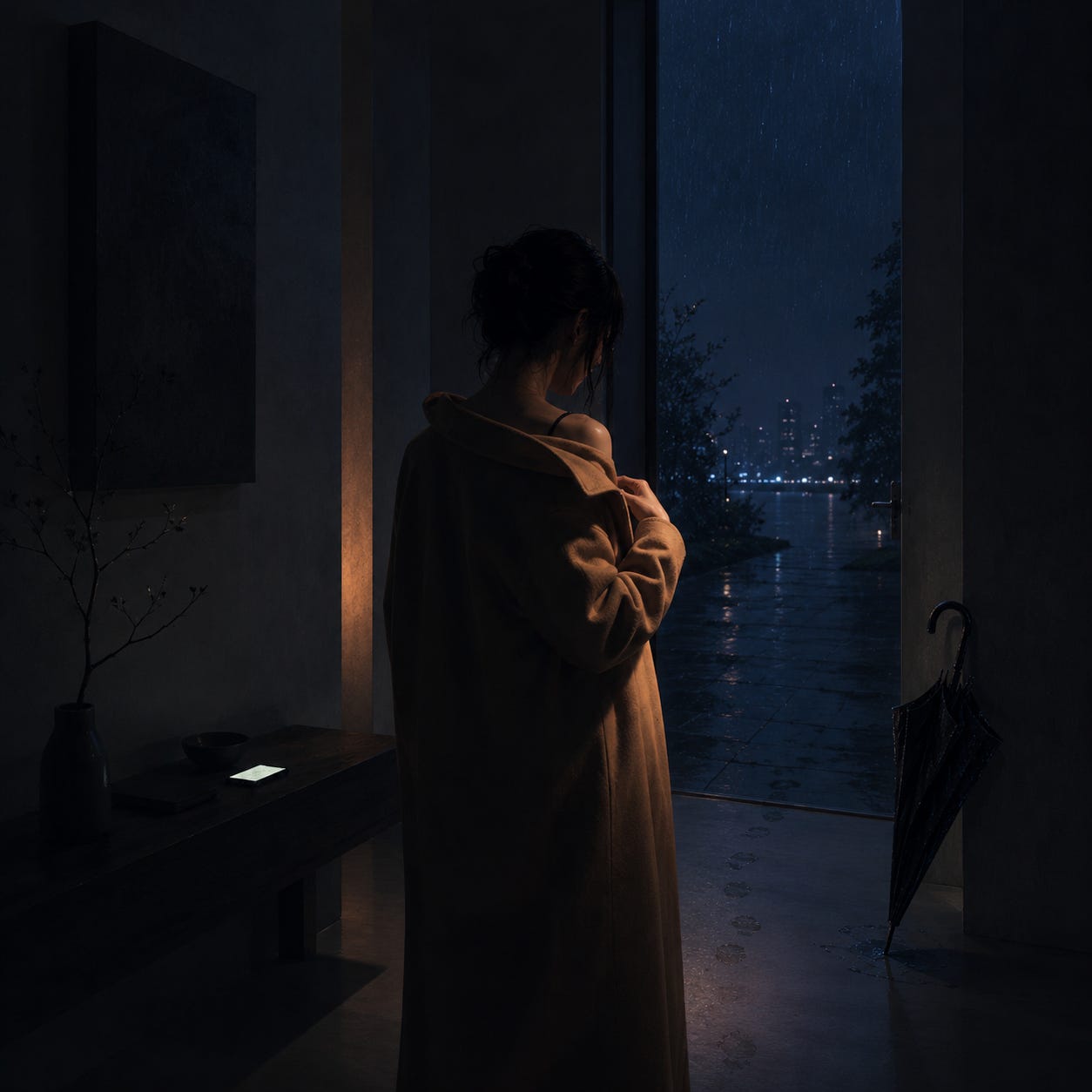
1:37 a.m. Thunder cracked against the windowpane.
The doorbell split the rain open. He stood there soaked through, pulling me into him before I could speak.
“You little coward,” he said. “I’m not letting you be scared alone.”
In that moment, I should have folded into him. Stood on my toes. Kissed him. Laughed at how reckless he was. Said I love you like I had every right to.
But I only stood there, stiff, my arms weakly circling his neck. Rain slid from his hair and fell onto my breath, which had already begun to lose control.
He wrapped a towel over my head, his voice so gentle it almost hurt.
“Don’t be afraid. I’m here. I’m not going anywhere.”
Rain, sweat, and the clean soap smell of his shirt arrived all at once.
This sudden tenderness. This unannounced safety.
A piece of sweetness fate had lent me by mistake.
My heartbeat began counting inside my chest.
One.
Two.
Three.
A silent countdown had already started, keeping time with the thunder outside, each sound heavier than the last.
He was so gentle there was no flaw in him. And I stood there as if I had been placed on a glass bridge suspended over nothing—afraid to hold him back too tightly, afraid that wanting this too much would startle whatever thin cable was still keeping happiness in the air.
The panic had no name yet.
But it was already growing, quietly, inside all this happiness.
The Wounds That Woke First
The thunder had just stopped. But something dull and familiar turned over inside me, so familiar my body panicked before I could.
On my ex’s birthday, there had been a cake covered with roses. He had promised me forever with his own mouth.
Less than twenty-four hours later, his post broke the lie open—there he was, standing beside another girl, in the very bar we had promised to go to together.
Beauty had shattered without warning, as if fate had set an alarm long ago and it had finally begun to ring.
My palms went cold.
The old footage started playing.
At first, it was not even love. Only when I came first in class could I earn a brief moment of praise. But before the warmth of it could settle, comparison and criticism would come crashing down from my parents.
Back then, I did not know how to call it a pattern.
I only knew that good things never stayed.
Sweetness had barely warmed in my hands before bitterness arrived to take its place.
Later, whenever tenderness came near me, my instinct built a cold wall before I could think. It was faster than reason. It had memorized every wound:
after promises, betrayal;
after praise, comparison;
after brief favoritism, the sound of something being taken back.
I looked up at his rain-soaked smile. All I could hear was the hollow ringing after the thunder had disappeared.
The more sincere his tenderness became, the clearer the old evidence grew.
I was still inside his arms.
But my body had already predicted the ending for me.
Maybe it was not that I did not want to cherish what was good.
Maybe every time something good happened, the old wounds were the first to wake.
The Evacuation Route I Drew in the Dark
The tighter he held me, the more frightened I became.
In my mind, I had already fallen into an argument that had not happened yet. I could see some future night. The same room. The same windows.
Only this time, he would no longer cover my ears against the thunder. There would only be the tired sigh in his voice:
“Why are you like this again?”
That sentence would retroactively judge everything tender about tonight as a fluke.
So I began building an entire plan for leaving inside myself.
If he said, “I’m tired,” I would stay silent for three seconds.
Leave room for dignity.
If he said, “We should break up,” I would nod and not ask why, so the memory would hurt less later.
If he slammed the door and left, I would stand still and not follow him. Close the door cleanly. Lock all my shame inside the room.
These thoughts were like evacuation routes drawn long before the fire.
His warmth was still around me. But I had already begun counting what I would have to cut away.
The key would have to be returned.
The hair tie would not be kept.
The sentence I miss you would be folded into a diary and left there.
The happier I became, the more I wanted to reduce the evidence that could one day turn against me.
I kept my smile deliberately small. Held I love you too on my tongue until it began to taste bitter.
Not because I did not want to say it.
Because I was afraid that when everything broke later, I would keep returning to that sentence and use it to tear myself apart.
I was suffering alone inside happiness.
He thought I had closed my eyes because I finally felt safe. He did not know that every light inside me was on, and every exit had already been marked.
Sweetness seemed to have settled over the whole room.
But all I could do was check whether my escape route had been saved.
When happiness became too real, I instinctively began preparing for its loss.
“I Knew It” Felt Safer Than His Arms
Last night, he had come through the rain and knocked on my door. But the moment I was held, I was already waiting for the pendulum to swing back.
The next morning, his replies suddenly slowed. By afternoon, his call had gently moved around everything I wanted to say.
By evening, on video—that distance in his eyes.
Cold in exactly the way I knew best.
I held my phone in my hand. Inside me, only one verdict remained:
See.
I knew it.
None of this cooling surprised me.
I knew the sequence too well.
Happiness arrived first.
Loss followed close behind.
I looked at the screen, and something almost absurdly steady rose inside me. Everything had happened according to the script I had predicted.
My premonition had not failed me.
What truly made me tremble was never the coldness of the ending. It was the suffering of being inside happiness—suspended in the air, not knowing when it would end.
Pain, once it settled, was clear.
Controllable.
I knew how to stop the bleeding. How to pull myself away. How to heal slowly.
But inside tenderness, I only knew how to go stiff. To smile awkwardly, carefully—as if I had borrowed a warm coat and was afraid it would be taken back at any second.
So I waited stubbornly for the sentence:
I knew it.
I waited for it to prove that beauty had always been temporary, and that my guardedness had never been unnecessary.
Those three words gave me more safety than his arms ever could.
This was not pessimism.
It was an instinct trained into me by being hurt too many times.
I would rather have the knife fall for real than keep standing inside tenderness, waiting for the moment it turned into one.
“Of Course” Arrived One Second Late
Before I had recovered from the coldness of last night, the morning wind lifted the curtain.
Then my phone vibrated.
“I was too tired last night. It wasn’t that I didn’t want to listen. It’s still raining today. Don’t forget your umbrella.”
A small reminder.
No spark of apology.
No sugarcoated promise.
Only a thin seam of light leaking through the clouds.
The warning inside me began ticking at once.
Was this deliberate repair?
When would the next distance return?
The old wounds surged up again. My instinct wanted to drag this message into the archive of “of course” and seal it there.
My finger hovered above the screen.
And suddenly, I saw my own stubbornness clearly—holding a cold hammer, about to knock out the small, fragile flame of tenderness that had just surfaced.
I stopped.
I did not ask for a reason.
I did not demand an answer.
I let that simple reminder stay there, quietly lit in the notification bar.
It could not prove forever.
It could not erase the coldness of last night.
But it had arrived.
I stood by the door. For the first time, I pressed down the pessimistic script written into my bones.
Slowly, I opened my umbrella and stepped into the thin rain.
Before the old, fated sentence—of course—could break through the soil inside me, I did not push this message back into a bad ending.
Maybe the hardest thing to learn is not to believe in happiness immediately.
Maybe it is to stop sentencing it, too quickly, as the beginning of something bad.
🌙 Why do some of us start preparing for the ending while we are still happy?
It is not pessimism. It is memory: when every good thing once came with a countdown — praise before comparison, promises before betrayal — the body learns the sequence. Pain, once it arrives, at least gives you something solid to stand on. Tenderness is harder: it asks you to stay inside the good thing without turning it into evidence that loss is coming.
So you build evacuation routes in the dark. You keep your smile small. You rehearse the ending before happiness has even finished arriving.
*I knew it* can feel safer than the arms holding you.
Have you ever braced for the fall so hard that you could barely feel the tenderness while it was still there?
If this felt familiar, you can leave it here quietly.
I read every comment.