

The summer heat of my teenage years clung to my skin. I was afraid that somewhere between the swings of bipolar disorder, I would no longer be able to carry any more weight.
So when he began,
“There’s something I want to tell you…”
I hit stop before the feeling could land.
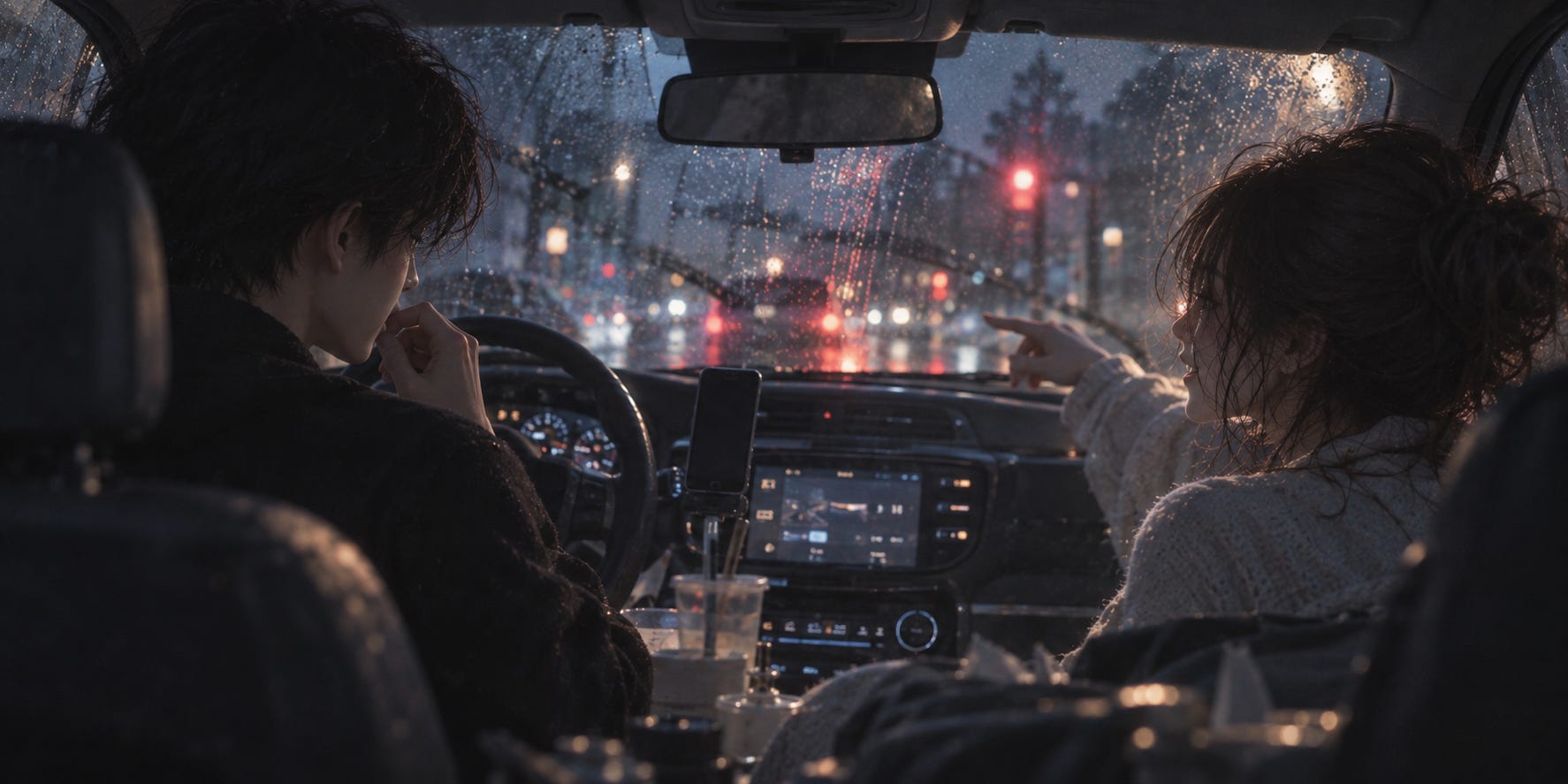
It was Friday night, after the movie, and we were trapped in the car on the way home. The red light came on at exactly the right moment, like a hard cut dropped into the middle of a scene.
Instinctively, I grabbed the first line I could find and changed the channel.
“That chase scene—he ran three blocks without getting out of breath. Did the director cut the oxygen budget?”
Then I turned the love song up to a suffocating volume, reducing sadness to background noise. I packed the car with laughter until there was no seat left for what was hurting him.
The light turned green. He took a breath. His lips moved again.
I jabbed a finger toward the window.
“Look at that sign. It’s flashing like a cheap filter.”
The second interruption.
He gave a silent little laugh, then swallowed the sadness back down.
The third time, he only tapped the steering wheel four times. I kept stacking jokes on top of one another, wearing a cooperative smile as thin as a sticker.
The wipers hurried across the glass. Even the windows seemed to be running away for me.
In the end, he folded his sigh into a barely audible “Never mind.”
I didn’t feel the relief of a stone finally hitting the ground. Only a sour numbness spread through my fingertips as I told myself quietly:
This is consideration.
The car climbed onto the overpass, a sea of lights surging below us.
That night, his first—and gentlest—cry for help stalled out inside my laughter.
It never started again.
His Way Out No Longer Led to Me
The moment my laptop screen went dark, a voice message came crashing in. I thought it was something sweet meant for me; even my fingertips had warmed in anticipation.
Inside was someone else’s antidote.
“I’ve been struggling to hold it together lately. It feels good to talk to you.”
That you was his college roommate.
Not me.
And struggling to hold it together was the ending my laughter had cut from his sentence in the car that night. It hadn’t disappeared. It had simply drifted toward another shore.
In my headphones, he took off his armor and talked about overtime, insomnia, the blind spots in his future. Every vulnerable pause landed safely on the other person’s “Mm-hm.”
That ease—the kind that didn’t have to worry about a dam breaking—was the outlet I had never given him. I realized that in our relationship, I had never made myself into someone his sadness could land on.
In the reflection of the screen, my face was pale as a truth arriving late.
Two thoughts crossed inside me—
The first was jealousy:
Why doesn’t he tell me?
The second was realization:
Was I the one who first signaled that he shouldn’t?
The red light in my memory flared back on. I grabbed at new subjects, turned up the volume, laughed too loudly, ricocheting his sadness into the far corner of the car.
All because I was afraid my bipolar swings couldn’t bear another layer of weight.
My chest felt so light it hurt, as if I had picked up a small stone of his sincerity that had arrived too late.
His silence and my running away were two edges of the same puzzle piece. Both were carefully guarding the same question:
Could I carry any more?
The Other Side of Our Unspoken Understanding Was Complicity
Even when he was falling apart, he chose the volume for me.
3:04 a.m. The neon from the footbridge flickered across the curtains.
I curled up on the window seat while two voices climbed through my veins:
He’s probably afraid I’ll lose control again.
I need to get myself stable before I can love him properly.
Then memory was suddenly dragged out of a hidden pocket.
Late at night, he would send only “Get some sleep,” leaving out the back-to-back shifts he had worked. The hand that bought vitamins tucked painkillers into the deepest pocket of his coat.
Underneath the gestures I had called consideration, another pattern had been there all along.
I used to be proud of how well we understood each other. I thought love meant each of us swallowing our own blade.
Orange light swept across the wall for the ninetieth time.
And suddenly, I heard the puzzle click into place.
His silence said:
Don’t add more weight. She already has enough.
My running away said:
Pull in the sharp edges first. I’m not sure I can take it.
We were both making the decision for each other:
Don’t say it. Better not let this love crack a little more.
A sour ache rose into my throat like rust.
We wrapped our love in protective foam, layer after layer, around the same warning:
FRAGILE.
But with every layer we added, we also took away his way out and my courage.
My phone lit up again.
Goodnight.
One word, as light as every volume he had ever chosen for me.
If what he had been putting down all along wasn’t the weight, but me—
what did I have left to catch this goodnight with?
We Both Believed the Same Lie
He pushed the door open just as I was hiding a small white pill deep in my throat. I looked up, and we exchanged perfectly mirrored smiles.
“Bitter?”
His voice was light as a feather landing on a wound, while the dark circles beneath his eyes hid in the shadow of the balcony, refusing to be seen.
I tightened my grip around the glass, locking the swallowed pill and the subject in my throat together. Then I replaced them with something effortless:
“I’m fine. I can handle it.”
The lines matched perfectly. He played everything is calm. I played nothing can break me.
Streetlight slanted in through the window and split his shadow in two. The front half was tenderness carefully trimmed into shape. The other half was quietly collapsing in the dark.
I finally saw the invisible rule we had both been following inside this love: If my back was already loaded with fragments, he could not hand me one more.
My vision suddenly went black.
Not from the medication.
It was the sentence neither of us had ever said, hanging in the air like a line of bold subtitles:
You can’t handle it, so he can’t tell you.
As long as that sentence remained in force, his exhaustion had to retreat first. And my pain could only keep performing the same line:
I can handle it.
In the dark, the fear became clear for the first time.
What had trapped me was never his consideration. It was the limit I had welded shut with my own hands—the one that said:
This is all I can carry.
And once that limit became law, even two simple words—I’m tired—became forbidden between us.
Maybe One More Second and He’ll Say It
“Lately, you—”
His words broke between his teeth, while his knuckles whitened around the umbrella handle.
According to the script, I should have thrown in a joke right away, wrapped the silence in humor, and mailed it off somewhere else.
Tonight, I locked every line behind my teeth and only looked up to meet his hesitation.
Wind slipped down my collar, cold enough to make my bones rattle. But my eyes burned strangely hot, as if my body had beaten reason to the warning:
Don’t run.
My heartbeat tapped drop by drop against my chest.
Nothing broke.
Maybe my pockets had not, after all, filled completely with collapse. Maybe I could carry a little of his weight.
He kicked a loose stone away from his shoe, his voice retreating behind its defenses:
“Never mind. It’s nothing.”
I didn’t give him a line to retreat behind. I didn’t change the subject.
Only then did I realize that bipolar disorder had taught me more than emotional swings. It had also written a backstage script into me:
Run first.
So whenever even a little weight entered a relationship, I made the decision for the other person before they could:
I won’t be able to carry it.
The streetlight brightened and dimmed, his hesitation moving across my face like shifting patches of light.
I let it stay. I let the unease take root.
Maybe if I waited one more second, the secret he had swallowed back would edge toward the tip of his tongue again.
The lighthouse beam swept across the river and anchored our shadows side by side.
Inside me, I tore up the old instruction:
Don’t use retreat to unload his weight for him.
If I didn’t run this time, would he be willing to—
say the whole sentence, all the way to its final word?
🌙Why do I shut down when my partner tries to open up to me, even though I want to be there for him?
Wanting to be there for someone is not always the same as feeling able to hold what they bring. When their pain arrives while you’re already afraid of your own emotional instability, even a small confession can feel like more weight than you know how to carry.
So you joke. You change the subject. You make light of it.
And if that happens often enough, the other person may learn the pattern too. They stop bringing you the difficult parts because protecting you starts to feel like part of loving you.
I kept protecting myself from his pain until he learned not to bring it to me.
His silence looked like distance. My running away looked like self-protection.
Only later did I realize we had both been answering the same question for me:
Can she carry any more?
Have you ever realized someone stopped opening up because you had taught them to protect you from their pain?
You can start with where you think the silence first began.
If we think practically it's so simple to understand and act conveniently but being vulnerable about situations brings so much difference in relationships (I might be going a bit out of context, but this is what came to my mind while reading your article). Beautifully put tho<333
When someone stops trying to explain themselves, it usually means they've already checked out emotionally. Thank you for being vulnerable enough to put this out there, Xiaobian.. your voice throughout this piece is so clear and authentic..🫶🏻🥰