

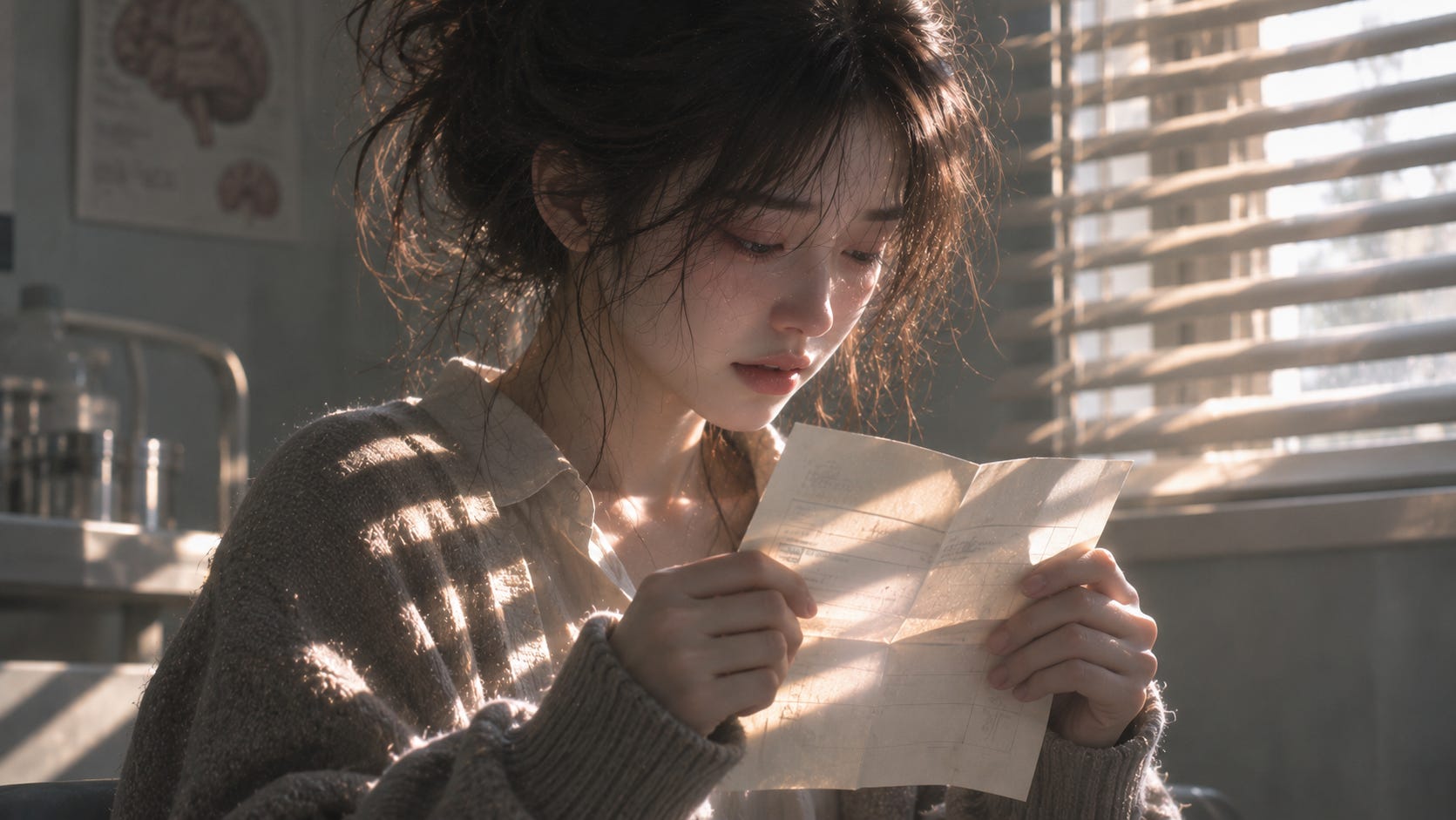
I broke down sobbing in the doctor’s office—not from fear, but from a relief so strange it bordered on absurdity.
I was fourteen, in the thick of summer.
Fierce sunlight slipped through the blinds, shattering into shimmering prisms across the thin sheet of paper bearing my diagnosis.
The doctor gently took my hand.
“What you’re experiencing is consistent with bipolar disorder.”
The black type lay motionless on the page. My gaze stayed nailed there, grinding over the same words again and again—
Bipolar disorder.
My breath narrowed to a thread. My fingertips wouldn’t stop trembling. Before fear could even arrive, the tears broke their banks.
My parents stood beside me, thinking I couldn’t bear the weight of the verdict. The doctor tried to comfort me, too.
“This condition can be managed.”
But inside, I kept repeating without a sound:
So I really was ill.
All those sudden collapses into sobbing, those feelings that sank without reason—
All those days and nights repeatedly blamed on my being dramatic, fragile, prone to overthinking—
None of it had been a farce I’d deliberately staged.
The hands that had been shaking moments earlier slowly grew still. I folded the paper with care and tucked it safely into my bag, as though preserving a letter that had finally written back after a whole year.
Only long after I’d left the doctor’s office did I taste the bone-deep sorrow beneath those tears—
How many times must a fourteen-year-old girl have been doubted before the sight of a name on a page could finally release her from asking herself:
Was the pain gnawing through me only something I’d imagined?
Even a Glimmer Became Evidence Against Me
Long before that sheet of paper gave my pain the name bipolar disorder, I had grown practiced at living with my own cross-examination.
That night, I ran my fingertips again and again over the words carved into the wall—“You don’t deserve to be loved.” I sobbed until my chest seemed to cave in.
Then a message from a friend lit up my screen. To my own surprise, a glimmer of relief rose in me: somewhere in the world, one person was still thinking of me.
But the glimmer never carried me to shore. Instead, it became another piece of evidence against myself:
If pain had already eaten into my bones, how could there still be enough of me left to smile?
So I kept overturning my own perceptions.
Someone would say, “You’re just overthinking,” and I’d stitch my expression back together by force, pretending everything was normal.
When night flooded the four walls, I’d sit alone, gnawing at the same doubt:
What if I really was crying over pain that wasn’t there?
When someone asked why I, of all people, had to be so fragile, I used the measure of what others could endure to cut into my own soul, as though pain came with a passing grade.
Even when I wanted to tell my parents, “I’m really hurting today,” the words hung on my lips, only for me to choke them back and murmur:
“Actually… it’s nothing.”
Later, I began collecting evidence for my pain: archiving the words I’d written as I fell apart, taking photographs of my eyes swollen from crying.
I was plaintiff, defendant, and judge at once, desperately laying out proof that the previous night’s despair had not been a lie.
I had never wished for an illness. I had only wished for pain that wouldn’t have to stand trial.
When the diagnosis finally settled into my palm, I stopped interrogating myself for being dramatic.
Yet another doubt began to push through the barren earth inside me—
Was every feeling now surging through me something I could trace back to bipolar disorder?
Joy Became a Suspect
It took me a while to understand that no longer doubting my pain was not the same as trusting myself again.
Ten minutes before the film was due to begin, a message from my friend dropped onto my screen:
“Something came up. I can’t make it.”
I stood alone outside the screening room.
Anger had only just flared in my chest when the gavel inside me came down first—
Was I just being too sensitive?
Was this anger nothing more than my bipolar disorder acting up?
Before that perfectly justified anger had even had time to burn, it was dragged into an interrogation room cast from the name of my illness.
After my bipolar diagnosis, this inward torment seeped into every fiber of my days. The cruelest paradox was that even joy came under suspicion.
For hours at a time, my body would feel light, my spirits lifted. I should have been able to hold that long-missed ease.
But vigilance swallowed the happiness first:
Was a manic episode beginning?
So I snuffed out my smile, lowered my voice, and forced the turbulence inside me back into a deathly stillness.
At a gathering, I drifted out of the conversation for a moment. A friend suddenly stiffened and asked in alarm, “Are you having another episode?”
What cut deepest was never the misreading itself.
It was that my feelings had barely begun to grow into a story of their own before they were labeled, filed away, reduced to a cold clinical symptom.
I had also clung to the brief reprieve that answer brought. One small “So that’s why” gave the confusion I’d lived with for so long a source, and let me breathe for a moment.
But once an explanation lay within easy reach, every emotion could be shoved under its name:
Anger, joy, silence, sleeplessness—even the searing sincerity with which I loved someone.
I’d found an answer that helped me read my past.
Yet somewhere along the way, it stepped over what I felt and began defining my present before I could.
If every rise and fall inside me could be given the name bipolar disorder, then once that name was peeled away, what would be left that I could call, without hesitation, “me”?
Ordinary Sadness Had No Standing
After my diagnosis, I encountered a kind of pain more wearing than a mood episode.
It had no name, no place in any register. It was the ordinary sadness anyone might have known.
At work that day, an idea I’d polished over and over was cut in two by an offhand dismissal. I sank into sadness alone.
At first, I wanted it to surge like the waves I knew, to take its place in the register of symptoms.
Yet this time, I couldn’t find a single sign that fit the diagnosis without leaving a seam.
It was simply sadness. Bare, nameless sadness.
Then a cold question rose inside me:
If this wasn’t an episode, was I even allowed to hurt this much?
I searched stubbornly for a medical footnote to this feeling.
I leafed through the case files of my emotions, checking them line by line against the symptoms of bipolar disorder. At an appointment, I asked my doctor:
“I cry easily. I’m sensitive. I depend on other people so much… Could these things be related to bipolar disorder, too?”
The doctor only replied:
“Not necessarily.”
I should have felt relieved. Instead, a hollow space seemed to cave in beneath my ribs, and I suddenly understood what I’d been asking for—
I wasn’t looking for a cause. I was looking for proof that my pain had permission to exist.
The name of my illness hung heavy as a shackle, yet it had shouldered so much of my shame.
If the illness was to blame, at least my hurt had a reason.
If it wasn’t, was every fragile part of me simply a defect I’d been born with?
The paper that had once testified that my suffering was real had quietly changed its role.
Once, it had said, You were hurt.
Now, I was asking it to say, You may hurt.
I’d thought I’d escaped the judgment in other people’s eyes. In the end, I’d only handed the power to decide to a word with greater authority.
What frightened me most was that one day I would have to stand again in that courtroom without a witness.
If this sadness could find no shelter under any medical name—
could it still stand, simply because I really had been hurt?
The Creases Remembered Fourteen
The instant my fingertips touched the paper, the dark weight of fourteen came crashing back into my palm.
I came upon the sheet bearing my diagnosis again while sorting through a drawer.
Its creases had faded to ashen white. Suddenly, I fell back into that blazing summer—the blinds sifting sunlight into shimmering prisms, and those hands that couldn’t stop trembling.
A long, sour ache spread through me.
I had never torn it up. Nor could I deny that those words had been carved deep into my life.
At last, I understood: the paper had been a cruel, contradictory gift.
The gift had never been bipolar disorder, nor the finality of a name settled into ink.
It was that afternoon: through a single thin page, the world acknowledged for the first time that my pain had not been imagined.
The diagnosis had been a visitor arriving late.
Before the doctor ever put pen to paper, countless nights had already come and wrung every tear from me. Before the illness had a name, the loss of control, the falling, the bewilderment, and the searing pain had already pierced my flesh, inch by inch.
It had only given suffering a name. It had never brought the suffering into being.
It could serve as testimony. It was never meant to decide whether I was allowed to hurt.
Even now, I still watch for symptoms. I still need medical help.
I’m only trying to reverse the order I once lived by. First, I let myself admit:
I really am hurting right now.
Whatever name belongs to that pain can be found later.
I followed the creases left by my fourteen-year-old hands, carefully folded the paper, and tucked it deep into the drawer.
It was still that strange gift in my life. Only now did I understand:
It had borne witness for me, but it had never been what gave me permission to feel pain.
The paper lay motionless in the drawer.
It was no longer my only witness.
🌙 At fourteen, I kept a sheet of paper as though it could hold all the tears I’d been asked to explain.
Why did my bipolar diagnosis validate my pain, yet make me question my ordinary feelings?
The diagnosis gave a name to suffering I’d learned to doubt. It brought real relief, and a way to understand what I’d been through. But slowly, I began asking every feeling for the same kind of proof.
Anger had to be explained. Joy had to be checked. Even ordinary sadness seemed to need a place on a list of symptoms before I could admit it hurt.
The diagnosis came late to my pain. The pain had never needed its permission to exist.
I still keep that paper. I still take my symptoms seriously. I’m only learning to admit that something hurts before I know what to call it.
Have you ever felt you needed an explanation before you were allowed to be hurt?
If a feeling came to mind while you were reading, you can leave it here. You don’t have to prove that it mattered.