

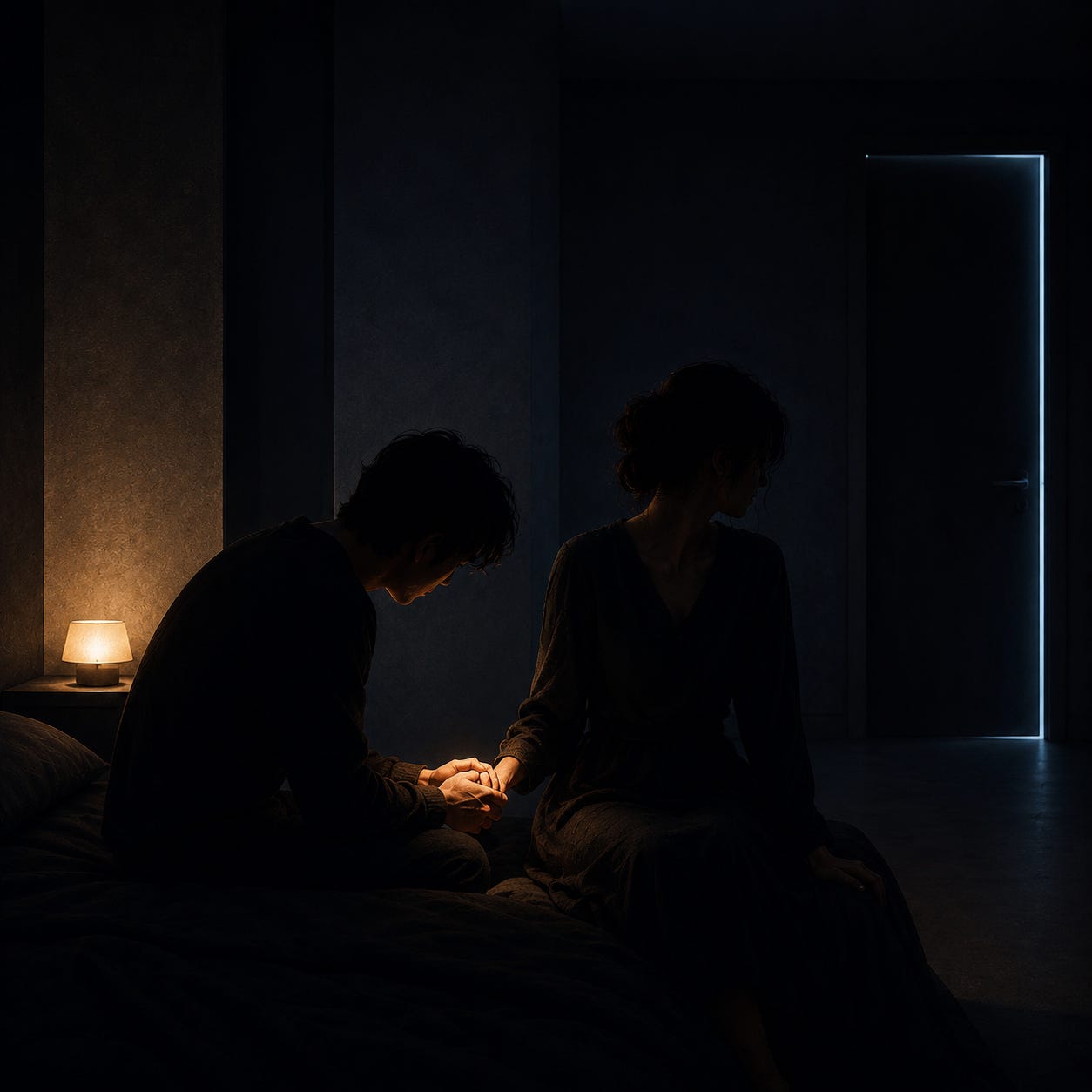
“I’m sorry.”
The words rang out suddenly, like an emergency brake in the dark, cutting off the grievance that had been surging inside me.
He held my hand. His knuckles were cool and faintly red. Weariness and guilt had gathered in his eyes, the tears almost falling.
But the ache behind my own eyes flowed backward instead. In front of that expression, even crying felt like an accusation.
The night pulled everything around us into mute. Only the lamp filament kept hissing, burning the hurt I had not finished speaking into a dead spark.
I swallowed the question that had already reached my lips and softened my voice:
“It’s okay. I was wrong too.”
That sentence was a step I gave him. It was also the door I closed with my own hands.
The door fell shut inside me with a heavy latch.
All the grievances I had wanted to say but never said were sealed behind it:
What hurt me today, you never heard.
The moment you started reasoning with me, I only wanted to be held.
He did not press me to forgive him. But the sincerity itself had already left me nowhere to keep being hurt.
That “I’m sorry” was like a period written too quickly, cutting off the feelings I had not yet finished.
I was not ready for the ending.
But it had already pressed stop for me.
My Hurt Had Nowhere to Get Off
I was squeezed against the subway car door, a sharp pain shooting from my fingertips through my whole body.
“Sorry, miss.”
A little boy looked up timidly.
I instinctively pulled out a polite smile:
“It’s okay.”
The grievance I had forced myself to swallow last night broke its banks all at once.
The car was packed beyond breathing. The arrival announcement echoed again and again. The crowd surged forward, but I alone stood there as if someone had pressed mute, unable to move even half a step.
My knuckles ached from the pressure of the crowd. The warmth left from his hand last night suddenly rose from deep under my skin.
His sincere apology had settled his peace of mind, but it had never smoothed my wound.
My sadness had only stepped offstage for a while, displaced and wandering, hiding inside this early morning train.
Two voices kept tearing at each other inside me:
He already apologized.
Stop being so dramatic.
But I still hurt.
This pain cannot just disappear into thin air.
In the end, I pressed my phone dark and let the bitterness inside my chest be squeezed by the crowd until it broke apart.
The wheels slowed. Pale light swayed across the train window. The crowd rushed toward the exit, but I stayed by the door, unable to move.
It turned out that an apology had only taken the weight off him. It had not found a place for my pain.
My sadness had not reached its stop because of his apology.
It had only been squeezed into the crowd,
with nowhere to get off
and nowhere to sit.
The Judge Inside Me Was Already Seated
“He already apologized. What more do you want?”
The question stabbed into my mind. I deleted the words from the chat box:
I’m still hurt.
The cursor dimmed.
A gavel fell.
My grievance was denied in court on the spot.
The cold white light of the bathroom split open my disarray. I wiped away my tears numbly, as if wiping away a stain that had no right to be seen.
More voices followed:
Is this really worth hurting over again and again?
You were always too sensitive.
A dull pain had already been surging inside my chest, but the surface of my body remained perfectly intact. I could not find even the smallest scratch to prove the wound was there.
In the trash folder of my notes app sat all the pain I had pinched out with my own hands: the screenshots of being blocked, the voice messages I never sent, the feelings deleted until only punctuation remained.
It turned out that I had long ago become my own judge. Sadness had to prepare its testimony.
Without evidence,
even staying hurt felt like wrongdoing.
In the mirror, my lashes trembled, but I was forced to keep silent, living inside a wordless torment.
The weak sentence—I’m really hurting—had only just risen to my chest before I pressed it back down myself.
It turned out that the first one to judge me was not his apology. It was the judge inside my body who had taken her seat much earlier.
Every time sadness arrived, I forced the wound to count its reasons, to list its scars, before I would grant it one inch of room.
But this time, the pain was clearly present,
and still,
it could not produce testimony convincing enough for me.
The judge inside me lifted her eyes again and asked coldly:
Do you really
have the right
to stay hurt?
My Pain Could Only Survive on His Mistakes
One sentence—
“You forgot my birthday.”
He went silent, and I cried until the tears would not stop.
One late apology—his eyes red as he admitted he was wrong—and all I had left was a powerless “Never mind.”
Late at night, I stared at the ceiling as two frames crashed into each other.
If he did not apologize, the wound had a trail to follow.
Once he apologized, all the evidence was cleared.
My emotions had always clung to his behavior.
When he left me on read, I saved the screenshot to prove the grievance of being neglected. I replayed the recordings of our arguments again and again, as if every rise and fall in his voice could become another scar.
But once the sentence “I was wrong” fell, all that evidence seemed to be taken away at once. The pain in my chest lost its support instantly.
The most painful thing was never only the hurt he had caused. It was the moment of sudden clarity:
my pain
had to live on his mistakes
in order to survive.
Without something outside me to confirm it, even admitting I’m still hurt made me feel guilty.
The whole room was quiet as a courtroom in recess. My fingertips rubbed over the screenshots I had deleted and saved again.
It turned out that what I had been waiting for was never an explanation. I had been waiting for him to confirm my grievance with his own hands.
Far heavier than “I’m sorry” was this unsolvable grief:
my pain
had never been able
to stand on its own.
It had to stay pressed
against what he had done wrong
before it dared
to have a name
inside my body.
No New Evidence in the Rain
Cold rain struck the car window like blades. That “I’m sorry” was still circling in my ears, refusing to fade.
The back seat sank into shadow. I unlocked my phone, and the screen lit up only one lonely face.
I hugged my knees tightly, trying to trap the emotions surging inside me. But my palms were empty. I could not find even a shred of testimony.
The strict judge inside me was ready to rise. Then another voice, faint but gentle, sounded from somewhere deeper:
You’re allowed to be hurt. You don’t have to find a reason. This feeling is real on its own.
The voice was like a thin light slipping through a seam in the rain. It landed first on the back of my hand, then slowly seeped into my chest.
I turned off the screen and let the tears fall quietly. For the first time, I tried to accept this fragility without forcing it back into hiding.
The ache in my chest was still there, but the tightness in my heart began to loosen little by little. Even the sound of rain slowly moved farther away.
Up front, the driver gave a lazy yawn. A passing streak of light slipped through the rearview mirror, hiding this small acceptance inside the night.
I knew the wound had not healed. But I finally understood:
pain did not have to cling
to his mistakes
in order to be real.
Tonight, let this sadness without evidence rest in the rain.
I stayed quietly beside it, waiting for daylight to break. And when morning came, I would slowly bring the self who had never been allowed to hurt back into life.
🌙 Why can a sincere apology make your hurt feel harder to defend?
It is not always because the apology was too small. Sometimes it is because “I’m sorry” closes the case before your pain has finished testifying. The weight lifts from the person who hurt you — but your sadness still has nowhere to get off.
And the first one to rule against you was never them. A judge inside you took her seat long before the apology arrived:
You look for evidence.
You count the reasons.
You ask your wound to prove it still has the right to be real.
But what you were waiting for was never an explanation. It was for someone to confirm the grievance with their own hands.
Have you ever known an apology was sincere, and still needed more time to hurt?
If this felt familiar, you can leave it here quietly.
I read every comment.