

“Whatever you want.”
Those three words were the gentlest betrayal I ever committed against myself.
That day in the café, I said them so lightly they almost sounded like breath.
He unfolded the map at once, as if he had been waiting for that small surrender.
“We wake up at three, leave at four, just in time to catch the sunrise at six.”
Every number was a nail, driven into the soft beach I had been imagining.
I had been turning to another page of the magazine. The coastline curved gently across the paper. Shell marks left by the tide looked like scattered kisses.
But his precise itinerary flared in his eyes like a bonfire, burning the sentence I had not dared to say into ash:
Actually, I just wanted to see the sea.
Three seconds.
The café music shifted into a louder chorus.
My chest became an empty echo chamber.
The sound of the map turning.
The spoon touching the side of the cup.
Everything was announcing the same thing:
I was quietly fading out of my own story.
When we pushed open the glass door, cold wind poured down the back of my neck.
The streetlamp clicked on.
My shadow paused for a second in the shop window.
It saw the girl who had once skipped class for two days just to see the sea—
and the woman now standing there with “I don’t want to go” rusting in her throat.
He turned to me.
“It’s getting windy. Do you want an extra jacket?”
I barely hesitated.
“Sure.”
Just then, the wind lifted the poster on the wall nearby, a sudden rush of sound—
hollow, like my own heartbeat.
The Luminous Cage
“Being with you is so easy.”
When he said this, I was in the middle of giving up the art film I had wanted to watch that night.
The cursor rested on the poster of a horror movie.
He turned to me.
“This one looks exciting.”
I swallowed the sentence stuck in my throat—
I’m scared.
Then I nodded.
So this was what being considerate felt like:
a pain that could still breathe.
Every time he said, “My friends asked me out,” the don’t go in my chest muted itself automatically.
“It’s fine. Go.”
That sentence was like a pre-recorded program. Whenever he needed it, I played it.
He hugged me and called me thoughtful, his clothes still carrying the fresh cold from outside.
In that coldness, I learned that loving someone meant turning myself onto mute.
It was not that I did not know how to refuse.
It was that, inside intimacy, I had mistaken saying no for the beginning of losing love.
Being good was also a glowing prison uniform.
It lit up the ease in his brow,
and lit the gentle shackles around my neck.
Every “it’s okay” was like using an eraser on the outline of myself—
until I was smooth enough to cast no reflection, but perfectly shaped to fill every gap in his life.
But late at night, scrolling through our chat history, I suddenly froze.
The cursor blinked in the input box.
And I could not piece together one complete sentence that began with:
I want.
I stood in front of the mirror, practicing how to frown,
practicing how to say,
“I don’t like this.”
But muscle memory lifted the corners of my mouth before my will could arrive.
If love had to use my silence to raise the floor of his freedom,
then when he said, “I love you,”
who was he actually speaking to?
To this shadow that never said “it hurts,”
or to the real me,
already lost somewhere inside the habit of pleasing?
Knew You’d Say Yes
Later, I learned that this state had a name:
a person gradually losing the ability to refuse inside love.
Late one night, he sent me a voice message.
“Let’s go camping tomorrow.”
Wind howled through the recording, like fate’s own narration arriving early.
“I’m a little tired—”
I only said half of the sentence before swallowing it back down.
What came out in the end were still the same two words:
“Sure.”
He laughed on the other end.
“I knew you’d say yes.”
But on my end, I heard the sound of myself cracking.
In that moment, I suddenly understood:
I had never been afraid of refusal itself.
I was afraid of the version of me that would be looked at again after refusing.
Would she seem less considerate?
Would she be removed from the list of people still worthy of love?
So before refusal could rise into my throat, I deleted myself first.
Cut off the tiredness.
Erased the boundary.
Sealed away every real feeling.
Even if my body had been hollowed out, I would still walk with you.
Even if my soul was raining, I would still smile beside you—
as long as you were still willing to stay near me.
What I had placed on the table was not one trip.
It was every chip I had left in this relationship.
So I chose silence again and again, not because I had no voice,
but because I had heard too many echoes of disappearance:
those who once said no
eventually became blurred figures in someone else’s story.
Now I could walk with you down any difficult road,
but I did not dare to say,
“I want to turn back.”
My greatest fear was never being wronged.
It was waking up one day and realizing
I had trained myself too well—
so well that he no longer needed to ask,
“Do you want to go?”
He already knew.
I would always say,
“Sure.”
An Infinite Number of Five-Second Silences
Yesterday, he asked what kind of cake I wanted for my birthday.
For five whole seconds, my mind went blank.
Not because I had no answer.
But because every answer I found had someone else’s name written on it:
“This one would look good in photos.”
“That flavor is the one everyone likes.”
In the end, I said,
“Choose the one you like.”
He smiled.
I smiled too.
But the smile felt like borrowed clothing—
there was always one corner that did not quite fit.
“I’m fine with anything. It mainly depends on you.”
Say that sentence enough times, and it grows a callus on the tongue.
Breathing air that others decide.
Living inside an outline someone else draws.
At three in the morning, my pulse was still beating at my wrist.
I asked the dark:
Where did I leave the girl whose eyes once lit up over a strawberry cake,
the girl who had practiced herself into refusal muteness inside love?
The silence did not answer.
Only the refrigerator hummed,
as if making the last cry for help on my behalf.
It turned out that losing yourself does not require anything dramatic.
All it takes is countless five-second blanks,
and choosing, again and again,
to become the reflection someone else was waiting for.
The Shadow That Said “Whatever You Want”
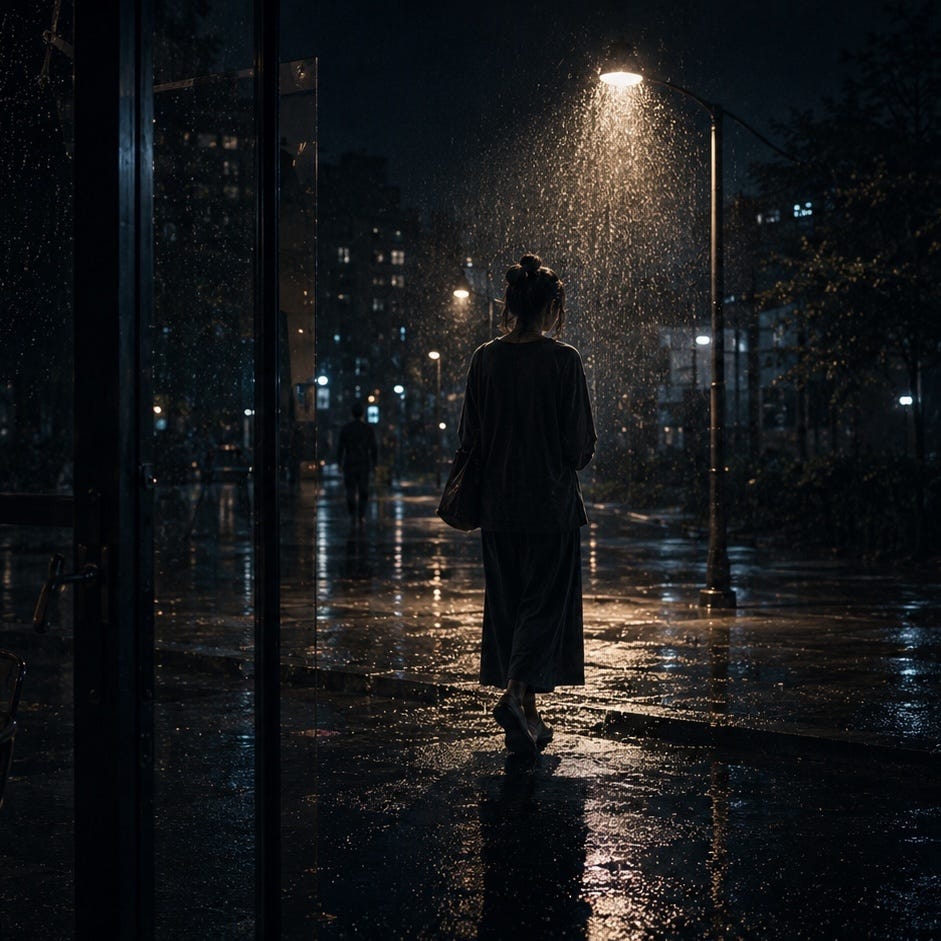
I stopped under the streetlamp.
The sky had just gone completely dark.
Light poured straight down, and the world was reduced to me and my shadow—
empty enough to feel fair.
It was cold.
I lowered my head and rubbed my hands together.
Then I suddenly froze.
All the way here, I had been busy warming the room for someone else.
The no’s I had swallowed,
the tears I had wrapped away,
the grievances I had folded into neat squares—
none of it had evaporated.
It had only turned to frost inside me.
If love requires me to keep turning down my own volume in order to stay,
then who had actually been heard?
The shadow that always said “whatever you want,”
or the me whose crying had gotten stuck in her throat?
In intimacy, being afraid to say no is often not because the other person is overpowering.
It is because I have mistaken being needed
for the only way to be loved.
The wind suddenly changed direction and lifted the hem of my coat.
The streetlamp remained silent.
But for the first time, it let my shadow fall whole onto the ground,
attached to no one else’s direction.
Breath moved through the cracks,
awkward,
real.
This time,
it belonged only to me.
🌙 What happens when “whatever you want” becomes the safest way to stay loved?
Self-silencing in love rarely begins with one dramatic disappearance. It begins in five-second pauses: the movie you do not choose, the trip you do not refuse, the cake you let someone else pick. Each small surrender teaches your own desire to arrive later, quieter, until staying easy starts to cost you the sound of yourself.
Have you ever said “whatever you want” so many times that you forgot what you wanted?
Not because you had no desire.
But because being easy to love started to feel safer than being fully heard.
If this felt familiar, you can leave it here quietly.
I read every comment.
If you have ever edited yourself before speaking, these essays may feel close: