

Under the blunt heat of noon, I sat in the car and suddenly went blank.
After walking out of the therapist’s office, the city kept sliding past the window, hurried and bright. Only my heartbeat seemed to stay behind, stiff and unable to move.
On the way home, delivery calls came one after another.
The pizza I usually avoided for being too heavy was ordered with extra cheese this time — openly, without the usual performance of restraint.
I closed the door and switched my phone to silent.
For a little while, I finally dared to disappear from everyone’s gaze.
I opened an old comedy without thinking. The jokes were outdated, but they filled the gray noise in my head just enough.
By the third slice, I had already taken a photo of the pink roses I used to dismiss as extravagant and useless.
I said to myself, very softly:
These past few days have already been hard enough. Don’t make today harder too.
That whisper landed like a soft bandage, pressing down the instinct to bind myself tighter.
On ordinary days, every sweet thing, every loose afternoon, every small romance and private preference had been postponed, overruled, delayed again.
My life had been reduced to gritting my teeth and enduring.
I did not qualify for even the smallest allowance of tenderness.
But now, after just making it through the aftershocks of a bipolar episode, food, flowers, solitude, and rest had all become reasonable forms of comfort.
I bit into the melted cheese, and a strange thought moved through me:
the things I usually sentenced as wasteful had to wait until pain had signed off on them —
before they could finally, legitimately, be mine.
Not Tired Enough Yet
When the invitation popped up, I was staring at the screen with sore, aching eyes after a night without sleep.
All I wanted was to curl into a corner and disappear from the world.
But the gavel inside me came down at once:
Everyone else can keep going. What makes you think you get to escape? It is not as if bipolar disorder has stopped your body completely yet.
Once the verdict landed, I pressed down that small fantasy.
My fingers kept moving across the keyboard. The cursor was never allowed to pause for even half a step.
By dusk, a lavender sleep mask appeared on the page.
My fingertip had barely touched that soft consolation before I selected everything and deleted it.
Even the right to loosen felt like a luxury too far away to reach.
My neck and shoulders held a stiffness that would not dissolve. Somewhere in my mind, a quiet comparison began.
When a friend is exhausted, I tell her to lay the weight down. I tell her to be gentle with her body.
But for myself, I set a colder scale.
Fatigue had to be verified one piece at a time. Pain had to be sorted into levels. Unless I had crossed the line into collapse, rest would always be overruled.
All night, I moved through people with a proper smile on my face.
Inside, something was being ground down again and again, hot with friction.
I wanted so badly to admit that I could not keep going anymore.
But by the time the words reached my mouth, all that was left was one obedient sentence:
“I’m okay. Let’s keep the plan.”
And just like that, every small cry for help was stamped and sent back.
I could make room for other people’s fragility so easily.
Only with myself did I become severe.
I had to weigh my exhaustion until it qualified
before I would grant myself
even one stingy moment of rest.
She Was Grading Her Own Pain
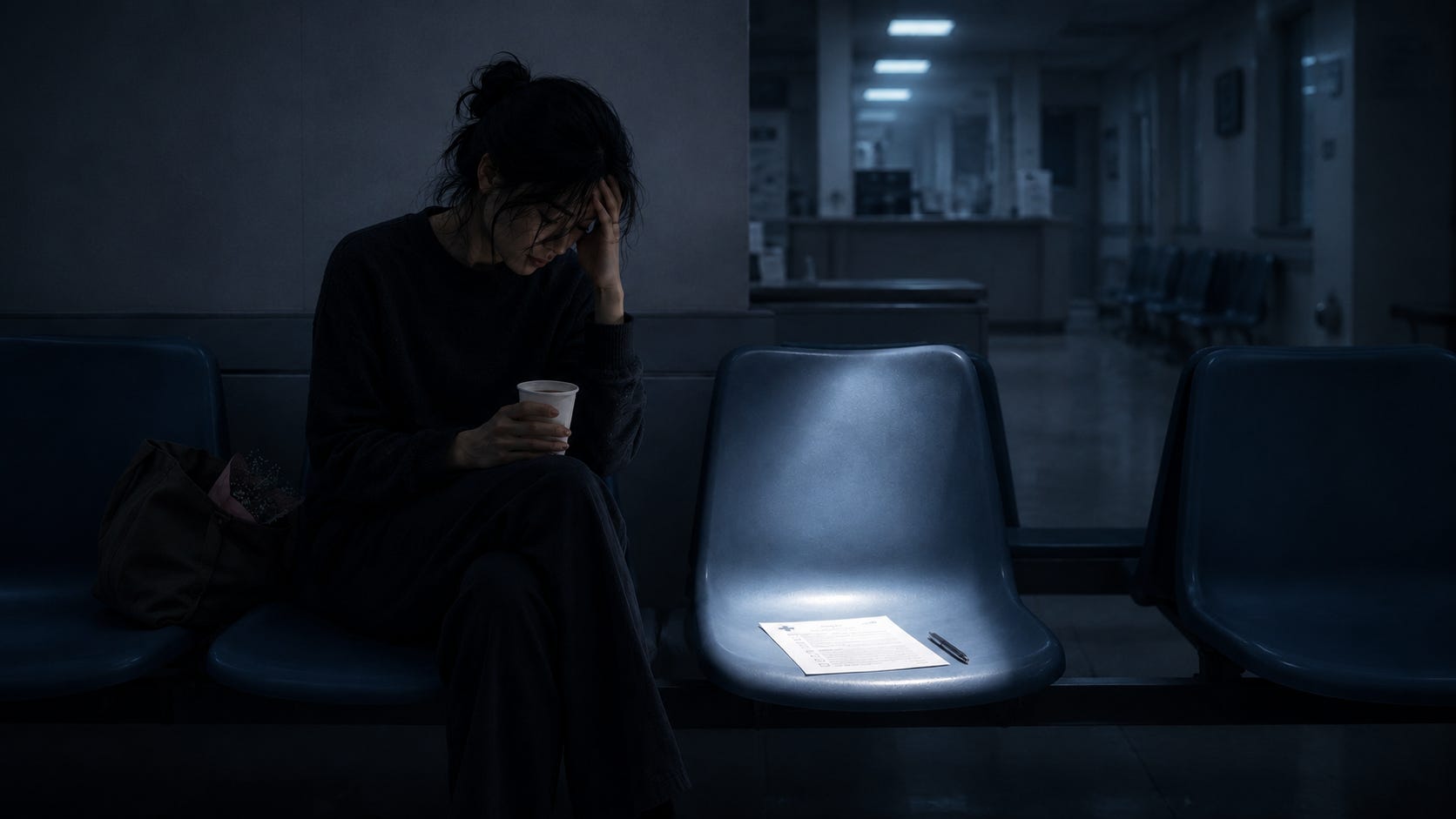
The white light in the waiting room was like an interrogation I could not escape.
My migraine kept chiseling at my skull, one blow after another, while I graded the pain inside my mind with a numb precision:
Had it reached ninety-five percent yet?
As if only pain too obvious to deny could print me a sick note.
It had always been like this.
My body had to sink until I could no longer leave the house before I dared to contact a friend, timidly.
My fingers would tremble over the keyboard, and even then, I would attach an apology to the end of every sentence, terrified of becoming even the smallest burden.
It was as if only when life had fully shut down, when every social connection had been cut off, when a doctor’s note ordered rest in black and white,
the fragile wish inside me
could finally be granted a legitimate identity.
With the people around me, I was always the softhearted witness.
When they showed exhaustion, I offered comfort. I allowed every loosening without suspicion.
But when it came to myself, even the word rest became something counterfeit, something that had to be checked again and again.
Living under the label of bipolar disorder, I pushed myself to stay even more tightly wound,
as if weakness, once shown, would count as a kind of dereliction.
Until today, sunk into that cold plastic chair, watching the call-number screen flicker, a hoarse voice inside me finally woke up:
I had been waiting for a diagnosis on paper
to prove that I deserved to be cared for.
So this was it.
It was not that I did not know how to care for myself.
I had only learned to wait for pain
to write the permission slip first.
All the thoughts that wanted to stop had been waiting in line inside me all along.
But for so long, without enough pain as proof,
I refused to let any of them through.
She Misread Recovery
The moment the elevator doors closed, the migraine was still pulsing faintly at my temples.
I had only just come through that sharp wave of discomfort, but my fingers had already opened the Notes app by instinct, picking up every unfinished task one by one.
The second my body caught a little breath, I hurried back onto the track of constant giving, rushing to certify that I was still “fine.”
I used to mistake this kind of forcing myself for discipline.
As I bent down to change my shoes, the image of myself in the waiting room suddenly struck me again: curled into my own body, holding a paper cup tightly, while some secret wish quietly rose inside me —
Finally.
I can stop now.
So this was the truth.
Only when I had completely lost the ability to keep giving did I dare to ache on my own behalf.
I had stubbornly believed that if I was still functioning, I should keep running.
As long as I had even one thread of strength left to move outward, rest was still an extravagance I had not earned.
At last, I saw the deepest clause inside me clearly:
If I was functioning, I had to carry everything alone.
Only when my body and mind were overdrawn
could I trade them in
for a brief piece of sleep.
It was never bipolar disorder pushing me forward.
No one was standing over me, forbidding me to stop.
It was me who had misread the meaning of recovery from bipolar disorder.
I thought that the moment I felt even slightly better, I had to immediately return to being useful in other people’s eyes,
boiling my living soul down
into a container
that only knew how to pour itself outward.
The hallway light spread in a thin, pale halo.
Inside that quiet blur of light and shadow, I saw the bar I had set far too high lower itself — by one centimeter.
The movement was faint.
Only I knew it had happened.
She Wanted Something Sweet
Before daylight had broken through, the vibration of my phone had already startled the morning open.
My newly awakened mind was heavy and dull. A hollow chill sat inside my chest. All I wanted was one moment of complete quiet.
On ordinary days, I would open my to-do list first thing, silently weighing the load of the day.
My fingertip hovered above the list.
Then I froze.
The headache was no longer hammering at me. My emotions were calm and steady.
There was no medical record to prove my exhaustion.
And yet the plainest thought inside me was only this:
I wanted something sweet.
I turned off every notification and walked into the kitchen.
Clear water entered the cup. Honey opened into amber ripples.
I held the cup on the balcony, letting the warmth move slowly through my body. My tightened breathing loosened, little by little.
The phone was still vibrating stubbornly.
I chose not to look.
Wind moved through the leaves with a soft rustle, and somewhere inside me, a faint but steady voice rose:
Today, I do not have to pay for the right to rest with a body full of pain.
A cup of honey water could not rewrite the long pattern of relapse and return.
It could not remove the weight of life for me.
It only let me settle my tired soul first,
before my body and mind had completely collapsed
and I had to rush back to repair the damage.
I had not suddenly become strong.
I had only spared myself, once, from a severe trial of my own making.
So this was what caring for myself could be.
It did not have to wait
for pain to submit the proof on my behalf.
Before the breaking point arrived,
to admit even a little tiredness
was also a way
of carrying myself back.
🌙 Why do some of us only allow rest after we have suffered enough?
Because rest can start to feel like a permission system. Pain has to sign the slip first. You grade the migraine, wait for the doctor’s note, put exhaustion on trial — and only when the body nearly collapses does stopping begin to feel legitimate.
Rest was never supposed to be compensation — something pain approves and suffering pays for.
Sometimes caring for yourself begins before the evidence is complete: a phone left unanswered, a cup of honey water, one small sweetness you did not make your pain pay for.
Have you ever waited until you were almost falling apart before you let yourself stop?
If this felt familiar, you can leave it here quietly.
I read every comment.