

At 3:11 a.m., the second wave came down like a boulder.
I was curled on the carpet, shaking, my teeth clicking in small, brittle sounds.
She lowered herself beside me, took my frozen hand in hers, and counted each breath for me.
When dawn finally cut into the dark like a blunt knife, she suddenly drew in a sharp breath.
“Oh no... my promotion review is at eight.”
My whole body went rigid.
That review was the step she had worked two hundred late nights to reach, paying for it in coffee and youth.
She splashed water onto her face in the bathroom. Makeup and meeting papers tangled together inside her canvas tote.
I tried to help her pack, but my legs had gone soft as cotton.
Wiping the water from her face, she forced a smile.
“Don’t worry. I can outrun time.”
When the elevator arrived, its stainless-steel doors gave us back the truth.
The shadows beneath her eyes looked like a garden battered by a storm.
Something in my chest was suddenly dragged into an abyss.
Every predawn hour she had spent beside me was being paid for later — in frantic mornings, the flushed face of arriving late, and points taken from her performance review.
I had thought I was only a private blizzard.
Then I understood:
my bipolar episodes were pulling her life into my time zone too.
Guilt burned through my chest like sulfuric acid. Every cell inside me screamed:
Look what you took from her.
I gripped the vibrating phone until it burned in my palm and held my breath, terrified that using up even one more sliver of her light would extinguish the lamp she had kept burning for me.
I Stole 43 Dawns From Her
At 6:47 a.m., she silenced the screaming alarm for the third time.
Her fingertips still carried the dampness of the tears she had wiped from my face before dawn.
At 9:05, the department meeting began.
She hid the swollen shadows beneath her eyes under foundation, but she arrived late, was removed from the morning briefing, and watched her name slip another line down the promotion list.
At 11:17 on Friday night, I fell apart over the phone again.
She turned down karaoke with her coworkers and rushed into my room carrying takeout.
The soup was still hot, but she sat beside me until three in the morning, watching the bowl of noodles harden into cold frost beneath the moonlight.
On Sunday evening, I went to return her umbrella.
Broken light leaked through the gap beneath her door.
She was bent over her laptop, revising a presentation deck beneath a deadline glowing red on the screen.
A message notification kept flashing. Her phone lay on the sofa with the speaker on.
Only then did I realize that part of her was always listening, afraid she might miss even one of my calls for help.
I stood frozen in the hallway, unable to knock.
She used the whole of her daylight to hold me up, and all I ever gave her back was one long night.
Later, I began counting the pieces of her life I believed I had stolen:
43 dawns.
127 alarms silenced too late.
309 cups of coffee gone cold.
The numbers gathered like an avalanche until I could no longer stand beneath their weight.
For the first time, I felt afraid. Inside that suffocating silence, I made myself a promise:
Stay away from her.
Maybe that is the only decent kind of love I can still give her.
I Loved Her. The Fear of Burdening Her Won.
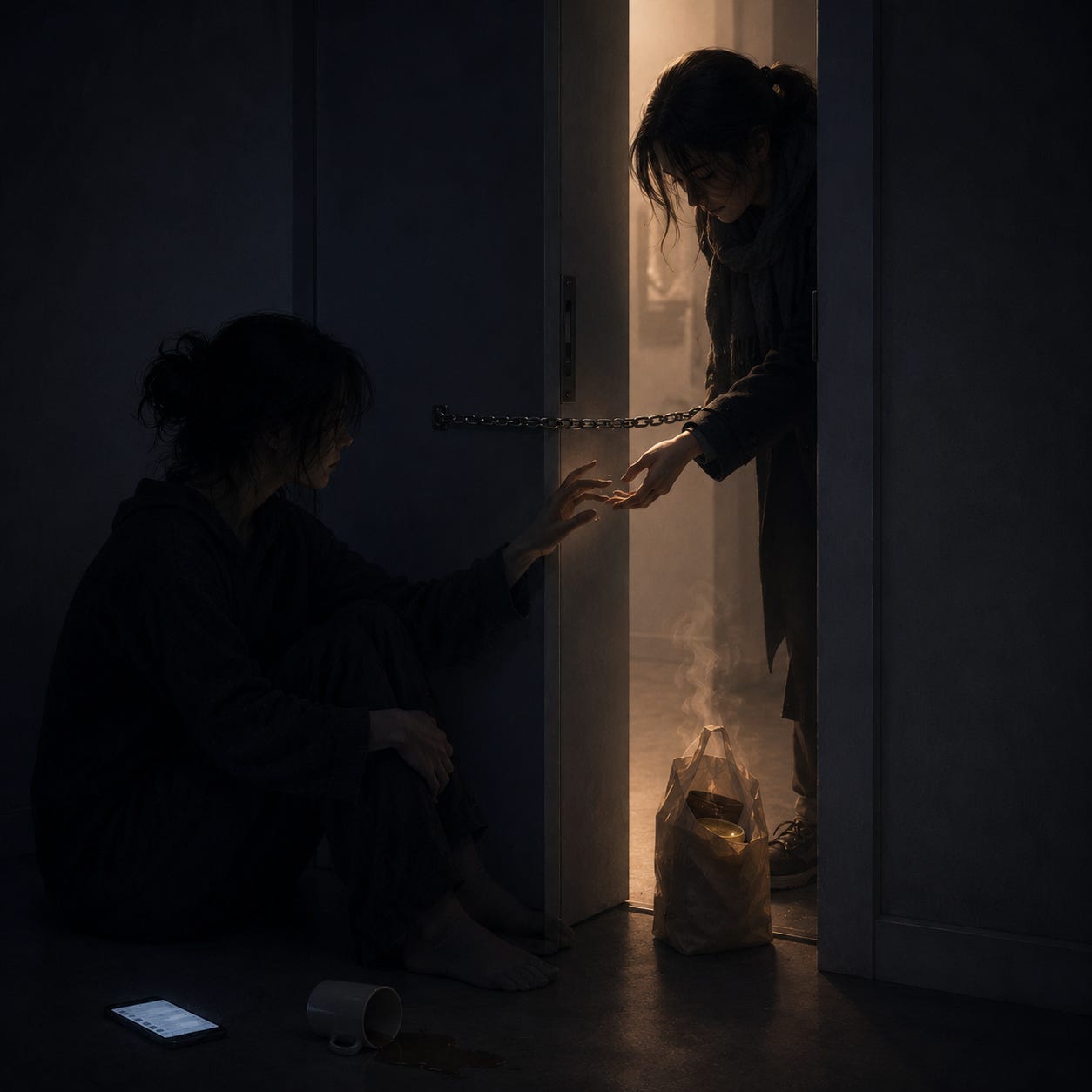
That evening, she stood outside my door holding takeout.
The instant the doorbell rang, I froze as if a spell had pinned me in place, my fists clenched in the dark.
The whole room became a sealed tin. Every second of silence screamed the same thing:
Go away.
Go away.
She did not ring again.
She only rested her forehead lightly against the door, and I heard the small breath of her sigh.
“At least let me know you’re okay.”
My phone screen suddenly lit up.
The message seemed to hold my tear-streaked face in both hands:
“I don’t need you to be strong. I just need you to still be here.”
Blue-white light rippled across the floor.
I almost turned the lock, threw myself into her arms, and let every hurt inside me break into rain.
But my fingers curled against the cold metal.
The part of me that loved her lost to the spell I had repeated until it sounded like mercy:
Don’t become her burden.
Through the peephole, I watched her bend down and leave the takeout by the door. Her orange silhouette slowly blurred as she walked away.
Heavier than the depression itself was the realization that, with my own hands, I was pushing away the only person willing to keep a light on for me.
She had built a bridge out of two hundred nights.
With one sentence — “It’s for your own good” — I broke it back into islands.
Did You Ever Ask What I Wanted?
At two in the morning, two days later, familiar footsteps stopped outside my door.
At first, I thought I was hearing things again — that longing had begun rewriting itself as a dream.
Then came a second sound, even softer, as if she were afraid of startling a heartbeat.
Her voice slipped through the cold air outside the door:
“You keep saying you’re afraid of becoming a burden to me. But did you ever ask what I wanted?”
The sentence gently pulled back every curtain I had been hiding behind.
The island I had built so carefully around myself had become the wall keeping her out.
Her voice continued:
“Darkness was never the worst thing. The worst thing was being shut outside while you convinced yourself you were protecting me.”
A thin line of light slipped through beneath the door. It was both the forgiveness she was offering and the understanding that had reached me too late.
I opened the door.
Her eyes held the reflection of an entire sky of stars.
I did not say “I’m sorry” again. I only reached for her and held her gently.
There, in the night that had not yet fully given way to morning, we shared breath — and with it, the courage to keep living.
I knew then that somewhere in this world, someone was still leaving a light on for me,
and still choosing to leave the door open.
🌙 Why do we leave the people who love us — and call it protection?
Because guilt can disguise itself as kindness. You count every dawn they lost to you, every alarm they silenced too late, every cup of coffee that went cold while they stayed — until the math tells you that leaving is generosity.
So you disappear. You call it sparing them.
But here is what the math never includes: they never got a vote. You decided, alone, that they would be better off — and took away their right to choose you.
The cruelest part is not the distance.
It is that you turned their love into a debt they never asked you to repay.
Have you ever disappeared from someone’s life “for their own good” — without ever asking what they wanted?
If this felt familiar, you can leave it here quietly.
I read every comment.
This one felt like a dance between the selves. I think we are often confronted with the same profound, eerie feeling: that the two selves within us - the lighter one and the darker one - seem separated, unable to find a bridge between them. I have had similar experiences, though with other struggles. Still, I felt your words vibrating deeply.