

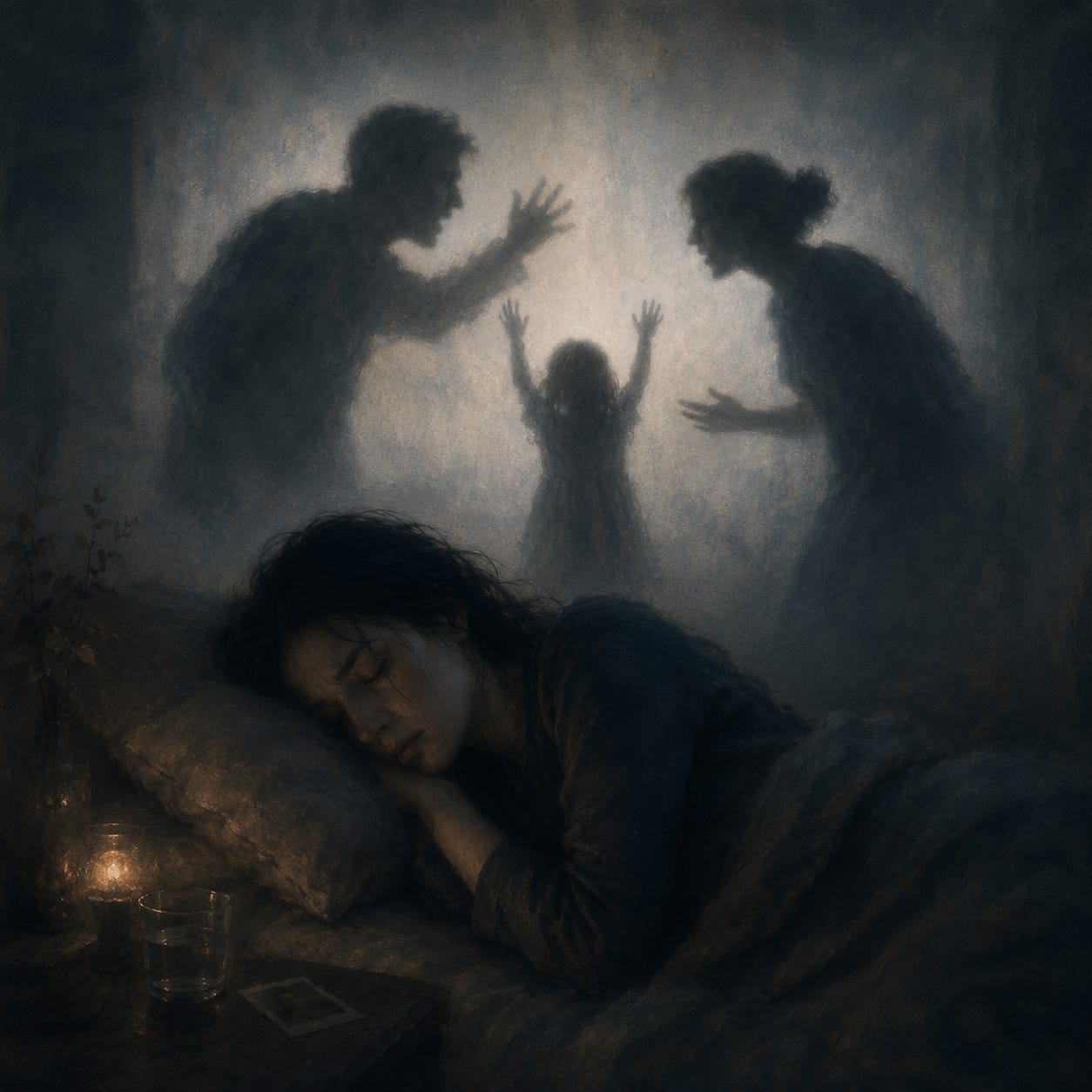
Their fights were a soap opera that never reached its final episode. She was always drafted in as the firefighter.
Her parents were two matches forever striking against each other, while she was treated as the magician who could make the flames disappear.
Late at night, she opened the Notes app on her phone. The dense entries looked like war logs she had bound together with her own hands:
“Dad said Mom is like a cassette stuck on repeat, playing the same complaint eight hundred times.”
“Mom said Dad is a walking ashtray. She wipes the coffee table clean, and a moment later it is covered in ash again.”
“I said: You’re family. Please stop doing this to each other.”
She thought she had signed one ceasefire agreement after another. She never noticed the same footnote printed in bold at the bottom of every page:
The next battle will be worse.
On an evening sweet with acacia blossoms, her mother erupted over the clutter on the dining table. Her father answered, “I’m only leaving it there for a minute,” and lit the fuse.
She smothered both flames. Her reward was her mother’s cold silence the next day, and the family photograph crashing from the wall when her father slammed the door.
Now she stood at the kitchen sink, washing dishes while the rush of water tangled with the sharp clatter of porcelain from the living room. Soap suds climbed over her fingertips.
Suddenly, she understood:
She was not a peace ambassador. In this war without an ending, she was the white flag raised again and again — and never truly seen.
For the first time, she wanted to try being a bad daughter.
She Began to Like the Taste of Coldness
She finally loosened her grip on the reins she had held for more than twenty years.
As her parents’ argument boiled over like water forcing up a kettle lid, she threw her father’s words into the whirlpool, like coarse salt into an open wound:
“Mom, Dad just said your temper is becoming more and more like Grandma’s.”
Silence dropped over the table. She kept peeling shrimp. Beneath the dry scrape of her fingernail against the shell hid a heartbeat loud enough to crack through ice.
The grievances that had lain dormant for years fermented into hard liquor in her veins, burning their way toward a clarity she had never known.
Twenty years, and she was finally no longer the moth that flew into every fire, trying to put it out.
For the next two weeks, she became an invisible director behind the scenes, delivering the most painful lines in the lightest voice.
“Dad, Mom just said you never had any intention of washing the dishes.”
“Mom, Dad says you have never truly tried to understand him.”
She seasoned every retelling with care — sharpening the tone, cutting away every word that might have softened the blow.
As their faces flushed and their voices rose because of something she had said, she tasted control for the first time.
A photograph of Bianbian, her chinchilla, sat on the desk, witnessing this betrayal. But when she woke at midnight, the shadows on the ceiling still frightened her.
She was afraid that without her, the house would collapse even more completely. She was even more afraid that she was beginning to like the coldness.
Then one day, her father stopped in the middle of an argument and stared at her:
“You weren’t like this before. Why are you always trying to start something now?”
She froze. The smile she had built, dinner by dinner, collapsed all at once — like a mirror shattering.
For the first time, she felt like a stranger to herself.
Her Childhood Followed Her Into the Apartment
She finally escaped her childhood home, slipping away before dawn like a thief carrying guilt from the scene.
But she could leave the house. She could not leave the family trauma already moving through her veins.
On the night before the move, she was still an automatic emotional vending machine: insert distress, receive comfort. Her fingers traced the scars on every piece of porcelain — those bowls and plates had witnessed too many nights when she served as the family’s tourniquet.
She thought that once she escaped the living room filled with landmines, she would finally be able to take off the invisible armor. But in the rented apartment, she felt like a toy whose batteries had been removed. Even breathing had become a rhythm she needed to learn again.
At six every evening, her nervous system sounded the alarm on schedule. One day at the supermarket, the cashier asked whether she needed a bag.
She broke down.
Her tears came as if a reservoir holding an entire childhood of shadows had finally burst through its dam.
At night, she dreamed that the arguments back home continued exactly as they always had, like a play carrying on perfectly well without her in the cast.
When she woke, she clutched the photograph of Bianbian like a drowning person clutching at a straw. Her pillow had become a marsh beneath her cheek.
She had once been the only lightning rod in her parents’ emotional storm, standing between them at the dinner table and absorbing the voltage every night.
Only now did she understand: she had not been saving anyone. What she had called love was emotional kidnapping — something she had been trained since childhood to accept.
One morning, sunlight refracted through a drinking glass, splintering into spiderweb cracks.
She stared at the fractured light and suddenly understood: even quiet could hurt. It hurt because, inside that quiet, she could finally see the part of her own soul that had been hollowed out.
Family trauma had been branded into her veins, as permanent as a birthmark.
She had left the house, but carried the entire battlefield with her into exile.
The Wound That Had Been Pretending to Sleep Woke Up
She began collecting the quiet that belonged to her, arranging it with the care of a museum curator handling fragile artifacts. Every uninterrupted evening was a precious object she had rescued from the ruins.
This was the first real peace treaty she had ever signed with herself.
The clock in the rented apartment slowly lost the color of an alarm. Six o’clock was no longer the prelude to gunfire. Eleven was no longer the final hour of another battle.
Now the hands moved according to a rhythm composed for her alone. With every quiet tick, they seemed to ask:
Who do you want to be in this moment?
Sometimes she dreamed of herself at seven — the little witch who stood on tiptoe, trying to smooth the wrinkles from the adults’ brows.
When she woke to a damp pillowcase, she could not tell whether she had been crying for the child still trapped in that hour, or for the woman who had escaped it and still could not find her way through the fog.
The jigsaw of memory lay scattered across the floor. She knelt among the pieces, gathering them one by one. Her fingertips traced the missing edges, the places where a childhood once grew before the arguments gnawed it away.
She did not go back. She did not forgive anyone.
But one evening, as dusk slowly deepened, she found herself wanting to write a letter to the little girl waiting on the other side of time.
Light from the window fell across the page like an apology left unfinished — and like a “thank you” she had not yet learned how to say.
🌙 What is a parentified daughter?
She is often the child praised for being unusually mature, when what she really learned was how to perform emotional work that belonged to adults.
She reads the room before she reads herself. She mediates, absorbs, reassures, and turns other people’s distress into comfort. Long before she knows what she needs, she knows how to keep the family from falling apart.
A parentified daughter becomes a function before she is allowed to be a daughter.
So, is parentification abuse?
Parentification can become deeply harmful when a child is repeatedly made responsible for a parent’s emotional stability or the survival of the family — not once, in an emergency, but repeatedly, as a role.
And because the family depends on that function, her exhaustion can remain invisible — even to herself.
Maybe the hardest part is not leaving the house. It is believing she is still a good daughter when she stops holding it together.
Were you ever praised for being mature when you were really carrying what the adults around you would not?
You can leave it here quietly.
I read every comment.
It hurts to know that children have to manage the atmosphere at home... I love how you captured the pain into words. Thank you for writing this.
This was heartbreaking to read. No child should ever have to become the peacemaker in their own home. Thank you for putting something so painful into words.