

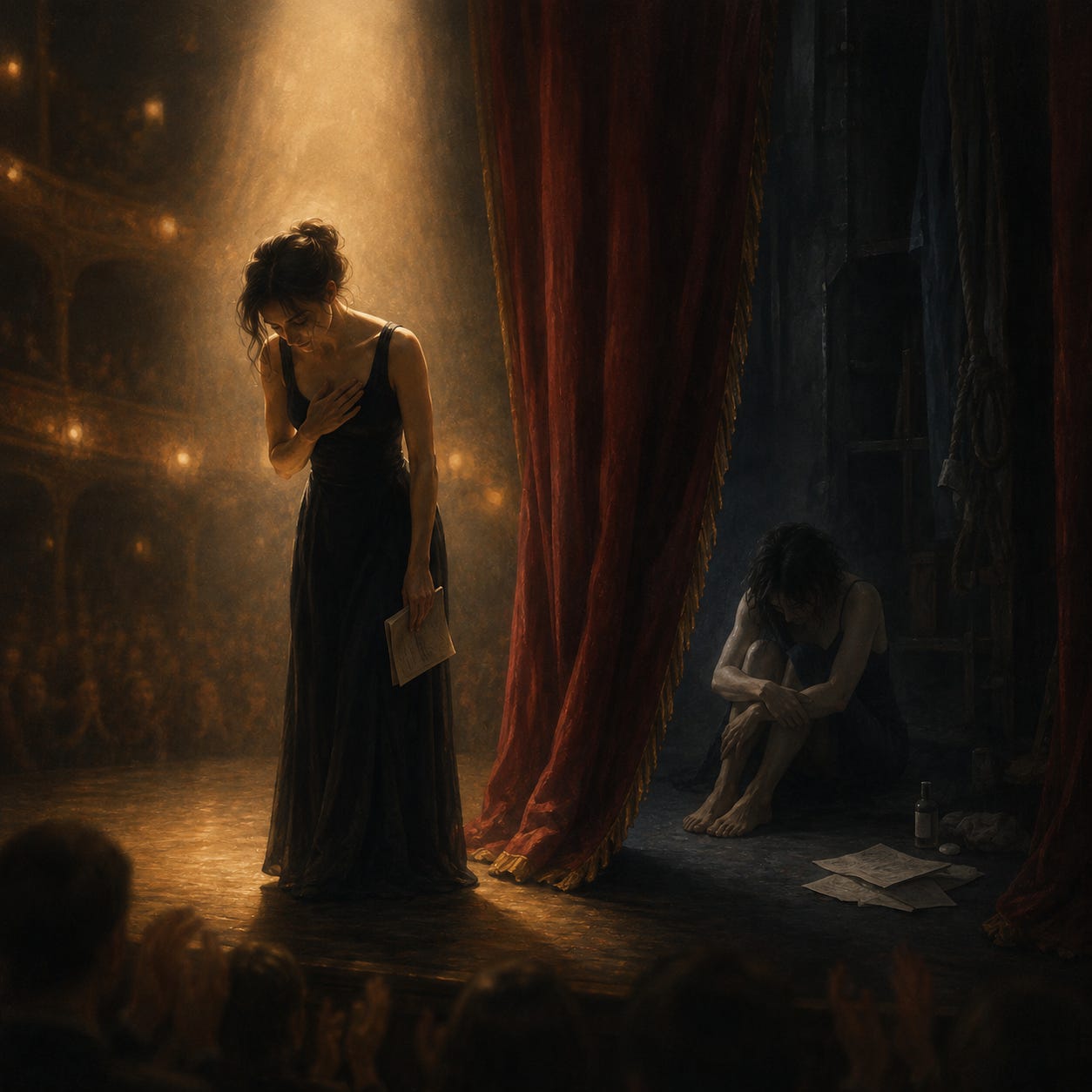
That night, the light was melted amber, and I was the moth flinging itself into the candle flame. The burning halo held every gaze still.
The speakers’ roar resonated between my ribs. Words ran madly after the drumsticks. Every joke fell like overripe fruit, bursting into splashes of honeyed laughter.
I raised my glass, danced, told jokes, tore the silence into streamers.
“You’re really carrying the whole room tonight!”
They laughed and crowded around me, their eyes bright as sugar frosting suspended over the dance floor. But all I could hear was a voice knocking inside my skull:
“Faster. Faster. Don’t stop.”
It wasn’t that I didn’t want to stop. The inertia had already branded itself into my flesh.
My heartbeat dented my eardrums like a trapped animal hurling itself against iron bars. My fingers trembled—not from stage fright, but from excitement pushed into overload, as though I were gripping a microphone leaking current.
Each time the laughter died down, I patched the seam with hotter lines, like a performer dancing on red-hot blades for a full house.
At two in the morning, I held a faded photograph of Bianbian, the chinchilla I had grown up with, and watched patches of light swim across the ceiling like shoals of dying fish. The electric current of exhilaration was still running wild through my veins, while my eyelids had gone light as two withering butterfly wings.
My phone lit up.
“You were center stage all night!”
The words stabbed into my irises.
I wanted to cry, but that current had hijacked my tear ducts and tuned them into trembling strings.
How much it felt like standing at the epicenter of a fireworks blast—everyone lifting their faces to cheer the brilliance, while only I knew what would remain after the applause fell:
a field of embers no one would stay to clear.
The Fake Flower They Called Gentle
She said I had been so calm lately, as if I had finally understood some great truth.
My practiced smile settled neatly at the corner of my mouth. I thought of those seven days—not enlightenment, but a sinking into a silent void.
It was like being trapped in a garden built of glass. Sunlight passed through cleanly, while every climbing rose had withered into a specimen.
That week, I barely left home. Waking felt like being trapped inside an abandoned space capsule, every movement draining what little fuel remained: getting out of bed meant fighting gravity; toothpaste foam looked like waves stranded after the tide had gone out.
Unsent distress signals blinked on and off across my social apps at three in the morning.
“I’m really falling apart.”
I deleted the sentence forty-seven times, just so I wouldn’t disturb anyone else’s happy time zone. The people who thought I was always sunshine would never notice that their sunflower was going through a long-premeditated withering.
Outside the window, the overpass dissolved into watercolor. Neon was an expired painkiller, casting a colored sugar coating across the curtains.
“You do not deserve to be loved.”
The words carved into the wall still looked fresh—a nightmare footnote left there when I was fourteen.
She handed me a tissue and said I had become gentler lately. I smiled and nodded, as though everything were under control.
I didn’t have the courage to tell her that I didn’t even dare claim the right to cry. I was afraid that once the tears came, I would never be able to draw that whole swamp back in.
That day, I came home and sat on the sofa for seven full hours, like a forgotten fake flower.
Silence peeled the color from me, gently, slowly.
Everyone thought I had simply fallen in love with quiet overnight.
The Standard Smile in a Chemical Embrace
She said I seemed brighter all over, like a shop window wiped clean in March—clear and quiet.
I pressed my lips into the curve of a dimple, my tongue pinning down the monologue I had rehearsed thirty-two times the night before.
“I really am much more stable than before.”
Those little white pills ironed my emotions flat, tuned my heartbeat to a single frequency, and locked the storm deep inside a safe. Now my face was the newest exhibit in a wax museum, every curve calibrated to exactly the right degree.
I looked into her pupils as I answered her questions. Each answer flipped itself over like a playing card, landing precisely on her beat.
Then suddenly, sound sank into deep water.
Her lips opened and closed like the silhouette of someone behind frosted bathroom glass. The sweetness of the milky coffee spread exactly three inches over my tongue.
The hand stirring the spoon moved with a drag, like a silent-film gesture always half a beat behind the score.
At the moment she declared me “back among the living,” she did not see the ten minutes I had spent frozen in front of the building’s revolving doors.
My breathing turned into the harsh pull of bellows. Halos of light rotated slowly around me, and I became a shadow-puppet figure paused mid-scene.
“Now this is the real you.”
Her goodbye embrace ironed over my stiffened back.
I lowered my head in a curtain-call bow, quietly hiding my script and the unhealed bruises beneath my foundation.
On the way home, the elevator became a sinking iron coffin. The sofa caught the shell of my body as it fell.
My friends raised their glasses to celebrate “my rebirth.”
But only the moon saw:
this exquisite calm was functional “stability” I had rented by mortgaging one-third of my soul.
They Preferred My Light
“You’ve always been the most optimistic one among us.”
When she wrote that in the group chat, I was in a depressive episode, counting the seams between the floor tiles.
In the cold light of my phone floated the face I had worn during that emotional fever, like a ghost who knew how to do stand-up.
My fingertips were still damp with mist from the mirror when I typed:
“Haha, yeah.”
They loved watching me toss flames back and forth in the group chat, never knowing that after every burst of laughter, another piece of my soul burned down to ash.
They called me the funny one, the backbone of the chat, the person who made everyone feel safe.
But airbags rupture too.
That winter night, my mood sank to the bottom. The social net mania had woven snapped after three days of silence, and a red exclamation mark stabbed into my pupils:
“Do you think you’re too important?”
I tried to explain, only to watch my message bounce back beneath a system notice:
“You are no longer their friend.”
Bianbian’s old photograph lay open on the table. His glossy black eyes seemed to ask:
Why are you trying so hard to shine?
They loved the light in my story, never knowing that every luminous body has a dark side marked by burns. On those nights that longed to be seen, only the moon had ever heard their real crying.
I sent my 1,024th standard smiley face and let the misrecognized version of me keep swelling slowly inside the chat box—
like a colorful balloon that never deflates, light enough to cover the crack just right.
🌙 What does high-functioning bipolar disorder look like?
It can look like laughing, answering messages, showing up, and seeming composed—while concealing overload, depression, or the flatness medication can bring.
Masking bipolar disorder is not always obvious pretending. Sometimes it is simply learning how to keep the acceptable version of yourself onstage.
Functioning is visible. The cost of functioning often isn’t.
Have you ever been praised for seeming “fine” when looking fine was costing you the most?
You can leave it here quietly.
I read every comment.