

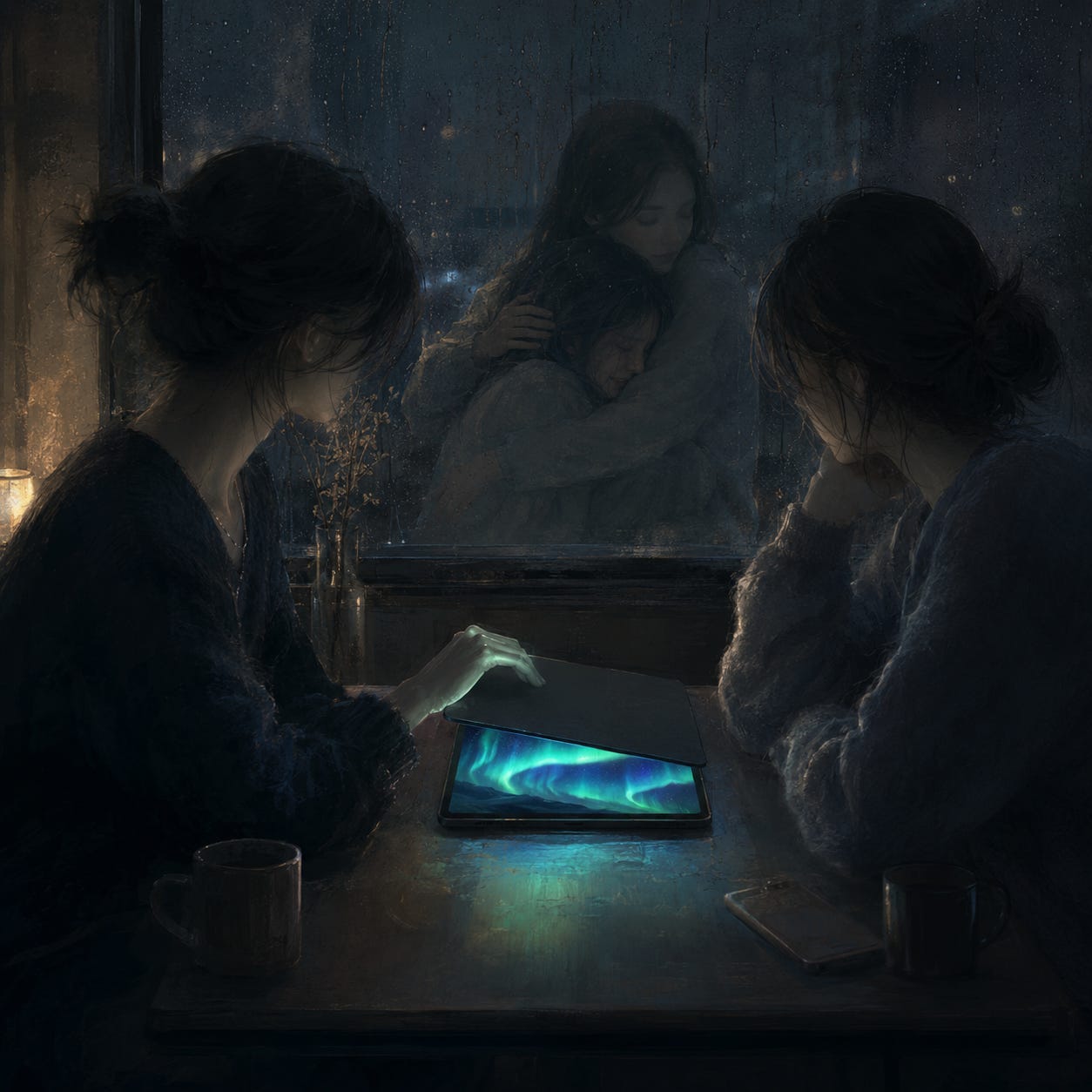
A video of the Northern Lights flickered across my iPad.
I rushed into my best friend’s chat. She had listened to me describe this dream countless times. My fingers poured all their heat into the screen:
“I’m finally going to see the Northern Lights!!!”
Just before I pressed send, my eyes caught her last message:
“I haven’t felt like doing anything lately.”
The cursor blinked like a warning. I deleted every feverish word until only one remained:
“I.”
The unsent half of my longing looked like a beam of light I had cut short with my own hand.
I kept sanding the joy down until I could type something flat enough to feel safe:
“I might go to Iceland at the end of the year. I hear the journey is exhausting.”
I stared at the sentence I had deliberately dimmed for five full minutes, my racing heart cooling one degree at a time.
She replied almost immediately:
“That sounds nice. Hope you have a good trip.”
Her gentle blessing settled on the screen. I had wanted to let the good news spill wildly between us. Instead, I felt relieved that I had hidden the light well enough.
I opened the ticket confirmation page again. My fingertip hovered, then stopped. In the end, I turned the iPad face down, afraid to let the joy show.
This rare happiness was allowed to burn at full brightness for one minute.
For the long hours that followed, I kept calculating how dim I had to make a light that belonged only to me.
We Knew How to Find Each Other in the Dark
The night she fell apart completely was the night we were closest.
At 12:12 a.m., a video call dragged me out of sleep. Onscreen, she was crouched barefoot in a dim hallway, her voice breaking into pieces.
“It’s really over between us.”
I threw on a coat and ran into the pouring rain. Twenty minutes later, I was helping her up, pulling my coat around her shivering shoulders. She kept choking out that she could not do this anymore, and I held all of it as her grief broke loose.
By the time the sky began to pale, she was asleep in my arms.
Back then, we were certain that each of us was the only piece of driftwood the other could reach while drowning.
Later, it was my turn to be crushed beneath self-doubt. She did not ask me to name the wounds. She only said:
“Wait for me.”
She stayed through the night, helping me cut open every cruel sentence and stitch my shattered self-worth back together, word by word.
We invented private rescue codes for each other’s abysses. Whenever one of us fell to the bottom, the other came running with the antidote.
Tonight, the Iceland flight page was still open behind everything else on my screen.
I searched our messages for the Northern Lights plans we had once discussed. Instead, I found midnight voice notes filled with crying and calls that lasted until morning, tracing an ECG of every low we had survived together.
Then I searched for the words “I’m so happy.”
The screen was empty, like light entering the wrong room.
We were fluent in the secret language of rescuing each other from pain. We had no idea where to place each other’s light.
The case file of pain grew thicker and thicker. Happiness remained a single thin page. We had built an entire warehouse for each other’s tears, but never made the same space for joy that arrived whole.
By then, before good news could make a sound, my fingers had already translated it into the language our friendship knew best.
I Lied in the Daylight
Two days earlier, in a café, she had clasped my fingertips, her gaze almost burning with sincerity.
“Next time, tell me your happiness exactly as it is, okay?”
I smiled and promised without hesitation, naïvely believing that a promise would be easy to keep.
Today, I turned the brass key and opened the door to the apartment I had waited so long for. When I pulled back the curtains, daylight flooded the living room. The roses in their vase broke the light into soft fragments.
I spun through the empty rooms, my chest burning with joy, wanting only to record every beam cutting through the dust and tell her plainly:
“I love it so much my nose stings.”
But the moment my fingers entered the chat, the heat cooled on its own.
“The place is all right. I’ll make do for now.”
She replied immediately, a faint sigh folded into the words:
“You really love it, don’t you?”
There was no accusation in her message. Only her quiet loneliness at being shut outside the light.
She had already emerged from that low. She had asked me to show her the whole of my happiness. This apartment, carrying everything I had hoped for, had nothing to do with any of her old wounds.
I could no longer use “I’m afraid of hurting her” as a shield.
I stood inside the home I had dreamed of and heard myself belittle this rare fulfillment.
Every excuse I had given myself had collapsed. Still, I handed her joy diluted beyond recognition, as though happiness had to pay an entrance tax in fragments before it was allowed between us.
If dimming my light had never really been about sparing her sadness or discomfort, then which version of myself was I protecting — the one I still did not dare let anyone see?
When the Abyss Closed, I Lost My Place
She had truly broken free from the past that had left her covered in wounds.
Outside the fitting room, she leaned toward me.
“I’ve met someone new. And I’ve made peace with my parents.”
I wrapped my arms tightly around her and told her, sincerely, how proud I was that she had survived it all.
We chose flowers and booked a restaurant. Every part of the celebration was bright and abundant, as though enough color could wipe the old wounds clean.
At the restaurant, we cut the second slice of cake. Sweetness filled the air.
Silence settled between us.
Once, a single “I can’t sleep” could keep us talking until daylight. Now that everything in her life had grown calm, it was my turn to go quiet.
A shapeless panic began rising inside me.
“You really don’t have insomnia anymore? Even when you see his messages, it doesn’t hurt?”
She nodded, completely at ease.
“I really am much better. You don’t have to keep worrying.”
I held my smile in place and listened as she talked about the new person in her life. I smoothed every flicker from my expression, hiding the nameless hollow inside gentle congratulations.
That night, before bed, I instinctively turned my phone’s ringtone to its highest volume.
The screen remained still. No frightened plea for help arrived.
In the silence, I finally saw the cruel symmetry of our friendship:
When she was happy, I instinctively searched for the embers of an old wound. When I was happy, I carved a crack into the joy myself.
I kept making my happiness small enough to resemble something that still needed comforting, while hungering for the place I occupied when she depended on me.
I had never been jealous that she was getting better.
I simply could not bear to lose the version of myself who had been needed and irreplaceable whenever she fell into the abyss.
The echoes of “You’re the only one who understands me” and “I couldn’t survive this without you” had given me something alongside the heartbreak of watching her suffer: the safety of being unmistakably chosen.
Over time, I had mistaken “She needs me” for “She will never leave me.”
Now we had both climbed out of the valley, and the abyss beneath us was slowly closing.
A bone-deep dread swept through me:
If neither of us ever fell into the dark again, waiting to be rescued, what reason would we have left to keep drawing close to each other?
The Ringtone Stayed Silent Until Dawn
On nights when no one called for help, I relied on the small sounds of things breaking to reassure myself that I still had a reason to exist.
Dried rose petals curled and cracked, their brittle taps against the table the only piece of driftwood I had left.
Tomato soup simmered on the stove, its steam clouding the camera lens. I lifted my phone, wanting to send her this small pocket of warmth:
“Somehow, on a night by myself, I made something that tasted like home.”
My fingertip trembled above the send button. The old instinct sealed the way out again.
My smile stiffened in the steam. The words remained trapped in the draft — too precious to delete, too frightening to send.
The night wind lifted the curtains. No one was falling anymore. No desperate call for help came.
The room was so empty that I could hear my heartbeat striking the walls again and again. The habit of being needed had nowhere to go.
With the abyss finally quiet, I could no longer find my place.
At three in the morning, I turned my ringtone back down to normal. The draft glowed quietly on the screen, like a letter set aside without an address.
The old ache remained coiled inside me. I still did not dare find out whether, once we no longer needed to rescue each other, we would continue choosing each other.
But tonight, for the first time, I had not carved a crack into this joy with my own hands.
It had reached no one. It remained in the dark, faint but stubborn.
It still did not dare be seen whole.
But it had learned to breathe quietly.
🌙 Why can sharing good news feel harder than sharing pain with a close friend?
Some friendships become fluent in crisis.
We know how to answer the midnight call, sit beside the wound, and stay until morning. Pain gives us clear roles: one person falls, and the other reaches.
Joy asks for a different kind of closeness. There is no emergency to solve, no immediate proof that we are still necessary.
So we soften good news. We search for old hurt inside someone else’s healing. We make happiness small enough to fit the language we already know.
When pain has always given a friendship its shape, joy can feel like the loss of a map.
That does not mean the friendship was false. It means we may have to discover whether we can keep choosing each other when no one is falling.
Have you ever found it easier to tell a friend what hurt than what made you happy?
You can leave it here quietly.
I read every comment.