

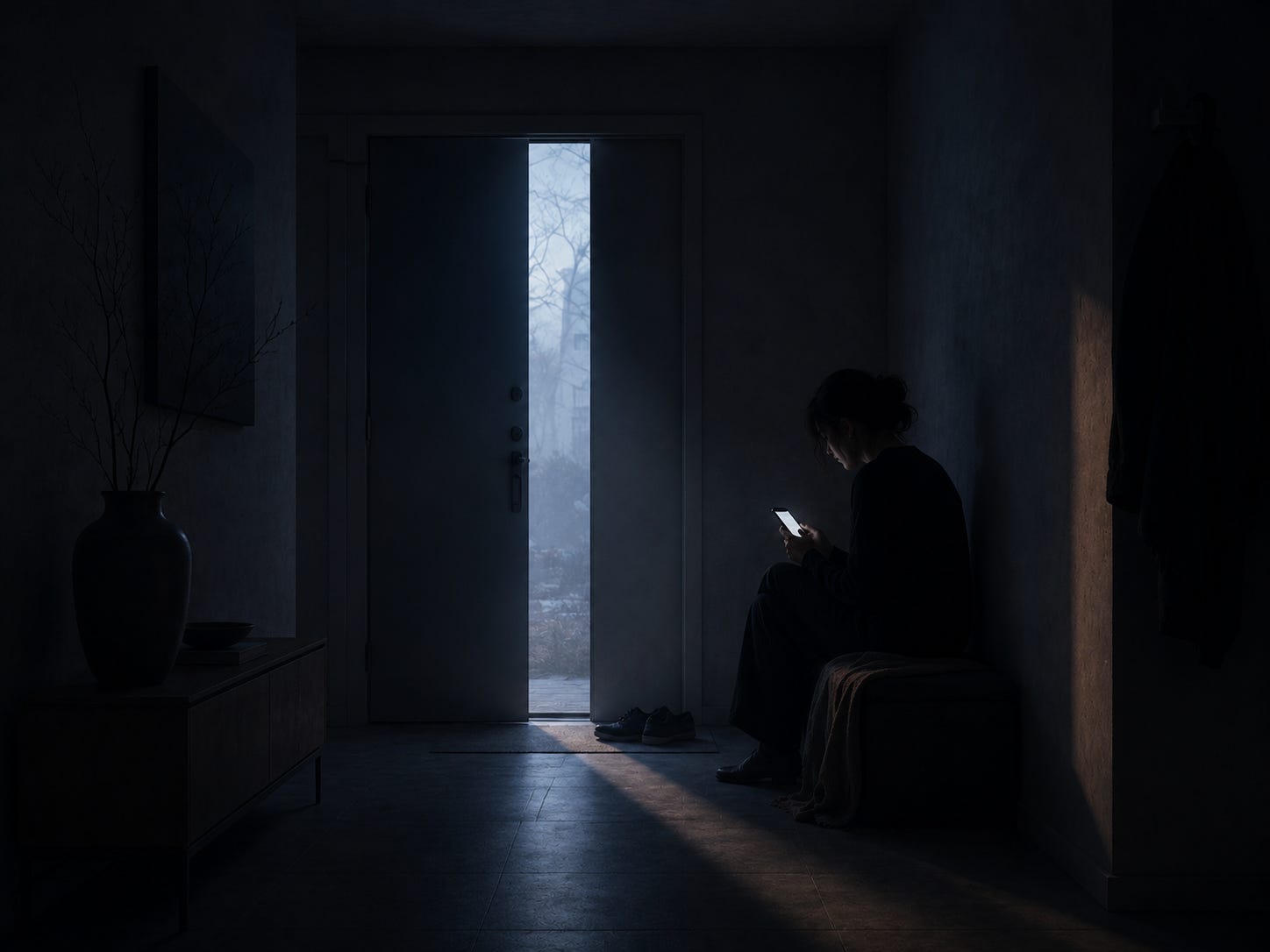
The half-formed drowsiness shattered the instant my phone lit up. Her avatar pulsed like an old doorbell, breaking through the heavy night:
“Are you there? I’m falling apart again.”
The white noise in my headphones cut off. I curled under the blanket, the headache left from overtime still needling through me. But my body had already grown an instinct of its own. Before my thoughts had time to react, I propped myself up and replied quickly:
“Don’t panic. I’m here. Take your time.”
Her confessions still followed the same unchanging loop: a tentative greeting, then a deep fall into self-blame, then several guilty attempts to stop herself halfway, and finally, the full handover of every fragile part of her, as she told me I was the only one who understood.
And I, too, followed the old mechanical rhythm—soothing, sorting fault from responsibility, naming the emotion, then staying beside it until it cooled. Every step was like a preset program, waiting only for her message to trigger it.
New lines kept appearing on the screen. I sat straighter and straighter, not even noticing the corner of the blanket sliding off me.
A sharp gap suddenly opened inside my chest:
I had not even had time to feel my own exhaustion
before I had already reached out
to catch her emotions.
In that moment, I could no longer quite tell—was it this tired friend she kept knocking on, or a door that had never once been locked, always left open for whatever she needed to let out?
Before I Could Say I Was Tired
The sour ache of an empty stomach rose up. It was 10:15 on a Friday night. The takeout still sat there, untouched.
A notification suddenly lit up:
“Can you listen for a little longer? I feel like nobody wants me.”
I put down my chopsticks and answered the video call. The thin warmth of the food was quickly swallowed by the night. In the camera, my shoulders and neck were tense, the fatigue beneath my eyes thick. But my voice was still gentle and steady:
“Don’t be hard on yourself. Take your time. We can go slowly.”
Her hoarse sobs came in broken waves. I comforted her softly, my tone so practiced it felt like needle and thread, stitching together her split-open emotions.
Just as the words were about to land, my fingertips suddenly trembled. For the first time, a question flashed through my mind:
What would happen if I admitted that I was already exhausted too?
The answer was only blankness.
I was afraid she would turn around and find another place to lean on. Afraid that this singular trust would disappear. Even more afraid that in this relationship, I had only ever been an outlet that could be replaced at any time.
The truth stuck in my throat. All I could do was keep softening my voice, holding up the emotions that kept pulling her down.
When the call ended, the food had already gone completely cold, a layer of chilled oil clinging to the inside of the container. The black screen reflected my face—the corners of my mouth still holding the curve of comfort, but my hands would not stop trembling.
It turned out that in this friendship, being someone’s shelter had already been carved into instinct. This posture of always being able to catch her always ran ahead of my own fragility.
I never dared to test it. I was afraid that if I failed even once, she would turn away and run toward another door, left just as open.
The Silence Was Louder Than the Doorbell
By the twelfth day, the familiar knocking had gone completely silent. Every time my screen lit up and it wasn’t her, I felt as if I had missed the last step of a staircase.
I casually posted a photo of the night, but the familiar trace of her never came. Instead, I saw her leaving a comment under someone else’s post:
“Thank you for staying with me.”
A buzzing rose in my ears. A sour ache swelled behind my eyes, yet not a single tear fell. It turned out that emotional dependence in a friendship never had only one place to go. In the end, I had become a role that could be replaced.
Out loud, I forced myself to sound relaxed, saying I had finally earned some peace. But my fingers kept refreshing the screen without permission. A suspicion I was ashamed to name spread through me:
Had she blocked me?
Panic, emptiness, and sourness tangled together. When her fragility stopped running toward me, my long night lost its point of support too.
I thought to myself: if she never came back, should I finally close this door that had been left open for so long?
Just as my thoughts reached a dead end, her message suddenly jumped onto the screen:
“I still want to talk to you.”
My chest jolted hard. After days of drifting with nowhere to land, my emotions finally dropped anchor. Hearing the small, broken sobs in her voice message, my first reaction was not exhaustion.
It was an almost humiliating relief.
I looked at the blinking cursor, pierced by my own response. I had thought I was tired of the repeated knocking.
Only when the silence truly arrived did I realize:
I had been waiting for it too.
The most unbearable part was not that she needed me.
It was that I needed her
to need me like this.
No Room Left to Be the Victim
Cold rain beat against the window frame. Every strike sounded like an interrogation forced up behind my eyes. I scrolled upward through our chat history. The whole timeline was a one-way road with no path back.
She cut open the sore of her emotions, and I offered comfort again and again. She fell into endless darkness, and I reached out to build her a ladder toward the sky. And somehow, my trembling sense of existence had been slowly filled by each act of giving.
My chest sank heavily. She emptied all her desolation here, while I gripped this feeling of being needed as my only anchor, barely tethering a soul that kept falling.
My phone suddenly vibrated. A voice message appeared. Her small, broken sobs were almost swallowed by the rain. The first thing that rose in me was not heartache.
It was an almost pathological relief.
The feeling was tender and sharp, stabbing straight into my softest rib.
Good.
She still needs me.
The thought flashed by like a cluster of fine needles, pricking again and again.
For a while, I had wanted to play the exhausted victim. I wanted to resent her for pouring all her darkness into me. I wanted to resent myself for being endlessly consumed. But the long emptiness of those twelve days crashed back into my mind.
The version of me who had turned up the ringtone, who had waited in the ache of no reply, tore apart every disguise of self-pity on the spot.
In that moment, standing at the door, I realized:
being needed
had never been the same
as being seen.
But I had been stubborn for too long. I had mistaken someone else’s dependence on me for proof that I was irreplaceable in this friendship.
The friendship had not become false. It had only become so complicated that I could no longer stand safely on the one-sided shore of hurt.
I Didn’t Open the Door Right Away
7:45 a.m. Morning fog drifted into the entryway. Her message arrived right on time:
“Are you there? I’m not doing well again.”
My thumb hovered above the keyboard; insomnia had worn my fingers pale. A heavy ache spread down from the back of my head, pressing hard into my shoulder blades. I felt as if I had been held down on the surface of water that kept rising and falling. Every breath had only half its air left.
The cold blue light washed over the lines of my palm. I swallowed the instinctive “I’m here.” My voice sounded hoarse, almost unfamiliar:
“I can listen to you, but...
I’m having a hard day too.”
Her continuous sobbing stopped suddenly. Her rain-like breathing went silent for four seconds. She wiped the tears from her face and said softly:
“Then you talk. I’ll listen.”
The stone in my chest was still sinking, but a long, narrow crack opened inside it. Silence spread between us on the screen, like a cracked riverbed. The wounds were still there, but at last, there was room for my shape too.
The loneliness had not left. The door of my heart had not closed. Only this time, as she was about to fall, I did not bend down and turn myself into a cushion meant to catch everything.
That brief hesitation was as small as dust, barely enough to hold one inch of shaky ground beneath me.
But it was enough to tell myself:
I am not only an outlet.
I am allowed to be tired too.
🌙 Why can someone else’s crisis feel like proof that you still matter?
It does not mean the care was false. It means the door stayed open for so long that every knock began to sound like recognition. You answer before your own exhaustion has a name, become the ladder, the shelter, the place where someone else’s pain knows how to land.
Then the knocking stops — and instead of peace, the silence feels like being replaced.
The most unbearable part was never that she needed you too much. It was realizing you needed her to need you like this.
Being needed is not the same as being seen.
Have you ever felt relief when someone came back to fall apart in front of you, even though you were already tired?
If this felt familiar, you can leave it here quietly.
I read every comment.