

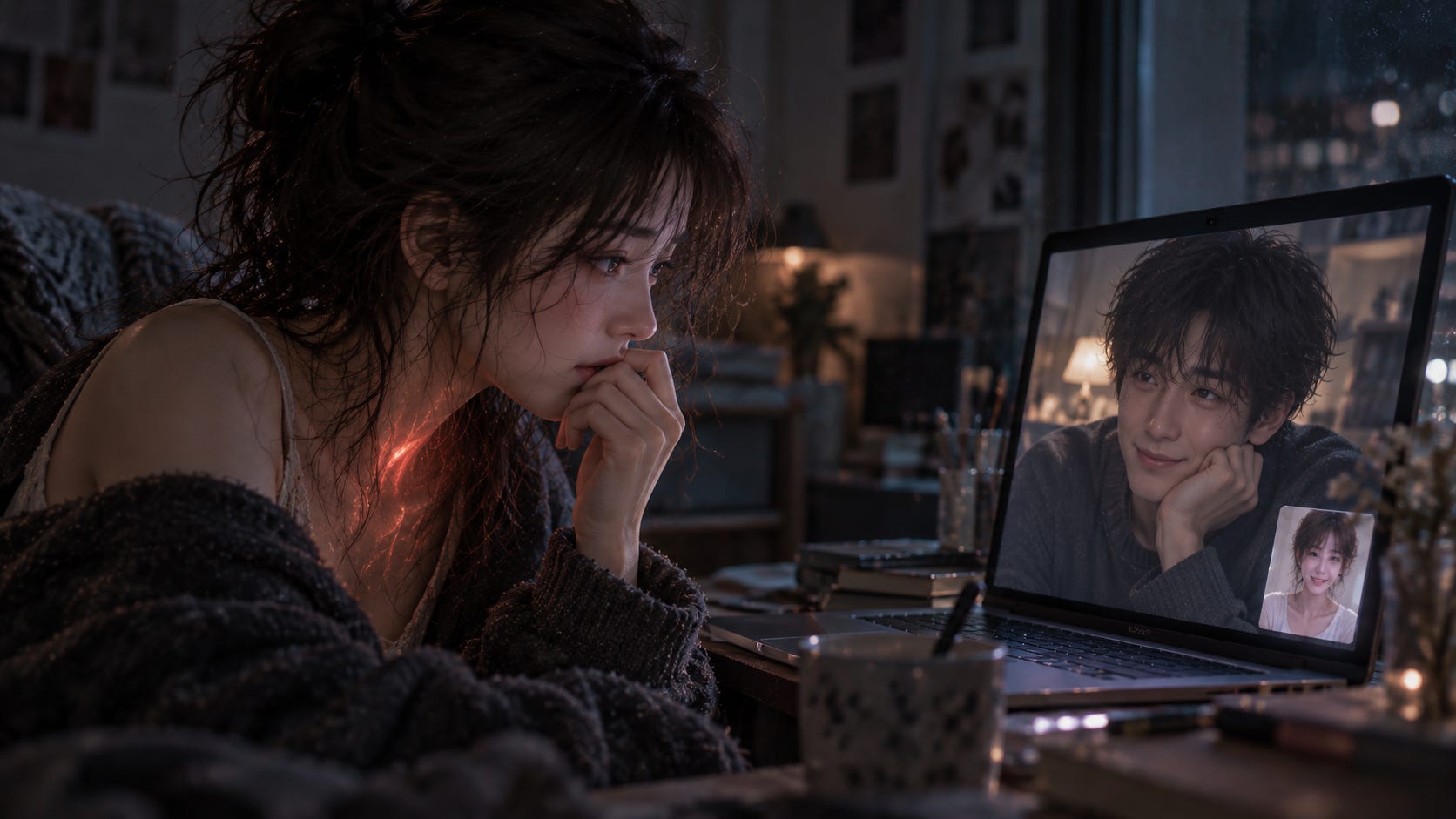
“You don’t have to explain. I understand.”
On the other side of the video call, his comfort was a cage coated in frosting, his gaze pinned to the space between my brows.
I hate everyone who judges my emotions through their own prejudices.
A second earlier, that scalding truth had been lodged in my throat. In the end, I swallowed it back down.
Instead, I offered him a respectable sentence, bleached clean:
“Bipolar moods are hard to understand anyway.”
He nodded solemnly, like a judge signing and stamping a document. But the pages beneath his seal were a draft I had falsified from beginning to end.
Then he leaned slightly forward, and the screen seemed to draw an inch closer with his warmth, making that thin “I understand” seem gentle and harmless.
I let out a breath of calm I had forced into place.
But an empty echo struck inside my chest:
What had he understood, exactly?
From that moment on, the real me found it even harder to speak.
The cold-white screen reflected my face, but could not show most of the soul I had hidden away.
Those raw, obsessive, festering emotions, like luggage abandoned in the middle of a lonely journey, crowded outside the video-call frame, with nowhere to be set down.
My heart struck the empty shell around it, giving back only a muffled echo.
So that sigh of relief had only been a pause button.
The real suffocation began a second later.
He Comforted the Me Who Didn’t Exist
“Have your moods been shifting again?”
Tears still clung to my lashes. He drew closer with a heart full of kindness, yet he couldn’t reach that deepest inch of hurt I had hidden away.
At half past six that evening, the riverbank had been brushed copper by the setting sun.
All afternoon, he had moved easily through the bustle of other people. I sat alone beside the campsite, watching the light on the lake break into fragments, then break again.
It wasn’t that I resented his enjoyment or my solitude.
It was the loneliness I was too ashamed to lay bare. Quite naturally, it was neatly filed under a gentle explanation: “bipolar mood swings.”
That was the simplified version I had placed in his hands.
He could only work within the boundaries I’d drawn, trying his best to give my sadness somewhere to rest.
“Probably just my moods acting up.”
I wiped away my tears and nodded along, hiding all my unedited sharp edges in the riverlight.
He comforted me in a low voice, holding out a warmth that was wholly sincere. In that moment, a hairline crack slowly opened inside my chest.
On one side was the understanding he was doing his best to give. On the other was the real me, in all her disarray, left standing outside the door.
The campfire crackled, bringing everything around me sharply to life.
I stood on the riverbank as dusk flooded in, holding a bundle of feelings no one had claimed.
For the first time, I could see the crack clearly:
He hadn’t lost me.
Together, we had left blank space on the page and mistaken the page for the whole of me.
So being understood could create misunderstanding, too.
Because what he understood was the version I’d put in order before handing it to him.
I Heard Myself from Outside the Story
“My girlfriend? She’s a born optimist. Nothing ever gets to her.”
As the champagne cork popped, my name became the hollowest ornament in all that noise.
Laughter rose around me in waves. I let my eyes curve into a smile, performing happiness without a visible seam.
My fingertips trembled as they gripped the edge of my dress. My ankles went numb inside my high heels.
Beneath that polished shell was a small, almost humiliating plea for help I didn’t dare let anyone see.
He hadn’t been wrong.
That was the version of me I had willingly placed in his hands: every sharp edge of sadness shaved away, every fragile fear hidden out of sight.
Now he read that version aloud with such ease, clean and precise as a copy made straight from the draft.
But I heard his words fall into the air, as though I were sitting in on a stranger’s biography.
The real me is quick to panic, quick to break. One brush with gloom, and she sinks straight to the bottom.
Yet here the room glittered and roared, its bright lights and wine wrapping around every feeling that stirred beneath the surface.
No one wanted to bend down and look into the bottom of the glass, where that knot of loneliness had sunk into the dark.
I clutched the mask of the “born optimist,” damp enough to ache.
Warm light settled across his gentle profile. He smiled and clinked glasses on my behalf.
I swallowed a mouthful of sparkling wine. Its tiny bubbles caught in my throat, choking out a silence I hadn’t seen coming.
Then a cold, clear question flashed through me:
Did I even know the person he was talking about?
I Kept Only the Me I Thought Could Be Loved
Could you hold me for a moment?
The words crumbled on my tongue before I could say them.
What came out instead was a polished reassurance:
“Don’t worry. I can handle it on my own.”
Afraid of becoming a burden, I rewrote my most instinctive need right there in my throat.
I folded myself into three spotless business cards: optimistic, independent, never relying on anyone.
The sobs that surged against my throat, the shame of holding out my hand to ask for something—I tore them all away and locked them in the drawer’s darkest corner.
I looked into the mirror, and something in me jolted awake:
I hadn’t only been performing for the world. Even I had come to believe that this template was the only version of me worthy of being loved.
So each time I was “understood,” it only confirmed that the template still worked.
My memory rewound to earlier that day.
He had smiled and praised me for always managing to digest every difficulty on my own.
Like a child hoping to be rewarded, I hurriedly drew back the hope I had already extended halfway toward him.
That smile flashed in the mirror now, sharp enough to sting my eyes.
At 1:20 a.m., the window latch clicked shut, sealing the whole night outside.
I stood motionless before the mirror. A sharp question split open inside my bones:
Beneath all those layers of disguise, which one is really me?
I cupped the cold running water in my hands and rinsed them again and again, but I couldn’t wash the trembling from my fingertips.
A single tear hung stubbornly from my lashes, wavering, refusing to fall.
The room was steeped in a sickly white light.
The heartbeats and hurts I’d deliberately set aside had begun to grow mold in the dark of my chest.
Only that tear, still suspended, lucid and stubborn, remembered for me: beyond the door lay a whole night no one understood, and all the pleas for help I had never dared to offer openly.
The Sentence I Didn’t Rewrite
“I think I might need you. A little.”
Even I went blank for a moment when the words came out.
It was as though I’d gripped the only key to laying my heart bare and thrown it into the air in one lonely burst of courage.
The coffee machine hissed and wheezed in the kitchen that Sunday morning.
He didn’t put on his familiar “I understand” expression. He simply stopped what he was doing, turned toward me, and asked,
“And then?”
Then he handed me the hot coffee he’d just brewed.
I held that small bundle of scalding tenderness tightly. The sharpness slowly eased out of my strained breathing.
“Then…”
“I still don’t know how to say it.”
I frowned, trying to dredge up the scattered pieces of what I felt. Everything inside me surged, but nothing settled into a complete answer.
“It’s okay,” he said. “We can take our time.”
This time, he didn’t file my unease away as a symptom of my disorder.
He didn’t rush to understand. He left room for me to say what was true.
He set his own cup beside mine, and two threads of steam rose side by side.
He didn’t offer an easy “I understand everything.” He simply stayed with me, quietly, giving me enough courage to take my time putting my disarray into words.
Perhaps my next sentence would still come out tangled and broken. Perhaps I would still instinctively hide my sharp edges, trim away my tender places, and hold back my panic.
But suddenly, I felt that at least until this cup of coffee went cold, I didn’t have to take back that key to honesty.
I could try, just once, to hold it to the door of my heart without a disguise.
🌙His attention was never the missing thing.
Why do I hide what I need because I’m afraid of being a burden in my relationship?
Fear of becoming a burden can start editing your needs before your partner ever hears them. A wish for comfort becomes “I’m fine.” A complicated hurt is given a safer explanation. Eventually, someone may understand you with complete sincerity, yet only know the version of you that asks for less.
I gave him a version of me that needed less, then mistook his understanding of that version for intimacy.
He wasn’t pretending to understand. I had handed him a story with its most necessary sentence missing.
Have you ever made yourself need less because you were afraid of becoming a burden to someone you loved?
If a sentence came to mind while you were reading, I’d love to hear what it sounded like before you changed it.
Even a few unfinished words are welcome here.
You framed the trap of labels so brilliantly here, Xiaobian.. When someone thinks they already have you figured out through a diagnosis, they stop actually listening to what you're trying to say. This post gives such a strong voice to what so many people carry silently..🥹🫶🏻
Being understood as a diagnosis instead of a person. You put words to something so lonely.