
I Couldn’t Tell If He Was Loving Me or Managing My Bipolar Disorder
He prepared for everything. I just didn’t know if that was care — or a contingency plan.

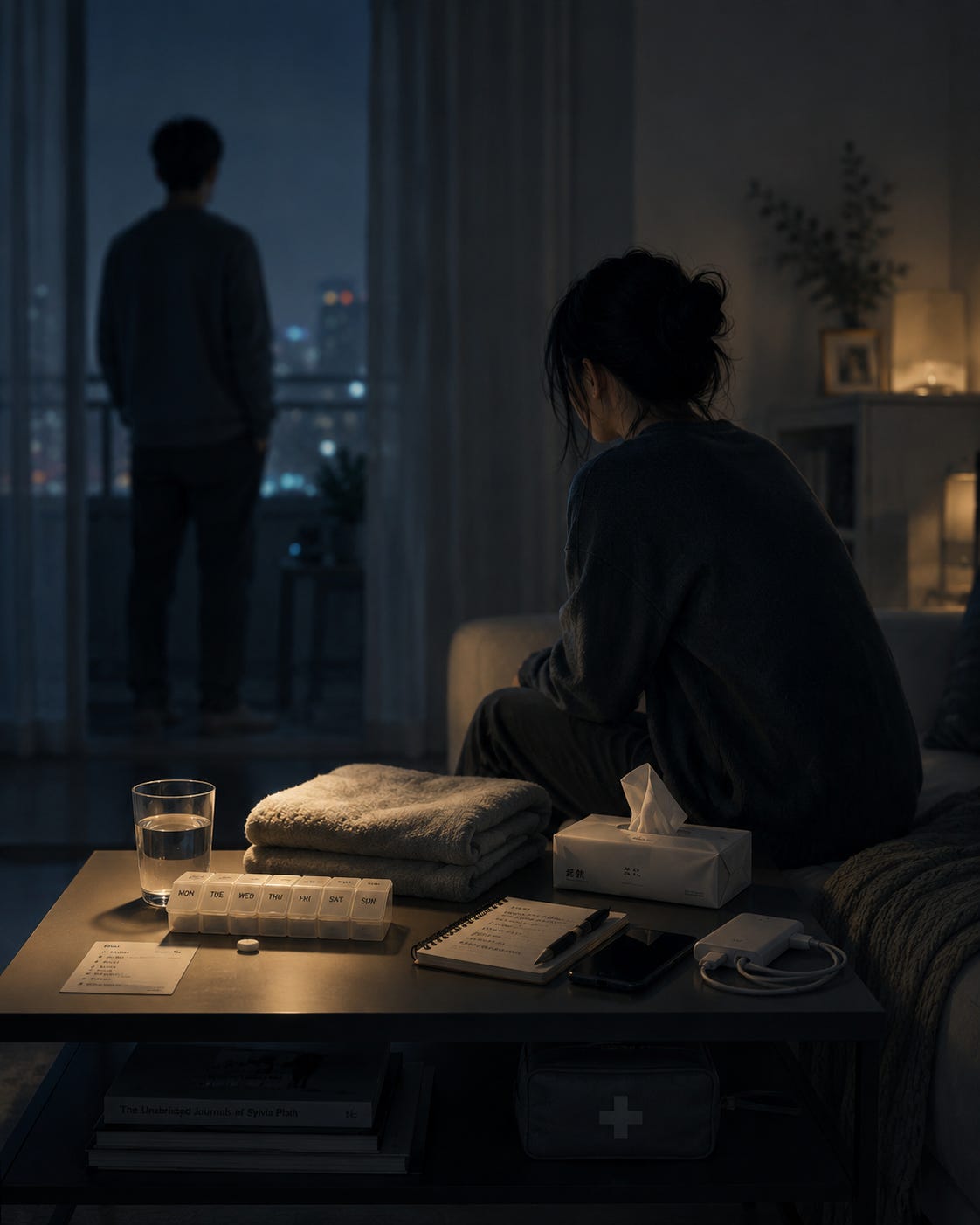
A pill was the first thing to puncture the last softness of dusk.
He handed me two back-row tickets to the music festival, the mood stabilizer resting steadily in his palm.
When he leaned close to my ear, his voice was almost unbearably gentle. But it felt like he was fastening a safety lock around me.
“I’ve got everything ready. If you can’t handle it, we’ll leave right away.”
Outside the venue, the crowd was loud enough to blur into one body.
I pulled out a delayed smile.
My shoulders had just begun to loosen when they tightened again by instinct.
A chill slipped through the seams of my bones and into my chest.
Without him, would I even know I needed these things?
I gripped the wristband tightly and suddenly realized I had been folded into a careful contingency plan.
Entering the venue.
Checking my state.
Taking the medication.
Choosing a quiet seat.
Keeping an exit open.
Every step had been arranged with such care that almost no room was left for anything to go wrong.
Then the bass dropped, heavy enough to shake the ground. The crowd’s cheering swallowed everything around us.
I gave him an OK sign and swallowed the desire I had not dared to say:
I wanted, too, to set all these precautions down and simply be someone’s date.
He held my hand and led me toward the back row, where the warm light gathered.
The lights beneath our feet were gentle.
But step by step, I was walking into a silence I could not name.
Lover.
Patient.
Fragile thing being watched with extra care.
Layer after layer of labels pressed against my chest, too heavy to push away.
The moment I accepted all that careful preparation, I felt it clearly:
This wasn’t quite love.
It was risk management.
I Learned to Lie to His Rating Scale
The question he always asked before a date—
“What number is your bipolar state today?”
did not come.
In an instant, I was seized by a suspended kind of panic.
The powder puff froze beside my cheek. A routine we had kept for months had suddenly been interrupted.
His old questions had been like checking a monitoring screen, and I had long since learned how to edit my emotions for it:
restless exhaustion translated into tiredness;
a long, sinking sadness converted into a cold number;
nameless unease explained away as poor sleep.
After long enough, I started to believe the numbers more than the feelings.
Cooperation became dependency.
I began placing my emotions onto his scale by myself. When something happened, I waited for him to decide. When my body felt wrong, my first instinct was to ask him for help.
Tonight, the act of getting ready stopped completely.
He was busy replying to messages.
He never asked.
My fingers froze on the zipper.
My mind went blank.
A sharp panic drove straight into my chest.
I realized that without his judgment, I could no longer tell whether I was happy or sad, okay or not okay.
Had I handed over the task of knowing myself to him?
The person in the mirror had smudged makeup and a heaviness gathering under her eyes. Panic and shame blocked my throat.
Without someone to sort me into a category and give me a score, I had become the stranger I knew least.
The desk lamp buzzed.
The powder puff trembled slightly, dropping a small cloud of loose powder.
This was no longer the happiness of being carefully cared for.
Somewhere along the way, I had quietly outsourced the instinct to sense myself—
to recognize what I needed—
to someone else.
In that moment, a gulf opened between the vanity table and my chest.
Even my emotions seemed to be standing on the other side,
waiting for someone else to name them.
I Was More Myself Before I Was Loved
An old post suddenly resurfaced, like a thin needle puncturing the silence of the night.
In the photo, the version of me from three years ago was standing under a bus stop sign in Dali. The wind had lifted my messy hair. I was smiling openly, almost brightly.
But that smile had been swallowed almost immediately by panic.
I had hidden in the restroom, counting my pulse, before I dared to return to the crowd.
Something pressed against my chest.
I began to envy that version of myself—
the one no one had prepared an exit route for.
Back then, when I lost control and felt dizzy, I squatted by the roadside and endured it. When I forgot my medication, I held a cup of warm milk and kept myself upright alone. When fear arrived at the last second, I simply turned around, refunded the ticket, and left.
Everything was clumsy then.
But whether I stayed or left, endured or retreated, the measure of it all still belonged to me.
I was the only ruler of my own emotions.
Now, I had lost that instinct almost completely.
Before going out, I first had to translate my mood into a number.
“State: six out of ten. Safe to go out.”
That had become the standard line.
After sitting down, I waited for him to hand me the medication. Even drinking water had become something I waited for him to signal.
Once his questions and arrangements disappeared, I stood frozen with my hand on the doorknob, unable to tell whether my body should move forward or pull back.
What I missed, it turned out, was the life where even the mess belonged to me.
I was not afraid of surviving alone.
What hurt was the life I had entered now:
my panic, my fear, my pauses no longer listened to my own heart.
They followed, step by step, the rules someone else had set.
The screen went dark.
Night reflected a docile, cautious figure in the window.
What I envied was never the absence of care.
It was the self who had not yet been defined by love as someone who needed special handling.
Love So Precise I Disappeared
I sat there for five minutes and still could not name what I was feeling.
Cold white light fell hard from above.
I sat cross-legged on the bathroom mat, my phone screen dark beside me. But the old photo from Dali was still burned clearly behind my eyes.
I closed my eyes and pressed my palm against my chest, counting my breaths one by one.
I kept asking myself:
Is this a five, or an eight?
But the answer was blank.
His usual questions appeared in my mind immediately:
Do you need medication?
Is your heart racing?
Those standards of judgment had already become templates that opened by themselves.
I tried desperately to break free from them. I tried to draw the feeling inside me.
But my thoughts were like matches soaked in water, unable to catch even the smallest flame.
When emotion rose inside me, my first instinct was no longer to look inward.
It was to wait, passively, for him to define it.
The quietest replacement was not harm.
It was love becoming so precise that I no longer passed through myself.
I looked up at the person in the fogged mirror.
His care was not wrong.
It had helped me survive countless moments of panic.
But for the first time, I saw it clearly:
a pane of glass built from gentle love had been placed between me and my own heart.
It was clear.
It was warm.
And still, it kept me from my original temperature.
I had not lost the right to be loved or cared for.
But inside a life where everything had been arranged for me, I had lost the instinct to listen to myself.
The tile was cool beneath me.
I looked up at the light and realized, for the first time:
it was not my emotions that had gone out of focus.
It was that I had gone too long without hearing my own pulse directly—
without anyone else there to judge it for me.
This Time I Didn’t Hand It Over
The entryway light came on.
His familiar question arrived right on time:
“How are you feeling now? Any discomfort?”
On other days, I would have immediately prepared the answer and handed it to him.
“A little tired. It’s fine. If there are too many people, we can leave early.”
That answer was practiced.
Appropriate.
Like a shirt ironed in advance, covering every wrinkle that had not yet been named.
This time, the words caught in my throat.
I looked away from him and asked myself quietly:
What is the truest thing I am feeling right now?
My first instinct was still to look at him,
to wait for him to define my emotion for me.
I pressed down hard on that old reflex and held my own hand.
“I’m not sure yet. Let me feel it for myself.”
He accepted it calmly.
“Okay. No rush. Tell me if you need me to do anything.”
That care took one step back.
It left a small space for me to be alone with my emotion.
Light and shadow crossed the entryway.
I was still tired.
Still anxious.
Still unable to fit my present state into any familiar standard.
But this confusion, this helplessness—
I did not hurry to hand it over to someone else.
The love had not changed.
Only this time, I did not borrow another person’s mouth to answer myself.
Compared with the safety of being neatly arranged, this uncertain, unpracticed feeling
felt more like a living, warm heart,
beating softly in my palm.
🌙 How do you know when care has begun to replace your own self-trust?
There is a moment that gives it away: someone forgets to check on you — and instead of relief, you panic, because you no longer know how to answer without them.
It can start gently: a number for your bipolar state, a pill offered before you ask, an exit route prepared before you know whether you want one. None of it has to be unkind. Sometimes love becomes so precise that you stop passing through yourself before you answer.
You wait for someone else to name the feeling.
You borrow their scale.
And slowly, even your own pulse starts to sound like something that needs permission.
Have you ever been cared for so carefully that you stopped knowing how to hear yourself?
Not because the care was cruel.
But because everything had been prepared before you could ask what you actually felt.
If this felt familiar, you can leave it here quietly.
I read every comment.
I keep thinking about the difference between being cared for and being quietly managed.
The hard part is not always refusing help.
Sometimes it is realizing you have started waiting for someone else to tell you what you feel.
Has care ever made you feel less like yourself?