

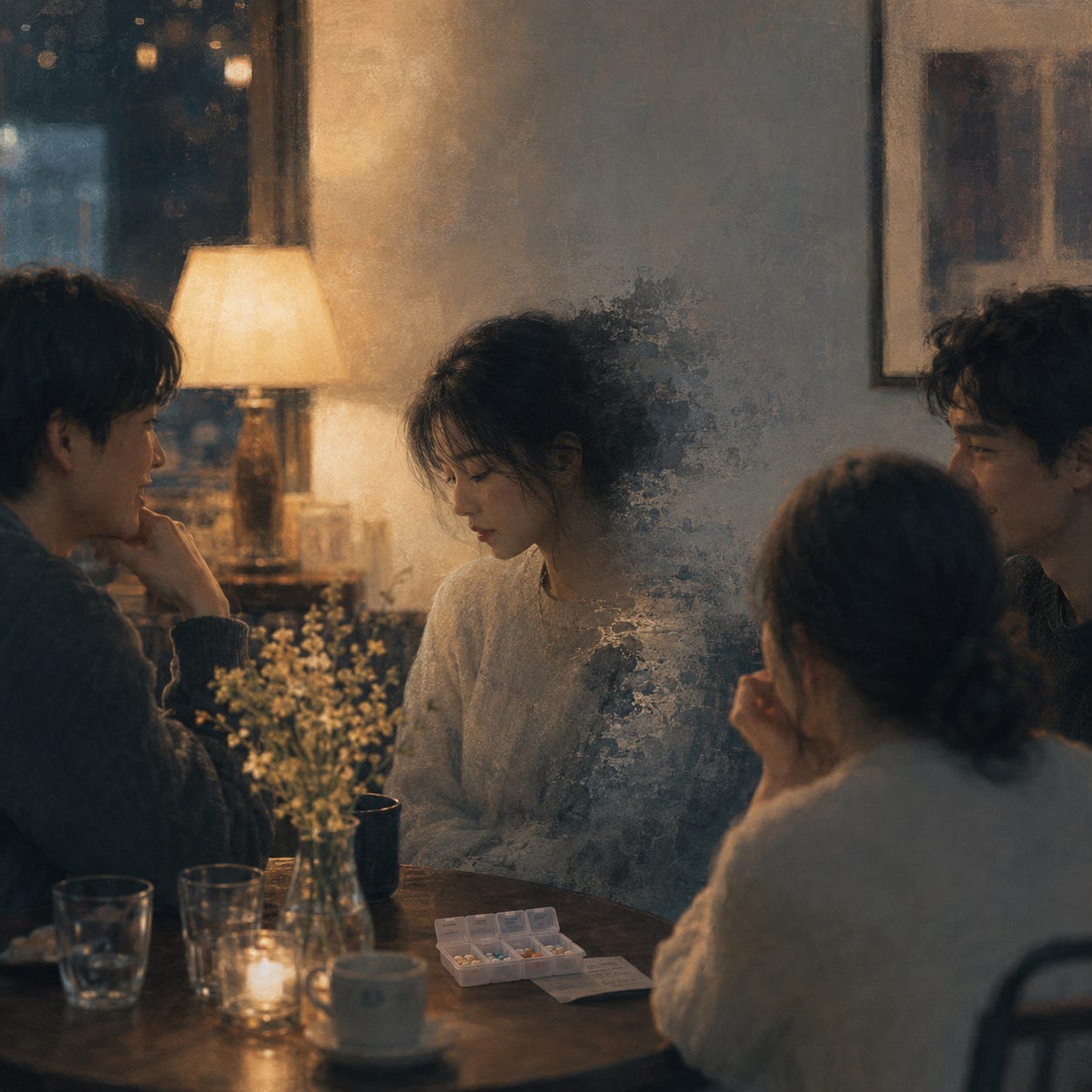
“Everyone’s a little bipolar, right?”
00:43.
The sentence floated into the group chat, light as if the night itself came with a soft glow.
My eyes stayed on the screen. My fingertips began to tremble, while the pulse beneath my palm started recanting its testimony:
Then what did my diagnosis count for?
And the dawn when I sat in front of my pills, counting all the way to one hundred and one—what did it count for?
I wanted to explain, but every word drowned at the entrance to my throat. My friend sounded lighthearted and sincere.
“Don’t be afraid. You’re the same as everyone else.”
The same.
One sentence washed me out into a faded background figure in an old photograph. My screen dimmed on its own, but my mind flashed back to that hospital corridor.
The smell of disinfectant was so clean it stung. The machine’s female voice calling out numbers was flat and free of feeling. When the diagnosis sheet was pushed toward me, its paper edge was sharp, as if it were naming me for the first time.
So pain could have coordinates. So it wasn’t just me being dramatic.
And now, it had become an old boat ticket no one would honor anymore.
More stickers surfaced in the group chat. Soft laughter and chatter drifted in from every direction, wrapping my silence in marshmallow until it could neither be seen nor heard—and I was too embarrassed to cry out that it hurt.
When pain was averaged out, even my right to hurt seemed to have to take a number. What was being averaged out was never only emotion. It was the weight of experience.
The more I breathed, the thinner the air became.
The world seemed to be holding an eraser, quietly rubbing me out.
Pain Left Its First Signature
“I get really high sometimes too. Once the alcohol kicks in, I can stay up all night.”
They laughed and raised their glasses. Their laughter fell into the crowd, splashed once, and disappeared.
I didn’t join in. My mind had already turned back to those three days—
At two in the morning, the light burned like a pupil being held open. The curtains swelled and collapsed, as though breathing for the air but not for me.
My heartbeat wasn’t drumming. It was pounding on a door.
Someone had twisted my brain to 2× speed, then suddenly cranked it to 4×. Every thought dragged sparks behind it, chasing one another, drowning one another:
Change jobs. Write a book. Learn Japanese. Move to the coast.
I wrote plans until dawn, the pages stacking themselves into a tower.
Collapse. Stack again. Collapse again.
Not one sheet had left a seat for exhaustion.
Their high had somewhere to land. The next morning, they would wake with a headache and laugh about the absurdity of the night before.
My high was the prelude to a bipolar episode. Like a derailed train hurtling into fog—horn blaring, screams rising, metal tearing—yet even the tracks were an illusion.
The destination? Only another stretch of brighter track.
Their nights jogged a few laps and stopped to rest. Mine had been shoved onto a belt that only sped up.
Not until dawn bleached the mirror white did I see the ring of panic in my own eyes.
So the one running fastest isn’t always chasing a dream.
The Pillbox Was Closer to the Truth Than Comfort
“You just need to adjust your mindset.”
A word of comfort, thin as a voucher no one would ever ask me to repay. I smiled and accepted it. A second later, my fingertips slipped with practiced ease into the drawer on the right side of my desk.
Another grammar lay inside.
The pillbox rested in the shadows—seven compartments, like seven locked rooms. Its edges had been rubbed pale. My fingertips had left the marks of paths traced again and again.
Each compartment was small, just large enough to hold the extra strip of night added to every day.
I had once tried relying on “adjustment” alone: breaking emotion down into logic, calling insomnia anxiety, mistaking acceleration for ambition.
But the moment the pills fell, they reminded me of what I knew:
some things do not leave the stage just because I have thought them through.
I pushed the box deeper into the drawer. The pills were quiet. They did not take part in easy afternoon conversation.
They simply fell into my palm on time, every day, yet were closer to the truth than any comfort.
Outside, voices were still gentle and daylight kept flowing. The world meant no harm—it was simply too accustomed to folding complexity into one light sentence, so the conversation could remain light.
That kind of generalization made real pain lose its coordinates. And I knew that pain reduced to a summary did not evaporate on its own.
The pillbox lined up as testimony, sunk in the dark of the drawer, reminding me by existing alone:
some realities have to be acknowledged by medication before they can slowly be negotiated with.
I Played the Acceptable Background Color
I had meant to speak—to tell them about the dawn of my first acceleration, when I stood in the hospital corridor clutching a thin registration slip, the smell of disinfectant invading my throat with every breath, formally signing a name beneath all the pain no one had named.
But my friend listened, smiled, and lifted her coffee. In that instant, I suddenly saw it:
on this manuscript page already filled with “ordinary,” any three-dimensional “me” was a formatting error.
Anything singular, in front of the majority, was always expected to mute itself.
And so I began a ruthless edit of myself.
I erased “collapse” into the lightly sketched phrase “a little unwell.” I erased “the light was cold enough to pierce bone” into a silent blank.
In the end, I handed over a single polished line of agreement:
“Yeah. Me too.”
When pain was flattened into an average, I learned to fold myself into the smallest possible volume.
Whenever someone asked how I was doing, I handed them the summary I had edited down to a skeleton, short enough to disappear at the speed of a live comment feed.
They nodded and tossed back:
“That’s good, then.”
Then they wove the weather, stock prices, and weekend check-in spots into an airtight net. I smiled and played the most acceptable background color in the crowd.
What had been turned down was not only the volume. It was the resolution of my existence.
A block of color was still visible, but the scars could no longer be made out.
Just right.
I stole none of the frame. And no one could truly see me.
Pain Still Belongs to Me
Late at night, I left only one lamp on and let the screen sink into the darkest part of the night.
I opened Notes and gently wrote down seven Chinese characters:
“Pain still belongs to me.”
The cursor blinked on and off, like a heartbeat standing in for my silence, quietly checking in with the human world.
In that moment, I suddenly understood:
what had been averaged out was only the language circulating through the world.
Not me.
Even if that weightless “everyone has it” was still drifting through the air, my original outline had already slipped quietly back into place somewhere no one could see:
Those late-night markings no one had witnessed. Those weights that belonged only to me. They did not need to be proven. They did not need to be summarized.
I no longer felt compelled to drag this difference into the light, nor did I etch lines of self-blame into my heart for a resonance that never came.
Even if, at the next gathering, I still lift the corners of my mouth and offer the same fitting line of agreement, I know exactly what it is:
a strategy for moving through the world, not another edit of myself.
🌙 Is everyone a little bipolar?
No.
Ordinary shifts in mood are not the same as bipolar disorder. Saying “everyone is a little bipolar” can sound reassuring, but it can flatten a diagnosed experience into something universal.
Once pain is treated as ordinary, the person living it may begin minimizing it too.
Have you ever caught yourself changing “I was falling apart” into “I was a little unwell” after someone told you that everyone feels the same way?
You don’t have to make it smaller here.
You can leave it here quietly.
I read every comment.
What makes this land is how precise the pain is against how vague everyone else's comfort is — "adjust your mindset," "everyone's a little bipolar," all fog, while your side of the page has coordinates. No easy line to pull out and quote back at you either. I just read it slowly, and I'm still sitting with it.
You really have a way with words!