

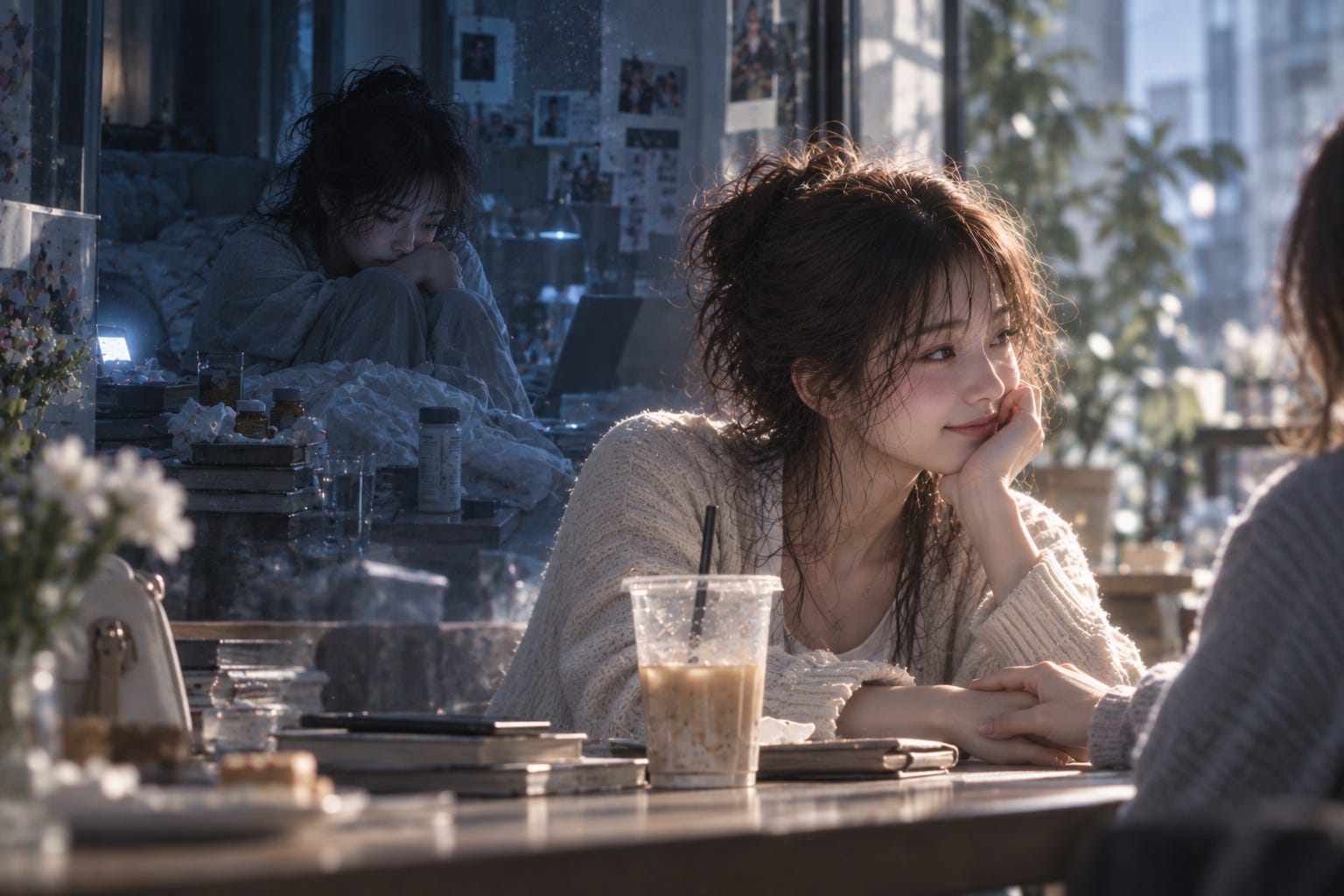
“You really don’t seem like someone with bipolar disorder.”
The words landed softly. She was leaning against the arm of the sofa, her expression earnest as she gave the back of my hand a gentle pat.
Warmth spread through me. I wanted to reach for her hand—and flinched away instead.
A moment earlier, we had been talking about the smallest things—the takeout that never quite tasted right, the newborn kittens by the mouth of the alley. She looked at how steady I seemed, and the thought simply slipped out, pure and unguarded.
I lifted the corners of my mouth out of habit. The smile stopped halfway.
My fingertips pressed a dent into the milk-tea cup. The ice knocked together with a brittle clink, sharp enough that my heartbeat seemed to pause inside it. A thin mist had gathered on the cup. The sweetness sat heavy at the back of my tongue, and suddenly I could taste none of it.
A silent sentence spread inside me:
You’re only seeing the part of me I can still keep steady.
A thousand other words crowded into my throat. I sealed every one of them back inside.
I sat stunned in the softness of the sofa.
I couldn’t quite receive the kindness in her praise. I couldn’t bear to tear open the peace in front of us, either.
The silence was like the bubbles in my cup, with nowhere to go, pressing against my throat again and again. Quiet. Burning.
I didn’t know whether to take what she had said about my bipolar disorder as comfort—
or as evidence that she hadn’t really seen me.
She Missed the Small Hours
At three in the morning, the old image of myself sitting alone surged back. It overlapped with what she had said earlier that day:
“You really don’t seem like someone with bipolar disorder.”
There was nothing pointed about it. Still, it had settled somewhere inside me and refused to leave.
I opened our chat with my fingertip. I wanted so badly to type the truth I had kept inside:
On so many nights, I sit here just like this, withered, waiting for the medication to carry me through the long night.
But my thumb went still above the input box. A thousand words dammed up in my throat.
“You really don’t seem like someone with bipolar disorder.”
The sentence kept circling in the dark.
I didn’t dare disturb the veneer she had seen, afraid the gentle expectation in her eyes would collapse into something unrecognizable.
In the end, I locked the screen. The room fell into stillness.
Only my frantic heartbeat kept time for the long night, second by second.
I slowly lay back against the pillow, still struggling with the question:
Should I lay the incomplete, vulnerable self that lived in the small hours—and all the real struggle she had never seen—fully before her?
But I knew that once I spoke, this tender misunderstanding could never go back to what it had been.
The silence I had pushed back down sat heavy on my chest, wearing at me more than any confession could have.
I Kept That Sentence on Life Support
I never dared stay with her long enough for the campfire to catch.
“Let’s go camping. Campfires are beautiful at night.”
Before the words had even settled, I hurried to change course:
“Daylight is nicer. Let’s head back to the city early.”
Avoiding the night on purpose had long since become a bone-deep instinct.
After that, whenever the slightest ripple stirred in me, I found a pretext to leave.
I disguised my medication bottle as a vitamin bottle and buried it at the bottom of my bag. My posts showed only morning light and green plants, every struggle in the dark cropped out.
Every carefully composed “I’m fine” became another thin curtain drawn across what I didn’t want seen.
People saw the steady veneer. They never saw how badly everything underneath was swaying.
Until that night.
The sand was cool beneath us. We leaned beside the fire pit, laughing ourselves breathless, when she said almost casually:
“See? I told you it wasn’t that serious.”
My stomach dropped. The laughter around me seemed to recede.
The sentence was light as a cinder, but it lit up the playbook I had been running on autopilot for months.
I wasn’t getting better.
With every “I’m all right,” I had been renewing the same tender misunderstanding:
You don’t seem like it.
Firelight moved across her unguarded eyes.
A bone-cold doubt erupted inside me:
If she saw the real me, would all that praise cave in?
I could no longer tell what I was preserving—the ease of this friendship, or the praise still suspended above it.
Only after that night did I begin to realize, dimly:
Some praise is not really praise. It can become a playbook you slowly begin to follow.
The Medical Record Was Keener Than Praise
The queue-number machine ejected a slip marked 38. I clutched my medical record, and her offhand sentence replayed in my ear at once:
“See? I told you it wasn’t that serious.”
The thin record sliced fine wounds across my chest, one close against another.
If I was really fine, what was I supposed to call last night—the way I had clutched my medication bottle and waited for morning?
What about three in the morning, hiding in the dark, crying without a sound, my fingertips finding that sentence on the old wall:
You do not deserve to be loved.
How could any of that be blotted out so easily?
The dose felt hot in my hand. The pointed questions I turned on myself closed in, layer by layer:
Had I mistaken plain exhaustion for illness?
If no one was there to see those struggles in the small hours, did that make them unreal?
The fluorescent tubes hummed overhead. The number calls wafted hollowly through the corridor. Cold sweat soaked through the paperwork.
That seemingly well-meaning judgment had begun demanding answers from my past, again and again.
The wretched memories were splayed out in daylight and examined.
I remembered huddling in the bathroom for hours, clutching the medication bottle as my body went cold all over, feeling myself being emptied out little by little.
I couldn’t help asking myself again:
Had I exaggerated the pain on purpose?
I had never wanted anyone to tell me:
“You’re seriously ill.”
I only wanted something that could stand as evidence—
evidence that the times my emotions had dragged me into the mud were not suffering I had made up out of thin air.
“Number 38.”
The nurse’s voice slit the stillness.
I stood and stepped forward, each footfall strangely light, as if I were walking on cotton.
It came to me then: I had never been waiting for consolation.
I had been waiting for evidence that the defeats no one had seen had really happened.
More painful than the misunderstanding was that I had followed her gaze into my own past and begun doing the doubting myself—
questioning every pain I had lived through
She Didn’t Get It. I Didn’t Take It Back.
Wind swept across the river, and the strength went out of me all at once. Everything I had held down for so long surged to my throat, nearly breaching whatever had kept it contained.
She was just raising a hand toward the low sun when I spoke first, my voice low:
“Today… I’m not doing so well.”
Six words fell into the evening light, like a pebble dropping into a deep pool without a sound.
My body felt too heavy to lift my feet. My vision swam with glaring specks of light. I didn’t want to explain every dose and every rise and fall. I wanted even less to squeeze out a smile and feign calm.
She didn’t ask for more. She simply took my hand, and her arm settled around my shoulders.
The evening wind rocked the river lanterns, fine specks of light spreading toward our feet. Her voice was steady:
“It’s all right. Don’t be scared. I’m here.”
I didn’t know whether she could ever fully get it. She had never seen me sitting alone at the edge of the bed in the small hours, gasping. She had never felt the pinprick restlessness in my hand.
But my taut pulse gradually eased. My clenched fingertips slowly uncurled.
This time, I didn’t take back the vulnerability I had let show.
We walked slowly on beside the river, my steps still heavy.
Across the water, the lights on the far bank bloomed into a narrow ribbon of warmth, as if the river had been dusted with a thin layer of sugar.
She still might not get all of my struggles. But when I said, “Today… I’m not doing so well,” she was willing to pause.
Some struggles are allowed to be real before anyone fully gets them.
🌙 Why do people with bipolar disorder hide how much they’re struggling?
Looking stable can change the way people treat you. When being “fine” brings relief, praise, or the chance to be treated normally, bipolar masking can start to feel safer than letting the full struggle show. Over time, the mask can do more than shape what other people believe—it can begin shaping what you believe about your own pain.
I kept the mask alive until I started believing it too.
I kept looking fine until “fine” became evidence against my own pain.
Have you ever looked so fine that even you started doubting how much you were hurting?
Pain does not need to be seen to be real.
You don’t have to make your pain more visible to make it believable here.
You can leave it here quietly.
I read every comment.
As someone diagnosed with Major Depressive Disorder, I often hear people say that I seem too happy to be someone living with depression. As if depression has a face, a certain look, or a personality that everyone should be able to recognize.
I hate how people have this preconceived image of what someone with a mental illness is supposed to look like. As if smiling, laughing, showing up, and living an ordinary life somehow invalidate the battles happening quietly inside someone.
You don’t have to look broken to be hurting, and you don’t have to prove your suffering for it to be real.
I haven’t finished your article but I will. 💕
Xiaobian..🥰 your writing handles this theme with such wonderful grace, and that final moment of dropping the mask to let someone see the messy vulnerability without an explanation is beautiful..🥹