

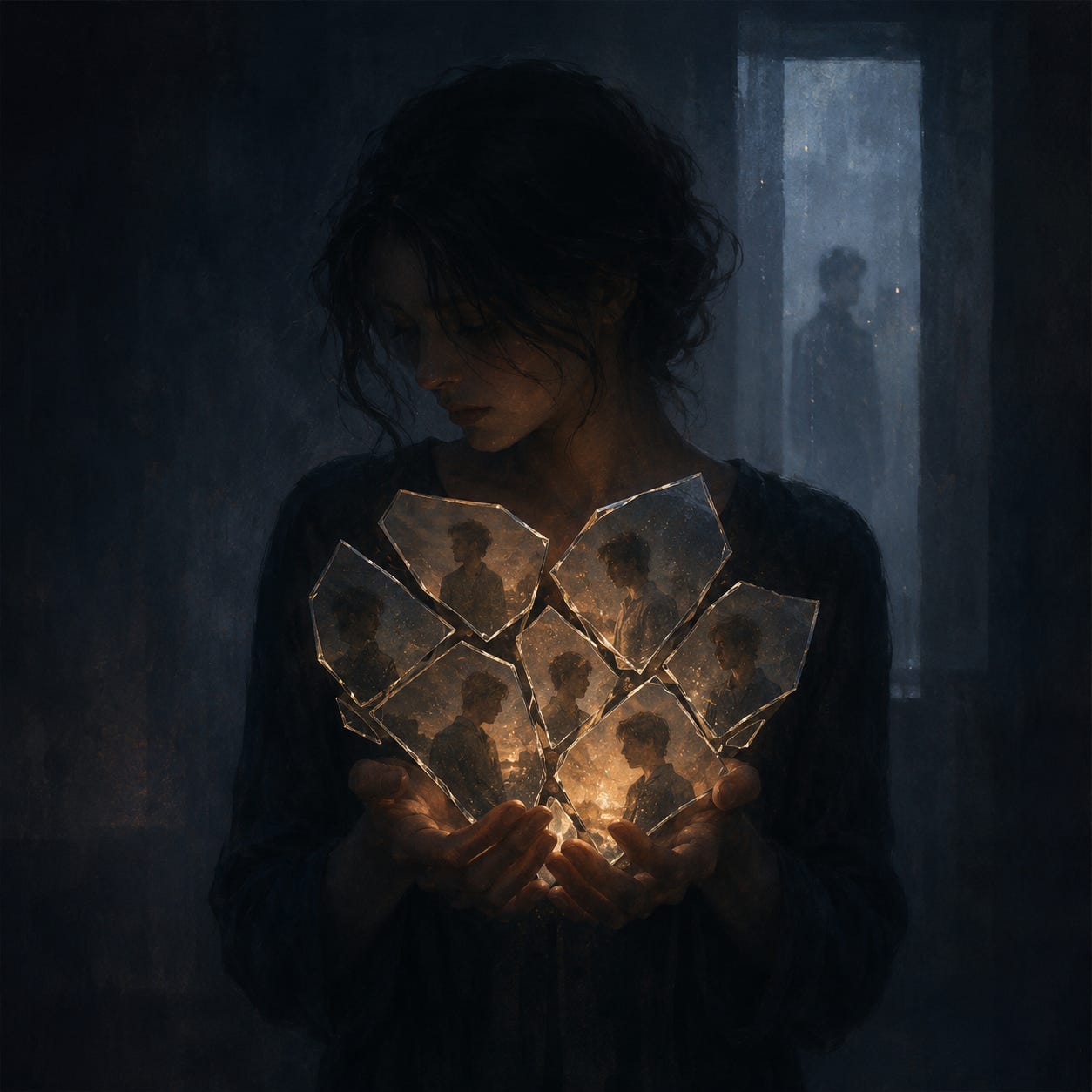
The second he handed me the lighter, my heart completed its rehearsal for a lifetime of burning.
I knew how absurd that was. But falling for someone, for me, had never been a stumble. It was always a leap from a cliff.
After the party ended, I stayed up pouring every urge to see him again into my screen. Each message screamed without sound:
Please believe this beating heart.
He took his time replying, leaving behind a single blunt blade:
“You catch feelings too easily. Maybe don’t move so fast.”
In that moment, even the lightest wind could make me tremble.
He did not know that I had spent a full twelve years practicing how to tell the fever of an episode from the warmth of something true.
On the page of my diagnosis, my love was a symptom.
In my world, it was the only clarity that needed no reason.
I want to answer the world:
If a heart this full cannot be trusted, what is left to measure love by?
If loving too fast is a mistake, I would rather make it again and again.
If a sincere heart needs to be treated like an illness, I would still choose to live with mine.
Love Is Not the Afterglow of an Illusion
If “I love you” is treated like a symptom, why does my heart still thunder for him after the fever breaks?
This love is a wildfire. All-night messages, coffee carried across city lines — everything feeds it.
They say, “You are only in love with being in love.”
But when the tide of feeling rises and recedes, his name remains on the ocean floor. Every wave breaks against his outline. The agitation changes only the volume.
His name remains the melody.
There is always someone ready to put my love on trial:
“You never loved him. You loved the version of him you invented.”
“Your feelings change with the weather. What could possibly prove they are real?”
So I ask:
If love must be certified stable before it counts, should every kind of intensity be sentenced?
In the measuring cup the world holds out, love must fall at an even drip.
But I was born a waterfall.
Not to sweep anyone away, but because life in me was never meant to arrive one measured drop at a time.
I admit that my heart is a revolving stage. At its height, every light is blazing. In the lows, the curtain hangs heavy.
But whenever the lights come back on, there is always a seat saved for you.
The love moving through my bloodstream is not the afterglow of an illusion. It is an unbroken current, carrying your name through every dark.
I no longer defend the words “I love you.” I no longer apologize for the temperature of my heart.
I carve one final testimony into my life:
Even if the world diagnoses my intensity as madness, I still sign my name beneath this heart.
It has burned.
It has cooled.
Every beat was real.
Being Believed Is a Luxury
You said I loved too easily, that I was cheapening myself.
The words struck like a poisoned arrow, piercing me and every soul that has ever emptied itself into love.
Our “crimes” are easy to name: we fall too fast, our feelings swell past the brim, we give too completely.
But they will never understand:
We are the most clear-eyed lovers there are.
Every dawn, we interrogate ourselves all over again:
Will I lose control because of him again today?
When the tide of passion recedes, will he still be there on the shore?
Even when I fall into a low, can I still trace his outline?
Most people can say “I love you” without doubting the sentence itself. Every time we say it, the words must first survive an inner trial:
“Is this love, or only emotion spilling over?”
“Do I even have the right to say those three words?”
We understand sincerity better than anyone because we have tested it again and again — with ten times the pain and a hundred times the effort.
And yet, this is the cruelest irony:
The more closely we examine ourselves, the less trustworthy we appear to everyone else.
Day after day, we begin to believe the cruelest hypothesis:
Maybe loving the way I do means I was born unworthy of being loved.
Maybe the emotional swings I cannot control have already disqualified me from ever being met with the same sincerity.
For us, being believed is never a gift.
It is only ever a luxury.
We hold broken glass and keep walking, bleeding with every step, and still smiling as we say:
“Look. My love is real.”
And the cruelest truth is this:
It is not that our love is unworthy of being cherished.
It is that this world has never once given us an embrace without suspicion.
I No Longer Submit Proof of Love
Someone asks me if I still love him.
I nod. I do not hand over the love letter I have rewritten a hundred times.
I used to be like a stubborn child, holding up an ECG strip for everyone to see:
“Look. This isn’t an episode. It is my heart dancing for him.”
Later, I learned silence. Not because I had stopped loving him, but because I stopped placing my sincerity on a scale and weighing it again and again.
Love was never an exam room. Why should it have to hand in a standard answer?
Now, his messages still make my heart skip a beat. I simply no longer strain to explain it — the way spring never explains why its flowers bloom, the way the sea never explains why the tide comes in.
I know there are many of us in this world — like a melody played outside the score, like travelers without a destination.
If they insist on giving us a label, let it be this:
“Never learned how to love in moderation.”
On the swing of our own feelings, we count every sway more carefully than anyone else could.
So let us love in our own way.
We still have the courage to be exactly who we are.
🌙 How do you know whether love is real when bipolar disorder can intensify your feelings?
There may never be a perfectly clean test.
Bipolar disorder can change the speed, volume, and weather of a feeling. But intensity is not proof of love — and it is not proof against it.
So I learned to ask what remains after the volume changes.
When the tide recedes, does the same person still have a shape? In a low, can I still trace his outline? Does my heart return to him when the fire has gone quiet?
Intensity may change the volume of love without inventing the person it keeps returning to.
Maybe the cruelest part of loving after diagnosis is not feeling too much.
It is having to cross-examine every feeling before you are allowed to trust it.
Have you ever doubted something real because your diagnosis taught you to doubt yourself?
You can leave it here quietly.
I read every comment.
Colored glass and artistic tiles are beautiful, but only when broken and assembled with the passion of a single life’s experience does it speak of feeling that transcends language.
Let no one judge the shattered pieces for they are the mosaic unfolding, whose priceless beauty gives meaning to life.
“On the page of my diagnosis, my love was a symptom.” Ouch! Xiaobian what are you doing to me!
Terribly unfair! First having to investigate your own heart before you are allowed to believe it. Most of us fall in love and then worry whether the other person loves us back. You first you have to ask... is even my love real? That is a rather lonely courtroom to keep returning to.
And then the waterfall! Loved that. Why must love arrive at an even drip to qualify as love? Some people drizzle. Some pour. Some arrive with thunder, lightning and the municipal authorities issuing flood warnings. 😄 Different does not necessarily mean unreal.
“I no longer submit proof of love.” Good! You stop carrying your heart around like documentary evidence. Exhibit A. Exhibit B. ECG attached. Enough.
Your writing made me stop several times. That's rare. Gladly subscribing.
I write at The Reflective State, where I meander, sometimes aimlessly, through reflection, humour, travel, history and fiction. Your piece brought my essay Agapi Mou, Philemou to mind. Mine approaches love from a very different direction. It asks what remains when love stops being about possession and begins changing the person who feels it. Perhaps our two pieces meet somewhere around the same question... who gets to decide what love is supposed to look like? If curiosity ever brings you my way, I'd love to know what you think.