

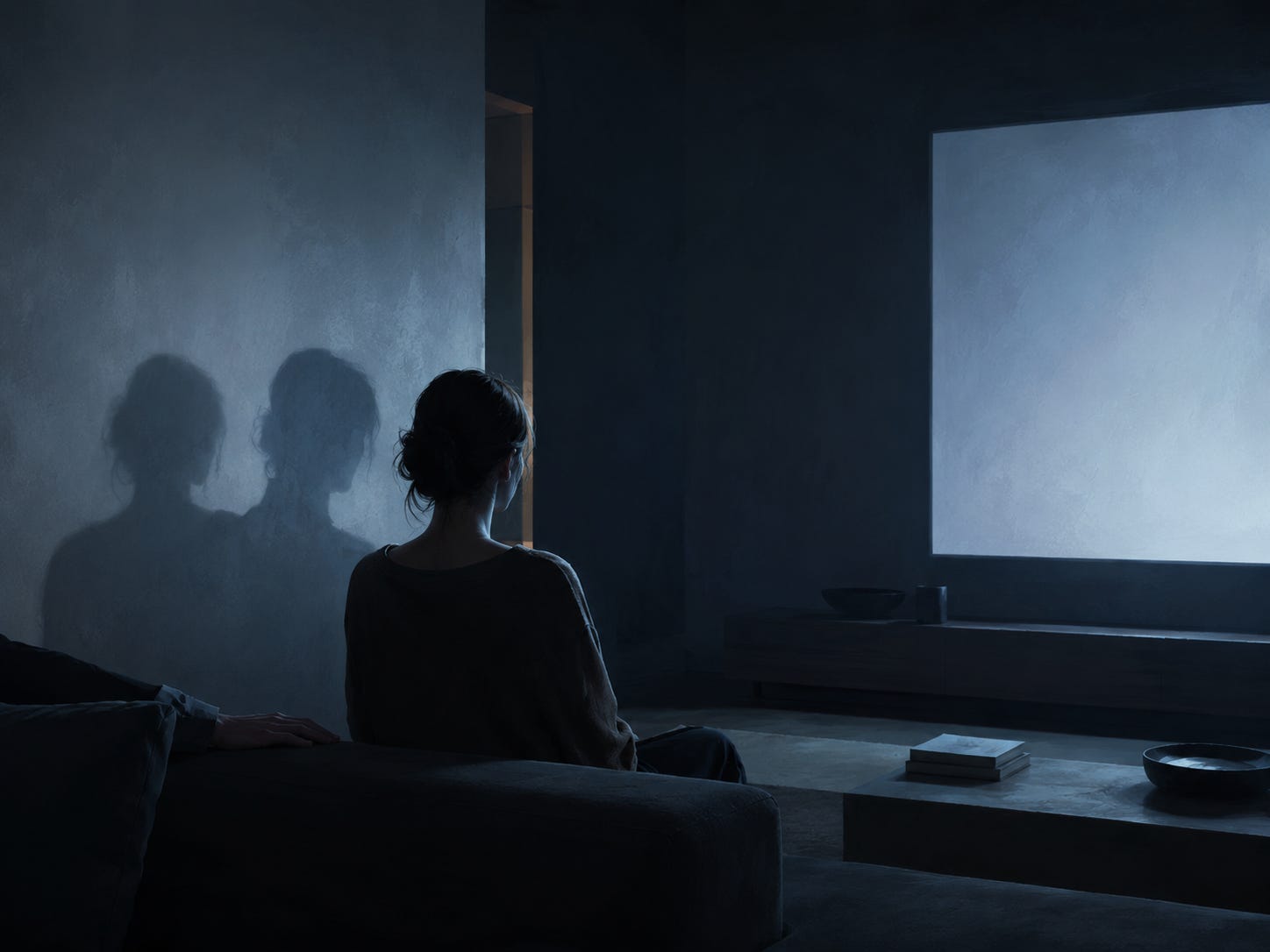
“I’ll stay with you. I love you as you are.”
Why would one sentence of love make time freeze for half a second?
When his words landed, the subtitles were still hovering on the screen, but my tears had already caught the light before the ending could.
“I know. Tha... thank you.”
The syllables broke apart in my throat.
His fingertips kept smoothing the silence on the back of my hand.
He thought I was crying because of the film.
He thought the tears led only to being moved.
But I had been pierced by one question:
Which version of me was allowed to count as who I really was?
The one before diagnosis,
who thought her emotions were only personality,
not mood episodes?
Or the one after—
who had learned to audit her own laughter before letting it out?
I was like a failing student standing at the blackboard,
smearing out a wrong answer.
Tears ran along my jaw and disappeared into the weave of my sweater,
leaving no trace.
On the screen, the male lead was still running through the rain,
performing a grand kind of sadness.
But inside me, another rain had begun to fall,
soaking the split-off self that had been labeled:
needs to be managed.
He bent closer and asked quietly,
“Are you sad?”
I shook my head.
I did not dare let the question reflect back through the shine of my tears.
The screen flashed:
The End.
He thought this conversation had also reached a complete ending.
But I knew
the real story had only just opened its eyes inside me.
Original Version: Not Found
After bipolar disorder had been written into my diagnosis,
2:17 a.m.
I dimmed the screen until it was almost extinguished,
and searched my photo album for a file called Original.
2018 · Untitled Fragment
A friend’s living room burst into dawn.
Bottles clinked and fell.
I stood on the back of the sofa, holding a speaker high above my head,
my laughter breaking through the ceiling.
Back then, I thought recklessness was a gift.
I called insomnia passion.
I called excess youth.
Album · Manic Episode Folder — after the bipolar disorder diagnosis
The timestamp stopped at 3:41 a.m.
The shopping cart swelled into a fire with no way back:
sixteen skirts,
two one-way tickets to Iceland,
and a guitar that would never make a sound.
My emotions were so intense they became blinding.
I once mistook that intensity for sincerity.
Album · Depression, Unsorted — after the bipolar disorder diagnosis
Every frame was black.
The curtains sealed the light shut.
I lay flat as a still life, counting the cracked lines on the ceiling.
My fingers could not slide past half the screen.
Even the delete key felt too heavy.
Breathing was like an expired subtitle strip—
fading,
traceless,
soundless.
The cursor blinked like an interrogation.
Was the party version of me real?
Was the one who stayed up all night writing love letters real?
Or was this silent shell the original?
The warmth of the screen sank away.
Night clung to my knuckles until it hurt.
The search bar remained blank.
In the album, every face had once been looked at carefully.
But not a single one
had been kept whole.
No One Ever Kept the Full Version
It turned out that I had not been unloved.
It was only that the people who passed through me had each torn off one frame—
like browsing a shop window
and taking the pane of glass that looked best to them.
That night at the party, the disco ball was spinning.
I raised my glass and pushed back at people,
my words scattering like broken ice.
My ex gripped my hand, fire in his eyes, smiling with pride:
“That was so cool.”
On an insomniac night, a friend rested her head on my shoulder.
I watched an entire season with her in silence.
Without interpreting a single line, she said softly,
“You’re so gentle.”
At five in the morning, the city fog had not yet lifted.
I wrote a two-thousand-word love letter to someone I was almost dating,
every word burning.
“You set my heart on fire.”
That intensity was like fireworks—
brilliant enough to light up a whole city for one moment,
then gone before dawn.
My sharpness had been loved.
My quiet had been loved.
My intensity had been loved too.
I was not someone who had never been loved.
It was just that each time, only one side of me lit up,
and no one ever kept the full version.
They each took what they loved.
I gave each of them what would keep them at ease.
In the end, the lightest and most painful confession turned once in my throat:
Even I only dared to love the versions of myself that were easy to carry.
The greatest fear, when you live with bipolar disorder, is not losing control of your emotions.
It is being loved only when you are performing well.
I switched between emotional states too quickly.
Before the next emotion could arrive,
I had already rejected the last version of myself
with my own hands.
The Most Pleasing Screenshot
The afterglow of the ending soaked the living room.
He tightened his grip around my finger bones
and repeated that vow:
“I love you as you are.”
The sentence landed.
I felt as if I had been pushed into an answer sheet
with only two mandatory boxes.
The intense version of me stirred restlessly on my tongue.
She wanted to take apart the plot we had just watched
with emotion at full volume,
to tell him how, in one second,
I had started hurting for the character until I burned.
The gentle version raised her hand at the same time.
The end of my voice had to be softened,my speaking pace had to slow down.
I had to become a cup of warm water,
just warm enough to cover the cold at his fingertips.
Memory flashed backward.
Last week, his eyes had softened because I said, “Whatever you want.”
Further back, he had once told me, “The way you catch fire makes my heart stir.”
The smoother I became at switching versions,
the more I questioned which frame of me could actually be saved for the long term.
The living room was quiet enough to hear the clock gathering its next tick.
I was split into two shadows:
one wanted to burn forward,
one wanted to step back.
The light fell across his calm side profile,
as if someone could press pause at any second.
My throat tightened until it felt dry and sore.
Any slight deviation in my voice might trigger that verdict:
“You’ve changed.”
Like a tiny mood episode being misread.
That was lighter than rejection,
but more complete.
So I only nodded softly.
I smiled very faintly
and swallowed both the intense version and the gentle one back into the dark.
It was not that I did not know what I wanted.
It was that I was afraid
what he loved was only the screenshot
that happened to look best in this light.
For someone with bipolar disorder,
love often has to pass through the checkpoint of stability first.
I turned my voice to mute.
The next second,
my eyes gave way before I did.
Held Before I Had an Answer
I cried
not because the vow was moving,
and not because I had been loved in exactly the right way.
It was because that confession had pushed me into a blank
I still did not know how to solve:
Which page was “as I am”?
The ending song rose slowly,
the melody gathering the story for us.
He held me tightly—
as if loosening his arms even a little
would make me scatter into flecks of light.
My tears fell quietly,
but my fingers clutched the corner of his shirt.
Only one echo was left in my mind:
I don’t know which one is really me.
The warmth in his arms was real.
But suddenly, I understood:
“as I am” was not a frozen frame,
not one well-behaved version chosen for someone else to love.
It was still turning pages.
Still moving.
Still too early to be named.
I did not explain.
I only held him back
half an inch tighter.
It was not that an answer had arrived.
It was that I allowed myself—
before I had found that page—
to be held first.
The ending song dropped its final note.
The light was gentle as before.
In his arms, I saw the outline of myself.
Still blurred,
but no longer running.
Maybe the real “as I am”
was never a stable version.
Maybe it began
the moment I stopped deleting myself in advance.
🌙 Why can “I love you as you are” feel like a question when you live with bipolar disorder?
It is not always because you doubt the love. Sometimes it is because you no longer know which version of yourself is being named. The sharp version was loved once. The quiet version was loved once. The intense version was loved once. But no one ever kept the full version — not even you.
So you learn to offer the most pleasing screenshot: stable enough, gentle enough, easy enough to stay for. The greatest fear was never losing control of your emotions. It is being loved only when you are performing well.
Have you ever been told “I love you as you are” and felt yourself asking, silently, *which one?*
If this felt familiar, you can leave it here quietly.
I read every comment.