

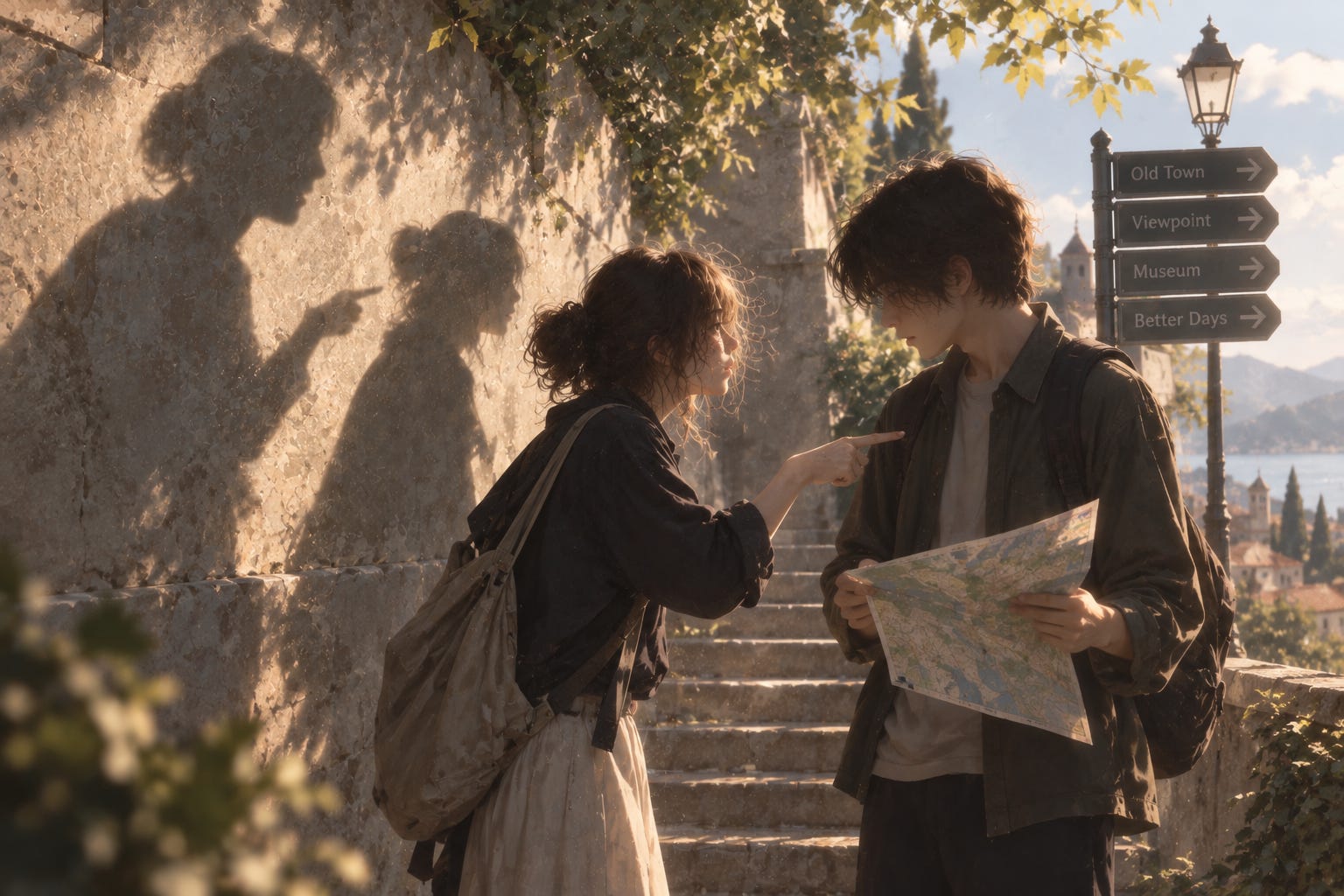
I used to think I had escaped the family I came from—until a familiar accusation came out of my mouth already sharpened.
“Why are you always so selfish? Why can’t you understand me?”
In that moment, sunlight struck his shoulder like a spotlight, but could not reach the expression unraveling on my face. My index finger jabbed toward his chest. The motion was so familiar I could barely breathe.
That finger of accusation—the one that had jabbed pain into my heart night after night—had grown from my own hand.
He went still. The tourist map trembled in his hands like the diary from my childhood, torn apart and taped back together.
“I’m sorry, I...” he began softly.
In the reddened corners of his eyes, a mirror suddenly appeared, showing me the child I had been—curled into the corner of a bedroom, sobbing.
I fled onto the sightseeing shuttle. The door slammed behind me, fracturing the overlapping reflections in the rearview mirror.
As the engine roared, memory came at me like a tsunami: the same summer, the same stone steps, the same self left riddled with holes after being humiliated in public.
My index finger burned as though it had just touched two bloodied souls.
Then I remembered that summer night when, after being scolded, I had made a vow to the fireflies outside my window:
“When I grow up, I will never make anyone who loves me tremble in front of me.”
I Repeated Her Violence in the Name of Love
What runs through blood is not only genes, but also the expressions we once swore to bury.
“No, listen to me. I’m not finished...”
In the afternoon quiet of the café, my friend had not even finished speaking when the sentence came free like an unsheathed knife, slipping cleanly into the gap in our conversation.
In that instant, I watched something go out in her eyes. And I saw myself more than a decade earlier, curled into a small shape in the shadows of the living room.
Memory ran backward like coffee reversing its pour: my mother crouched among scattered toys, every accusation a scalding liquid, burning red the soft beginnings of flight in me.
“When I grow up, I will never become like this.”
I buried that vow inside me, never knowing the seed itself already carried an inherited barb.
And now, the way my friend absently rubbed the handle of her cup was the same gesture I had once made as a child, pressing my hands over my ears against the storm.
My sentences were building a familiar cell in midair. Every syllable became a length of wire fencing, keeping her point of view outside. My hands moved like a conductor’s, yet the music they summoned was my mother’s old concerto of selfishness.
The whirlpool in my coffee turned deeper and deeper, like a trap in time pulling me toward the starting point I had sworn to escape.
I had not escaped the family I came from. I had only taken up her script.
And somewhere, a mirror was waiting to show me the truth I least wanted to admit.
Her Face Was Waiting Inside Mine
The mirror suddenly filmed over with frost, like a notary choosing my most wretched moment to read aloud the terms of a bloodline inheritance I had no power to refuse.
The bathroom light was bright as a merciless exposure. Rose-scented mist floated through the steam like a mediator performing tenderness. Cold water ran along my chin, carrying the gunpowder smell of the argument that had just ended.
A familiar face surfaced in the mirror, and my whole body shuddered.
The crease between my brows. The curve of my mouth. The storm held down behind my eyes.
Each one had been imprinted on my soul by my mother, long ago.
The face in the mirror leaned toward me like a ghost wearing my skin. Its lips moved and delivered the line I hated most:
“I’m doing this for your own good.”
My fist was already pressed against the glass. The cold beneath my knuckles reminded me that the one doing the hurting now was the same little girl who had once been hurt.
The rose scent suddenly thickened until it stung my nose, as though it were burning through every inherited injury carried in my blood.
What hurt most was not watching myself grow into her likeness.
It was knowing this was wrong and still being unable to stop repeating her rage—then, just as she had, pretending it was all because of love.
What I fear most is that one day I will be forced to understand the truth behind that lie.
Forgiveness Is Too Heavy a Door
In the silence after the unraveling, the whole house felt like a cocoon hollowed out from within.
I curled up on the window seat. Moonlight cut my shadow into the shape of the woman my mother had once been.
The rose scent slowly congealed, while bitterness spun itself into a web across the air. Everything was so quiet I could hear the little girl inside my chest sobbing in secret.
Then memory turned a page and stopped in a dance studio flooded with harsh white light.
The dents in the wooden floor held the sweat I had shed. She stood in the doorway like a measuring ruler.
“Not good enough. Again.”
I had always thought it was nothing more than merciless pruning.
Until another image broke in.
Her unsteady footsteps crushed the shadow of an overtime sheet beneath them. In the mirror, a brief flicker of pride rose on her face—then she bit it back until it disappeared at the corner of her mouth.
Her silence, I suddenly understood, had not been coldness. She had been afraid that one word of praise would disarm me completely.
The realization was cruel. It was like seeing myself holding the script she had handed me, reciting the same lines to someone I loved.
Understanding hurts more than hate.
With every part of her I understood, the shadow drove another inch into my bones. And the boundary I had believed existed between us may have been an illusion from the beginning.
Understanding her did not make me less afraid of becoming her. It only gave me one new second—the second in which I could hear the old line before I said it.
🌙 Why do I become like my mother with the people I love?
Sometimes the patterns we hated in our parents become the ones we reach for under stress because they were the first ways we learned to handle love, anger, or conflict.
You can consciously reject them and still repeat them with the people closest to you.
Recognizing the pattern doesn’t mean you have become your parent. It means an old relationship script has finally become visible.
Sometimes the family script survives by learning your voice. A tone, a look, or a sentence can arrive before you have time to recognize where you first learned it.
Have you ever heard a parent’s voice come out of your own mouth—and realized the old script was still running?
You don’t have to forgive anyone here to notice what was passed down.
You can leave it here quietly.
I read every comment.