

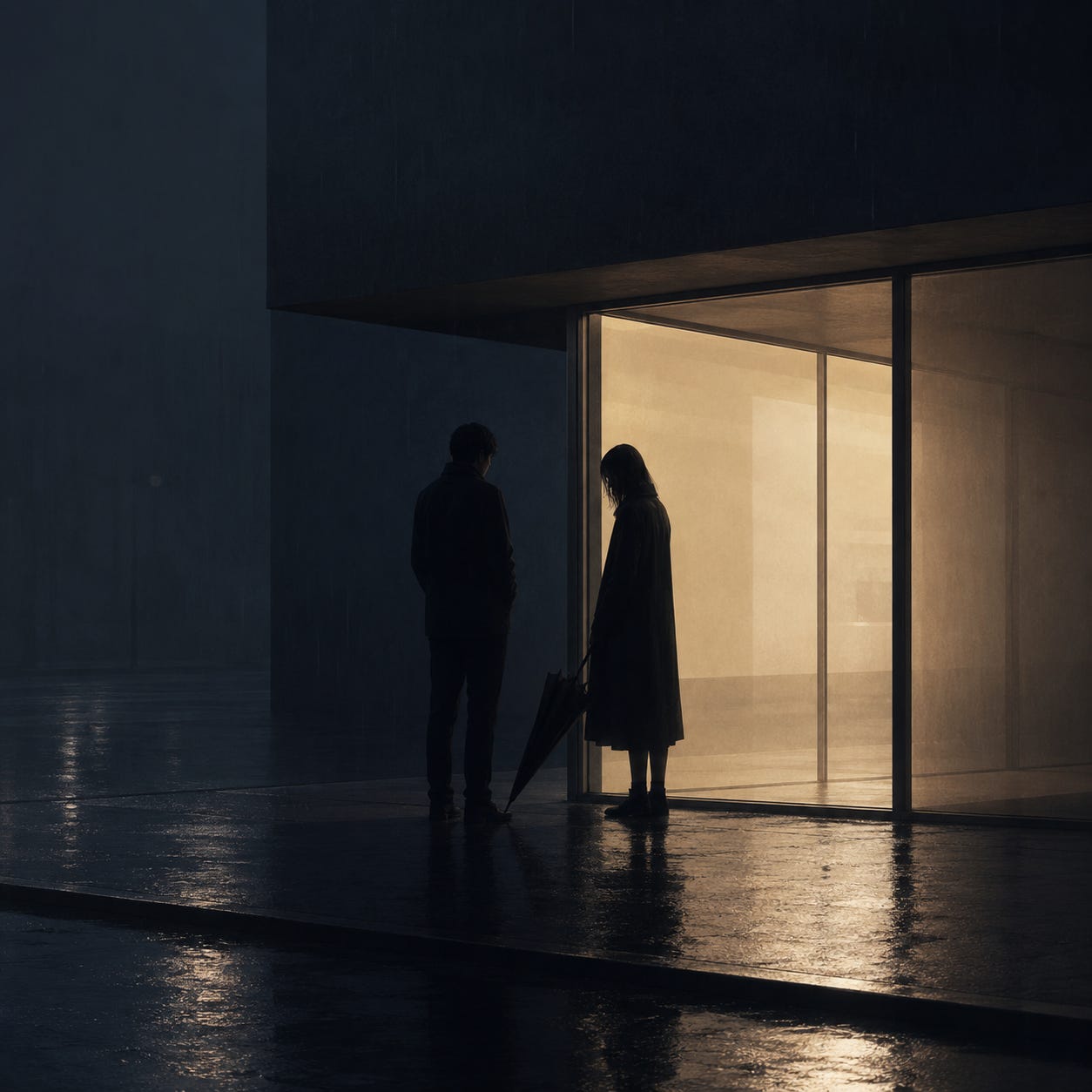
“I think I’ve completely fallen for you.”
The sentence landed softly.
I should have stepped into it, into all that tenderness waiting for me.
Instead, the first thing I felt was fear.
It was Friday evening, outside a convenience store. Rain was still dripping from the edge of his umbrella.
He stood in the neon light, his eyes bright enough to make the dusk feel exposed, waiting as if my answer mattered.
My eyes were already burning.
But I could not find even the smallest spark of joy.
Only one sharp truth kept knocking against my chest, over and over, and I could not say it out loud.
The register beeped behind us, cutting through the silence, as if urging me to hand over an answer.
He tapped my shoulder lightly with the umbrella, his voice soft enough to make me lose my footing:
“Should we wait until the rain stops, or run now?”
I nodded, then shook my head.
My smile became something soundless and hollow.
Four months of closeness moved around us in the wet air, but there was still nowhere inside it for me to land without editing myself first.
The rain thinned.
He reached for my hand.
I lifted the umbrella handle between us, almost too quickly, and held it there like a small, ridiculous border.
“Let’s wait until the rain stops.”
What I did not say was burning inside me:
wait until you see the thirty percent of me I have kept hidden.
Then decide if you still want to love me.
The raindrops fell farther apart, like a string of unanswered questions.
I pressed the thin paper over my chest a little harder.
When the rain stopped, I knew it would loosen at the edge.
And the first pale crack would enter the air
before I could stop it.
I Only Gave Him the Edited Version
“Parties have always felt like high-volume noise to me.”
On the other side of the video call, I finally set down the first test.
Blue light softened the outline of his worried face.
His voice came through almost like a whisper:
“You don’t have to swallow everything alone anymore. I’m here now.”
I smiled.
But inside, I was measuring him with terrible precision.
A three-second pause.
One small blink.
I counted every tender hesitation, then folded the sharper island of myself back into my sleeve.
He had passed the first test beautifully.
But what he saw was only the safest few lines of me, after I had already removed the edges.
On a Sunday after the rain, we leaned against each other beside a dark television screen.
I turned over the least creased page of an old wound and said, lightly:
“My last relationship almost broke me completely.”
The sentence moved across my sleeve like a thin blade, showing only a gentle scar.
He held my hand tighter.
One tear fell into my palm, warm enough to feel real.
I froze.
Quietly, I marked it down:
the tear stopped after five seconds.
His breath trembled once.
He had passed the second test almost perfectly too.
But the warmth stayed on the surface of my skin.
It never reached the deepest crack in my bones.
Rain tapped against the window.
I looked at his face in secret while light and shadow wove questions across the floor.
I lowered my head and pressed the rim of the cup against my lips.
A cold and burning thought passed through me:
Some pages are too sharp to touch —
even for me, even now.
I Was the One Who Made Love a Test
I wasn’t afraid he would say he didn’t love me.
I was afraid I would lose control and ask again:
“Are you sure?”
This loop has always been the most stubborn illness in me —
a small mechanism, winding itself in the dark.
That night, he asked:
“Why are you so quiet all of a sudden?”
The answer had already boiled in my throat:
I am terrified of losing you.
But what came out was light, almost harmless:
“I’m just tired.”
In my notes app, the same obsession kept multiplying:
“If he replies one minute late, does that mean he loves me less?”
I deleted it in daylight.
At night, it grew back in full — like a dark vine, wrapping itself around my heart without making a sound.
This part of me was sticky, repetitive, impossible to quiet.
Love would arrive in my palm,
and before I could receive it,
I would break it open to check if it was real.
Like holding a rose and counting every thorn first,
before allowing myself to believe in its scent.
What I gave him was always the filtered version —
my fear of parties, the pale outline of an old wound.
Things that sounded honest enough,
but safe enough not to cut anyone.
The darker current underneath, I sealed with silence, then covered it with something soft,
so soft that even I learned to walk around it.
It was not that I didn’t want to come closer.
I was afraid that once I handed him the whole of me, he would do what had been done before:
turn around,
and leave.
I Locked the Door and Waited for Him to Knock
“Don’t leave me—”
The words had already reached my throat.
Then my jaw locked shut.
Starlight spilled across the balcony.
He was only half an arm away from me.
I wrapped what was about to break open in my chest into something light and irrelevant:
“The sky is beautiful tonight.”
He did not notice.
He kept pointing at the constellations, bright with interest.
I pressed my fingers into the grooves of the wooden railing, letting the dull ache hold down the cry that was losing its shape.
I was afraid he would see the darker lines beneath:
clingy,
sensitive,
unsteady.
So the obsession built itself into a small, lonely city —
the door locked from the inside,
and I stood behind it, waiting for someone to knock.
What I had been waiting for was never just love.
I was waiting for someone to see me behind that door
and still be willing to keep knocking.
Not someone who loved one part of me.
Someone who could see the whole of me
and not run.
That night at the bar, the lights swayed over everything.
He was laughing freely with his friends.
A sourness rose inside me so suddenly that I almost crossed the room, almost pressed the words into his shoulder:
I just want you to stay with me.
My hand lifted to my chest.
Then slowly fell.
He looked so alive inside his own ease.
I didn’t dare disturb him.
A crack opened,
then repaired itself before anyone could see.
Late that night, I added another line to my notes:
Wait for him to open the door.
My finger hovered.
In the end, I deleted “open the door”
and changed it to:
pass by, maybe.
The cursor blinked —
like a heartbeat knocking,
then pulling itself back.
The room was quiet.
Only the lock kept biting itself in the dark, making a small, muffled sound.
It reminded me:
the key had been burning in my palm all along.
But I had never found the courage
to put it into the lock.
I Asked One Less Time If He Was Sure
“Stop asking. You don’t have to be so careful. I’m not going anywhere.”
The restaurant list was still glowing on my phone.
With one sentence from him, all that brightness softened.
My fingertip hovered over “Highest rated,” and my breath lost its rhythm without warning.
I had already rehearsed this so many times in my head:
filter out the noise,
remove anything that might make him frown,
then bring him the remaining choices
and ask again,
and again,
afraid that one wrong step might push him toward leaving.
But he only smiled.
He ruffled my hair, set the phone face-down on the table, his voice easy as clouds passing —
and said something that burned anyway.
He picked the phone back up, scrolled to the Thai place I had never let myself choose.
He did not turn to ask me.
He simply selected it —
a gesture so casual it seemed to have no idea what it had just unlocked.
When the screen flashed “Reservation confirmed,” I held my breath, still tangled,
and for the first time,
I did not ask:
“Are you sure?”
Weekend light scattered gold across the glass, laying a shallow, warm shadow over the wooden table.
A quiet thought trembled somewhere inside me:
maybe he really did see the crack.
And this time,
he did not step back.
🌙 What does it mean to be afraid of being seen by someone who says they love you?
It usually isn’t that you doubt every tenderness. It is that you know they have only met the edited version — the safer pages, the wounds with their edges removed — because the last time someone saw the whole of you, they left.
So you keep wondering whether love would survive the part of you that still asks, again and again:
Are you sure?
Have you ever wanted someone to see the whole of you, and feared that the moment they did, they would stop knocking?
If there is a version of you that only appears after trust, you may leave it here quietly.
I read every comment.